An automotive accelerator must run perception, planning, language, and cockpit models under a fixed vehicle power and cost envelope. A narrow DSA can be efficient today and obsolete after the next model change. Li Auto’s M100 aims for a middle point: tensor-granular dataflow whose schedule is explicit in software rather than discovered through a large GPU cache hierarchy[1].
Orchestrate movement, not cache misses
M100’s compiler and runtime schedule tensors through compute clusters, data-movement engines, on-chip memories, and external DDR. The architecture largely removes hardware-managed caching. Tensor size remains flexible, while coarser scheduling reduces instruction and synchronization overhead. The design relies on predictable model dataflow; irregular control still needs software handling.
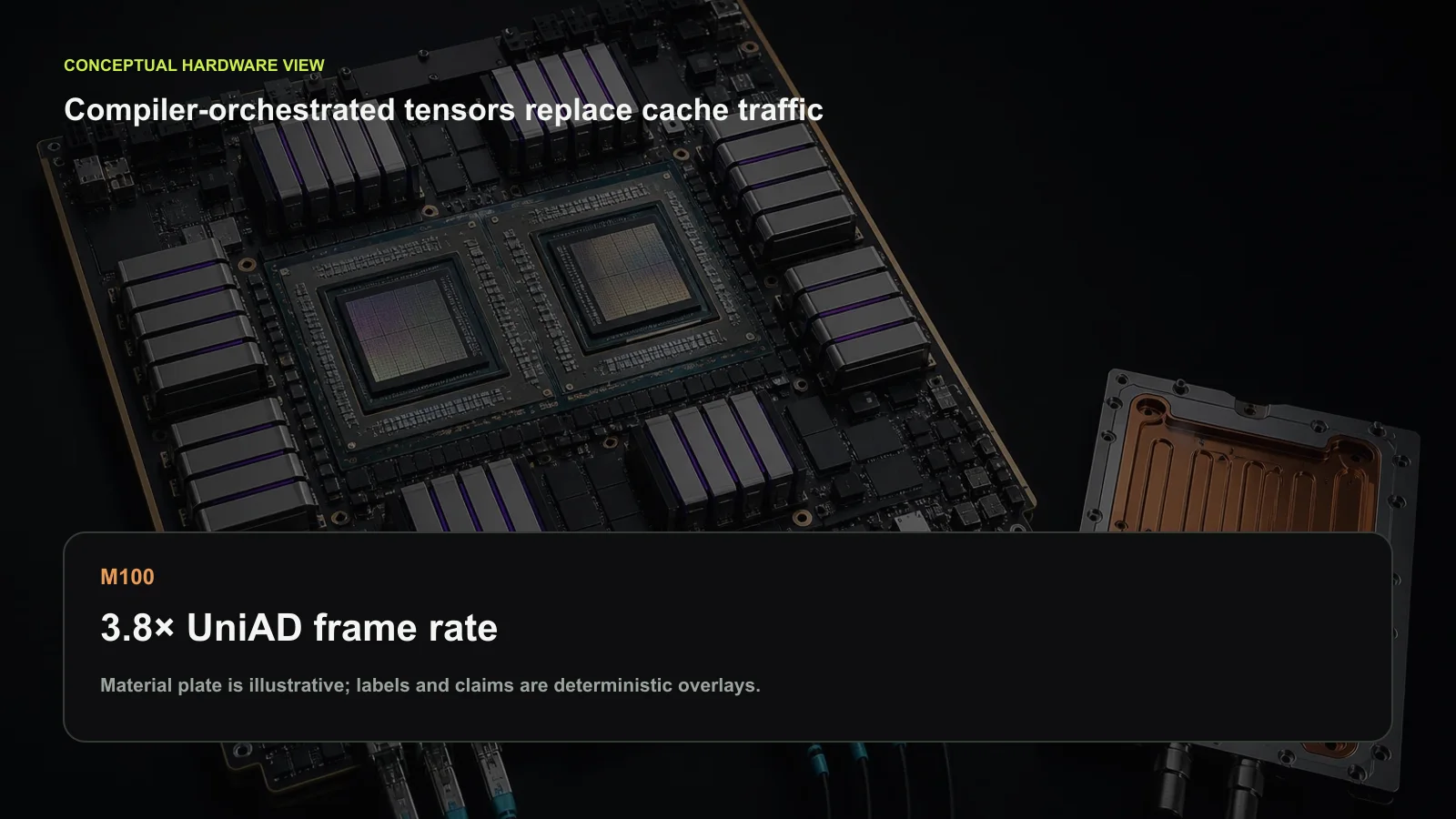
Against NVIDIA Thor-U at the same power budget and identical 273 GB/s DDR bandwidth, M100 reports 1.2× to 6.3× speedups across UniAD components and 3.8× higher end-to-end frame rate. The tested chip activates eight of fourteen clusters for UniAD, leaving resources for concurrent work. Llama-2 7B decode is similar, 20 ms versus 21.34 ms, because external memory bandwidth dominates. Prefill numbers in the extracted table indicate Thor-U is faster, so the paper’s strongest evidence is workload-specific, not universal.
Automotive compute is a lifecycle problem
A vehicle platform must support perception, sensor fusion, planning, language, and cockpit features for years after the silicon is selected. Model families and tensor shapes change faster than an automotive qualification cycle. A narrowly fixed datapath may deliver excellent efficiency for the launch workload yet require a second processor or a new vehicle controller when the software portfolio changes.[1]
A general GPU avoids that lock-in but carries hardware and software designed for broader graphics and datacenter use. Large register files, fine-grained scheduling, cache coherence, and speculative cache behavior consume power and area even when an inference graph has predictable tensor movement. M100’s design question is whether software can retain model flexibility while hardware removes mechanisms that structured inference does not need.
The answer has to include software maintenance. Moving scheduling into a compiler lowers hardware overhead only if new operators can be mapped without redesigning the chip. The useful comparison is therefore coverage over the vehicle’s model roadmap, not peak throughput for the network available at tape-out.
Tensor-granular orchestration replaces cache discovery
M100 moves tensors among compute clusters, on-chip storage, data-movement engines, and DDR according to a generated schedule. Hardware-managed caches are largely absent from the main data path. The compiler knows which producer creates a tensor, which consumers need it, and when its storage can be reused, so it can prearrange transfers instead of waiting for a miss to reveal demand.
This approach reduces tag lookup, replacement, coherence, and fine-grained instruction overhead. It also exposes errors that a cache would mask. If the schedule requests data too late, a compute engine stalls; if it keeps a tensor too long, on-chip capacity is lost; if it evicts too early, DDR traffic rises. Compiler quality becomes a directly measurable architectural resource.
Tensor granularity is the compromise. A completely static spatial accelerator can be efficient but inflexible, while instruction-by-instruction control recreates a GPU scheduler in software. Coarser objects let the runtime coordinate useful blocks of work and movement while the engines handle regular inner loops.
Clusters provide capacity and concurrency
The evaluated M100 configuration contains fourteen clusters, and the UniAD mapping uses eight. Unused clusters are not automatically wasted. They can reserve capacity for other vehicle functions, absorb a larger future model, or operate within a lower power state. End-to-end automotive performance must account for concurrent camera, planning, safety, and user workloads rather than assigning the entire chip to one benchmark.
Partitioning also creates locality decisions. Tensors should remain near the cluster that consumes them when possible, but replicated inputs and cross-cluster reductions can increase on-chip traffic. The compiler needs a cost model for local storage, fabric bandwidth, DDR, synchronization, and power. A balanced mapping may use fewer clusters if spreading work would make movement dominate.
Fault containment and real-time scheduling add another requirement. Automotive software needs bounded latency and isolation between functions of different criticality. The paper demonstrates performance, but a production platform must also show how cluster reservations, memory protection, quality-of-service, and recovery interact with the orchestrated schedule.
UniAD favors explicit dataflow
UniAD joins several perception and planning components whose tensors flow through a structured graph. Such work can reuse intermediates and overlap stages when the compiler sees the dependencies. M100 reports component speedups from 1.2× to 6.3× at matched power and external bandwidth, with 3.8× higher end-to-end frame rate in the evaluated configuration.
The range matters. Different components have different arithmetic intensity, operator mix, and movement. A 6.3× result likely represents a path where the comparison system’s general scheduling or memory hierarchy leaves more overhead to remove. The 1.2× component shows that explicit orchestration is not equally advantageous everywhere. End-to-end 3.8× also cannot be reconstructed by averaging component speedups because pipeline overlap and critical-path placement determine frame rate.
Using eight clusters means the reported end-to-end point is not a peak all-chip number. That strengthens the concurrency argument but complicates comparison: the remaining clusters have value only if a realistic concurrent workload can use them within the same power and memory budget. A follow-up system test should run the full vehicle workload set and report deadline misses, not only isolated UniAD throughput.
LLM decode exposes the DDR ceiling
Autoregressive decode reads model weights repeatedly while generating relatively little arithmetic per token. When the working set lives in external DDR, both M100 and Thor-U approach the same 273 GB/s limit. The reported 20 ms versus 21.34 ms Llama-2 7B decode result is therefore close, despite very different compute organization.
This near-tie is valuable negative evidence. Removing cache and scheduling overhead cannot create external bandwidth. Compression, lower precision, weight reuse across a larger batch, or a faster memory system can move the limit; adding more compute clusters cannot. It also shows why TOPS is a weak predictor of decode latency.
Prefill has a different balance because many input tokens create larger matrix operations with more reuse. The paper’s extracted comparison indicates Thor-U is faster in that phase. A product that needs interactive language must report time to first token and per-token decode separately, together with sequence length, batch, precision, and memory residency. One phase cannot stand in for the other.
The compiler becomes part of product compatibility
An orchestrated accelerator depends on graph lowering, operator fusion, tiling, placement, transfer scheduling, and runtime coordination. Unsupported operators need an efficient fallback that does not force repeated device or CPU crossings. Dynamic shapes and control flow require guarded variants or runtime decisions without discarding the static schedule’s benefit.
Versioning is critical in a vehicle. A compiler update that changes memory reuse or timing must be qualified against the same safety and latency requirements as other platform software. Generated schedules should carry hardware, compiler, model, and calibration identifiers so an over-the-air update can be reproduced and rolled back.
The durable asset is not one schedule but a cost model validated against silicon. It must predict when an operator is compute-bound, on-chip-fabric-bound, or DDR-bound and improve as new traces arrive. If predictions drift, the toolchain should expose the mismatch rather than silently emitting a legal but slow mapping.
Matched power and bandwidth narrow the claim correctly
The comparison holds external DDR bandwidth at 273 GB/s and uses the same power budget. This removes two easy explanations for a speedup and directs attention toward dataflow and utilization. However, equal budgets do not make every subsystem identical. Software maturity, precision, operator implementation, clocks, memory allocation, and the included power boundary can still differ.
Reported component speedups should therefore be accompanied by absolute latency, utilization, energy, and quality. A ratio can become large when the baseline lacks a tuned path. The LLM prefill reversal is a reminder to publish losing cases as well as wins. It helps readers identify which workload properties select the architecture.
Power also needs a sustained thermal context. Vehicle enclosures, ambient temperature, concurrent controllers, and cooling policy can reduce clocks below a laboratory point. The system claim becomes stronger when the same schedule meets deadlines under the thermal and concurrency conditions of the deployed domain controller.
What buyers should test next
The first test is model breadth: convolution, attention, sparse operators, dynamic shapes, custom post-processing, and mixed precision under one released compiler. The second is concurrency: the full set of perception, planning, language, and cockpit workloads with isolation and deadlines. The third is lifecycle change: compile a model generation not used to design the silicon and measure how much performance requires new hand-written kernels.
Memory tests should separate on-chip reuse from DDR traffic and include contention from other workloads. For language models, publish prefill and decode curves across batch and context. For automotive graphs, report frame latency distributions and the number of active clusters, not only average frames per second.
Lastly, evaluate failure and update behavior. A schedule should recover from a cluster or transfer-engine error, and an over-the-air compiler or model update should be reversible. These conditions determine whether explicit orchestration reduces hardware complexity without creating an unmanageable software dependency.
The boundary of the evidence
M100 is compared with one NVIDIA automotive configuration under selected power, bandwidth, models, and software. It does not establish superiority over every GPU, dataflow accelerator, or future Thor release. UniAD and Llama-2 7B are useful anchors, but the vehicle model portfolio is broader and continues to change.
The paper nevertheless answers an important architecture question. For structured graphs, a compiler can use tensor lifetimes and dependencies to replace much of the cache-discovery machinery and recover substantial throughput. For bandwidth-bound decode, the same architecture converges on the external-memory limit. A credible product strategy must embrace both results.
A cacheless design needs explicit observability
A cache-based processor can expose miss rates and bandwidth counters that help explain a slowdown. M100 needs equivalent visibility for scheduled movement. Operators should see when a tensor was expected, when its transfer began and ended, which engine or path blocked it, how long a cluster waited, and whether DDR or on-chip storage caused the delay. Without these signals, a compiler regression can look like a hardware defect.
The trace must connect compiler decisions to runtime events. A mapping identifier should recover the tiling, cluster placement, buffer lifetime, and transfer plan that produced a measured frame. Sampling can control overhead, while deterministic capture around missed deadlines provides detail. This is especially important after an over-the-air model or compiler update, when the hardware has not changed but timing has.
Performance isolation also requires accounting by workload. If UniAD uses eight clusters while language and cockpit functions use the others, the platform should attribute DDR bytes, fabric occupancy, power, and stalls to each schedule. Otherwise, one workload can meet its isolated target yet cause another to miss a safety deadline.
The architecture should be judged across a model-generation change
The strongest future validation would hold silicon constant and introduce operators and graphs that were not present in the original design set. Measure how much is supported through ordinary compiler mapping, how much needs new library code, and how often a CPU or external accelerator fallback is required. Include engineering time and qualification time, not just final latency.
This test distinguishes programmable dataflow from a collection of fixed fast paths. If the cost model and movement engines adapt, M100 can amortize its hardware across a long vehicle lifecycle. If every new architecture feature requires hand scheduling, the removed cache complexity has become a recurring software cost. The answer will determine whether orchestrated dataflow remains flexible after its launch benchmarks age.
Model portability should be measured with quality held constant. A fast fallback that changes precision or replaces an unsupported operator with an approximation is not equivalent unless the automotive application accepts the result. Compilation success, numerical agreement, latency, memory traffic, and power should therefore be reported together.
The platform also needs a capacity rule for concurrent schedules. Static reservations offer predictable deadlines but can leave clusters idle; opportunistic sharing improves utilization but introduces interference. Priority, preemption points, and buffer ownership should be explicit so a cockpit workload cannot delay a safety path and a safety reservation does not silently consume the entire efficiency advantage. The evaluation should repeat under hot and cold starts because loading code and tensors after a vehicle wakes can create a different critical path from steady-state driving. Boot-time memory reservation and first-frame deadline are product requirements, not setup details that a throughput benchmark may discard.
What we take from it
M100 shows where dataflow wins and where it cannot escape physics. Explicit orchestration keeps engines busy on structured perception graphs, but a bandwidth-bound decoder converges toward the same DDR ceiling. The architecture will succeed if its compiler adapts faster than automotive models change and if the saved cache complexity becomes deployable cost and power rather than new software fragility.
The compiler becomes part of the silicon contract
M100 moves decisions that a cache would make dynamically into compiler-generated data movement. This trade is attractive only when the compiler can prove dependencies, size local storage, and schedule transfers for the operator shapes that production models actually use. Unsupported control flow, irregular access, or a new model transformation can force a slower path. The usable accelerator is therefore the intersection of silicon capability and compiler coverage, not the peak capability of either one alone.
Deployment should preserve that intersection as a versioned artifact. Each model release needs the compiler version, generated schedule, memory plan, fallback operators, and measured headroom under contention. Regression testing should include shape changes and mixed workloads rather than only the kernel that motivated the architecture. Buyers should ask what fraction of end-to-end inference remains on the orchestrated path and how quickly a new operator receives an optimized mapping. That answer determines whether dataflow specialization saves fleet cost after the model changes.
Source and attribution
This article is independently written and uses an original conceptual plate. No source figure, table, or text is reproduced. The authors provide a public arXiv manuscript; the proceedings version is © IEEE 2026.