Memory-safe languages cannot immediately replace the installed base of C and C++. Arm’s Memory Tagging Extension (MTE) attaches a small tag to each allocation and pointer, then checks their match on memory access. The obstacle has been deployment cost. AmpereOne moves that cost into hardware already present for server reliability[1].
The useful question for an operator is therefore not whether tags can catch memory bugs in principle. It is whether synchronous checking can remain enabled without reducing sellable DRAM or penalizing untagged tenants. This review follows that cost through tag storage, memory traffic, and allocator behavior, then separates architectural overhead from software work that can still be engineered away.
Tags without a reserved-memory tax
Conventional tag storage reserves part of DRAM capacity or adds a separate memory structure. AmpereOne co-locates tags with data by repurposing part of the protection-code budget, while preserving the required error-detection contract through microarchitectural changes. Load and store pipelines perform synchronous checks so a sequential buffer overflow is detected deterministically; randomly assigned tags give probabilistic protection against use-after-free errors.
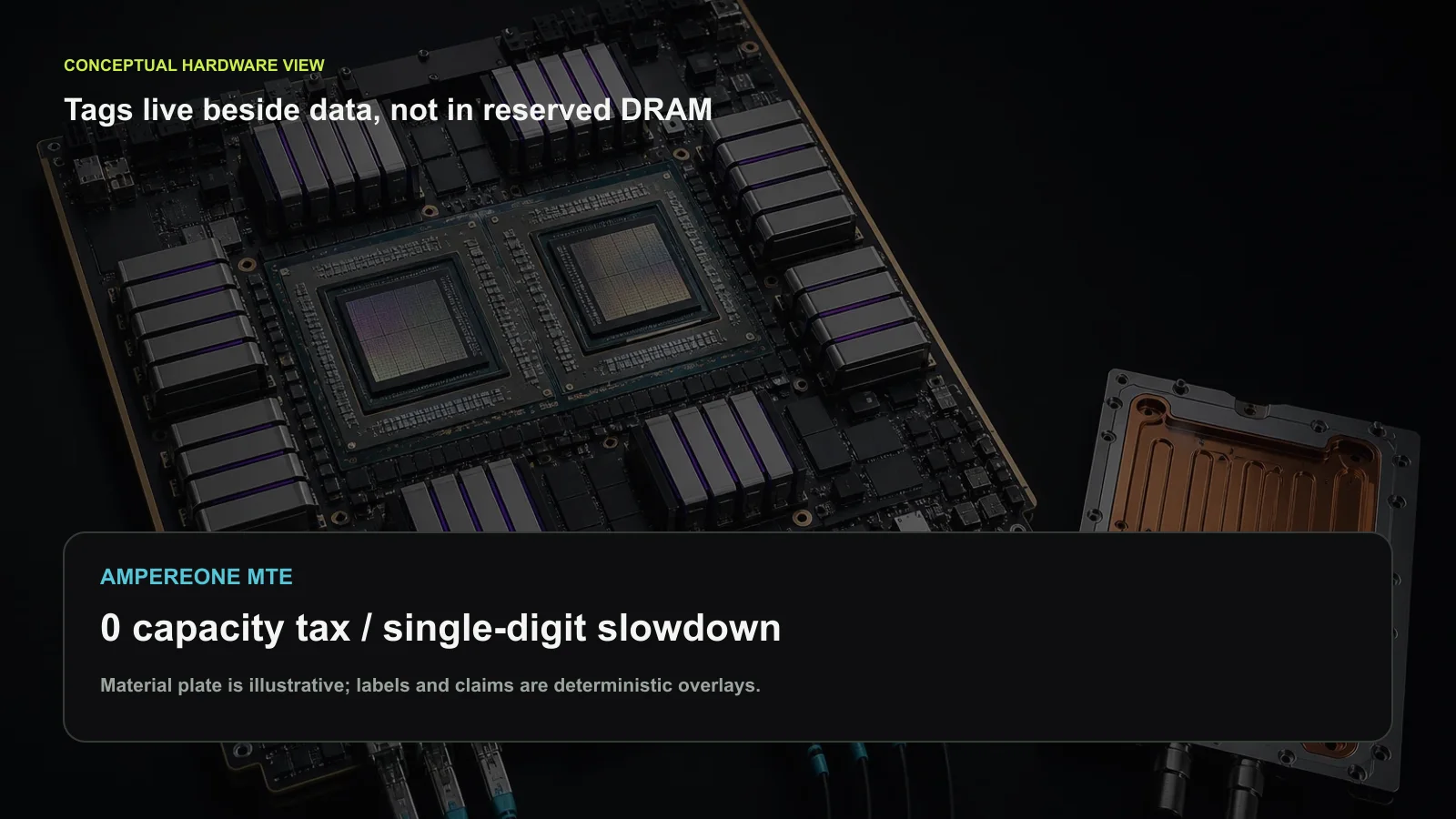
Across tested datacenter workloads, the performance impact is in the mid single-digit range and memory capacity loss for tag storage is zero. The remaining overhead often comes from software allocation. The evaluation had to replace jemalloc, which lacked tagging support, with glibc malloc; small-object initialization and tagging then dominated several cases. That diagnosis is useful because it identifies a software optimization path rather than a fixed hardware penalty.
What the four-bit check can and cannot prove
MTE divides physical memory into 16-byte granules. Software assigns each granule a four-bit allocation tag and places the corresponding address tag in otherwise unused high bits of a pointer. Top-byte-ignore keeps those bits out of address translation, while the processor compares the two tags before completing a load or store. In synchronous mode, a mismatch raises a precise exception and prevents the access. Asynchronous mode can allow the memory operation to finish and record the mismatch for later handling, which lowers the immediate control cost but is less suitable when an exploit must be stopped at the faulting instruction.[1]
The protection differs by bug class. If adjacent allocations use different tags, a sequential overflow crosses into a granule whose allocation tag cannot match the source pointer, so synchronous checking blocks the access deterministically. A stale pointer is different. Four bits provide only sixteen values, so an allocator eventually reuses a tag and an attacker may guess the current value. Tag randomization therefore reduces the probability of a successful use-after-free or nonadjacent out-of-bounds access rather than proving that none can occur. The paper cites prior analysis to motivate the security value, but AmpereOne does not turn probabilistic temporal protection into a complete substitute for type safety.
This distinction determines how an operator should describe the feature. MTE is an additional enforcement layer for native software, not a claim that every memory error disappears. It complements hardening, compartmentalization, safe-language migration, and conventional page protection. The useful architectural question is narrower: can a fleet keep synchronous checking enabled on enough sensitive code that a large class of corrupting accesses is stopped before it becomes an exploit?
Why a server cannot borrow the mobile trade-off
A phone vendor controls one software image and can decide which processes use tagging. A cloud server may host many tenants whose kernels, allocators, and applications make independent choices. AmpereOne configurations also reach far higher core counts and memory capacities than a handset. Once any tenant can create tagged physical pages, the memory system must preserve tag state conservatively across aliases, page-table changes, DMA paths, and reuse. A page-table bit alone cannot tell the processor that a physical location will never carry a valid tag under another mapping.
Capacity makes this conservative rule expensive. Four tag bits for every 16 bytes amount to roughly 3% additional storage when the tags occupy a sequestered memory region. On a server with terabytes of DRAM, that percentage is not an abstract overhead. It removes memory from virtual-machine profiles, changes the cores-to-memory ratio purchased for the rack, and can reduce sellable instance density. It also applies to the full physical addressable pool because software may eventually tag any page, even when only a subset of current tenants has enabled MTE.
The reliability requirement pulls in the opposite direction. Datacenter DIMMs already carry parity bits so the memory controller can provide single-error correction, double-error detection, and stronger symbol-oriented protection in supported configurations. Using those bits for tags is attractive only if the resulting code still meets the platform’s error-detection and correction contract. Thus, “free tag storage” does not mean that bits appeared without cost. It means Ampere changed the encoding and controller behavior so software-visible capacity stayed constant while the supported reliability level remained available.
Co-location removes a second memory transaction
Sequestered tags create a traffic problem in addition to the 3% capacity loss. A cache miss may need one read for data and another for its allocation tag before a synchronous check can retire. Tag writes can also introduce extra transactions. Those requests contend with application traffic on the memory controller and mesh, so an untagged tenant can experience interference produced by a tagged neighbor. The penalty becomes especially awkward in a cloud because the provider may promise a performance range without controlling every co-located guest’s security settings.
AmpereOne instead carries the tag with the data in metadata derived from the ECC codeword. A read returns both at once, allowing the load pipeline to compare tags without fetching a remote side table. The implementation supports multiple ECC organizations for different DIMM arrangements rather than assuming that every populated system exposes the same spare-bit budget. That flexibility matters operationally: a feature that works only for one memory configuration would split the server fleet and complicate capacity planning.
Co-location still has a write-side edge case. An untagged partial or write-only transaction must preserve any tag already associated with the line. If the incoming write does not contain the old metadata, the memory system may need a read-modify-write sequence. Ampere’s design therefore has to decide where that preservation occurs and how to prevent the extra work from entering the core cache path. The important comparison is not simply “side table versus ECC bits”; it is the number and location of data movements created by reads, tagged writes, and ordinary writes under mixed tenants.
Synchronous checking is a pipeline contract
Detecting a mismatch after an access has architecturally completed is useful for debugging, but it does not give the same containment guarantee as a precise fault. Synchronous MTE requires the tag comparison to finish before the memory instruction commits. A straightforward serial implementation would add a new stage to every checked load and store. A deeply out-of-order server core must instead carry the tag through translation, cache, miss handling, replay, and retirement while maintaining the ordering rules expected by the operating system.
That work is why the paper evaluates more than the storage format. The processor must preserve tags across caches and memory, propagate faults precisely, and avoid slowing software that never asks for tag checking. In a multitenant machine, globally enabling the hardware capability cannot be allowed to impose a large baseline penalty on every virtual CPU. The resulting goal is not zero latency for an isolated tagged instruction. It is single-digit workload impact while tagged and untagged execution coexist on the same SoC.
The design also reinforces a broader security rule: prevention modes should be assessed at the point where side effects become visible. A benchmark that measures only allocator throughput misses pipeline stalls, memory traffic, and exception behavior. Conversely, a core-only microbenchmark cannot show whether page management and reuse preserve tags correctly. MTE is useful because the ISA, core, memory controller, firmware, kernel, and allocator agree on one tag lifecycle.
The allocator became the measured bottleneck
Ampere tested real datacenter software rather than reporting only synthetic tag-check latency. That choice exposed a confounding software substitution. The deployed workloads commonly used jemalloc, but the evaluated version did not provide the required MTE integration. Replacing it with glibc malloc changed allocation behavior independently of the hardware feature. Small objects then paid for initialization and tag-setting work at a frequency that some applications had never been tuned to tolerate.
This means the reported mid-single-digit range should not be read as one fixed silicon surcharge. Part comes from checking accesses, part from maintaining metadata, and part from a different allocator and its tagging policy. Workloads with long-lived large objects amortize allocation work differently from services that continually create and free short-lived structures. Memory bandwidth, cache pressure, object-size distribution, and the fraction of code compiled and configured for MTE all influence the final number.
The diagnosis is encouraging but not automatic. An optimized allocator must batch tag updates, retain suitable size classes, randomize values well enough for the security objective, and avoid leaving stale tags during reuse. It must also cooperate with sanitizers and debugging modes without turning production into a laboratory build. The next useful comparison is therefore not MTE on versus off with two unrelated allocators. It is the same production allocator, tuned for both modes, with overhead separated into allocation, initialization, tag maintenance, and access checking.
What a fleet deployment still has to decide
AmpereOne supplies the hardware floor, but operators must choose the enforcement domain. Enabling synchronous checking first for hypervisor services, parsers, network-facing native components, and other high-risk processes can capture more security value per unit of overhead than tagging every allocation immediately. Rollout also needs crash attribution, tag-fault telemetry, and a policy for restarting or isolating affected services. A precise fault that cannot be diagnosed at fleet scale may be disabled after the first operational incident.
Compatibility is another boundary. Device DMA, pinned buffers, shared memory, virtualization, and confidential-computing paths must preserve the same metadata assumptions as CPU loads and stores. Native extensions that manipulate pointer bits or use custom allocators require review. The paper establishes feasibility on the processor and workloads it evaluates; it does not certify every operating system, peripheral, hypervisor, or application combination.
The procurement implication is specific. A buyer should ask whether the quoted memory capacity remains available with MTE enabled, which ECC modes remain supported for each DIMM population, whether synchronous mode is the measured default, and how much of the benchmark delta comes from the allocator. Those questions distinguish an ISA feature from a deployable server security capability.
How to read the reported performance result
The most defensible use of the evaluation is as a decomposition, not a universal percentage. First, co-located metadata removes the separate tag-read traffic that would otherwise affect every cache miss to tagged memory. Second, the core performs a synchronous comparison without turning it into a long serial dependency. Third, the software path initializes and changes tags as objects are allocated and released. Only the first two are fixed by the processor. The third changes with object lifetime, allocator implementation, page policy, and the fraction of a process placed under protection.
For that reason, a fleet trial should preserve the application’s request mix and tail-latency target. Average throughput can hide an allocator lock or page-initialization burst that appears only at the 99th percentile. A memory-capacity result also needs to distinguish software-visible DRAM from internal parity storage and from any metadata kept in caches or controller state. “Zero capacity loss” is a strong and useful claim precisely because it refers to the capacity offered to software; it is not a statement that tags consume no wires, gates, or energy inside the system.
The comparison should also include untagged neighbors. A tagged service can meet its own throughput goal while adding memory-controller pressure that harms another tenant. Co-location is intended to remove the dominant extra read, but write preservation, cache behavior, and fault logging may still create shared effects. Measuring both the protected process and the surrounding host is the only way to confirm the multitenancy objective that motivated the design.
The architectural lesson extends beyond MTE
AmpereOne illustrates a recurring server-design opportunity: reliability metadata can sometimes carry a second protection function if the code is redesigned rather than merely shortened. Similar reasoning appears in confidential-computing integrity trees, poison tracking, and memory-encryption metadata. The opportunity is attractive because the server has already paid for wider DIMMs, controller datapaths, and checking logic. The risk is coupling. A change made for security must not silently weaken error coverage, reduce supported memory configurations, or complicate service repair.
The correct evaluation order is therefore capacity, reliability, traffic, latency, and software integration. Starting with the ISA feature or a core microbenchmark would miss the economic constraint that prevented deployment. Starting with a 3% DRAM reservation makes the design choice understandable: move the tag into an existing physical channel, rebuild the protection code around it, and then optimize the core and allocator until synchronous checking is operationally tolerable.
What we take from it
AmpereOne turns memory safety from an ISA checkbox into a full-stack deployment question. Efficient tag storage and synchronous checks establish a viable hardware floor, but allocators, kernels, and fleet policy determine the realized cost. The paper’s strongest conclusion is that the bottleneck moved: once hardware removes the capacity tax, ordinary memory-management software becomes the next architectural target.
Source and attribution
This digest uses original wording and a newly composed conceptual plate. It reproduces no paper text, figure, or table. The public arXiv version is CC licensed; the ISCA proceedings version is © IEEE 2026.