The usual way to add flexibility to an AI rack is to put a larger switch in the middle. Cornell University and Lightmatter ask whether the rack can instead change the connections underneath each accelerator[1]. Their OFC 2025 paper presents LUMORPH, an architecture built around LIGHTPATH, a silicon-photonic substrate that combines accelerator attachment points, wavelength-multiplexed transceivers, waveguides, and Mach-Zehnder interferometer (MZI) switches. Software can form a direct optical circuit between selected tiles, then replace that circuit for the next communication round.
The proposition matters because direct-connect fabrics solve one problem while creating another. A ring, torus, or cube can give collective communication predictable bandwidth without packet queues. However, its shape can restrict which free accelerators form a valid tenant allocation. A rack may have enough idle chips in aggregate and still be unable to embed the requested topology. LUMORPH brings circuit switching close enough to each tile that the topology can follow the allocation instead of forcing the scheduler to find an allocation that matches a fixed graph.
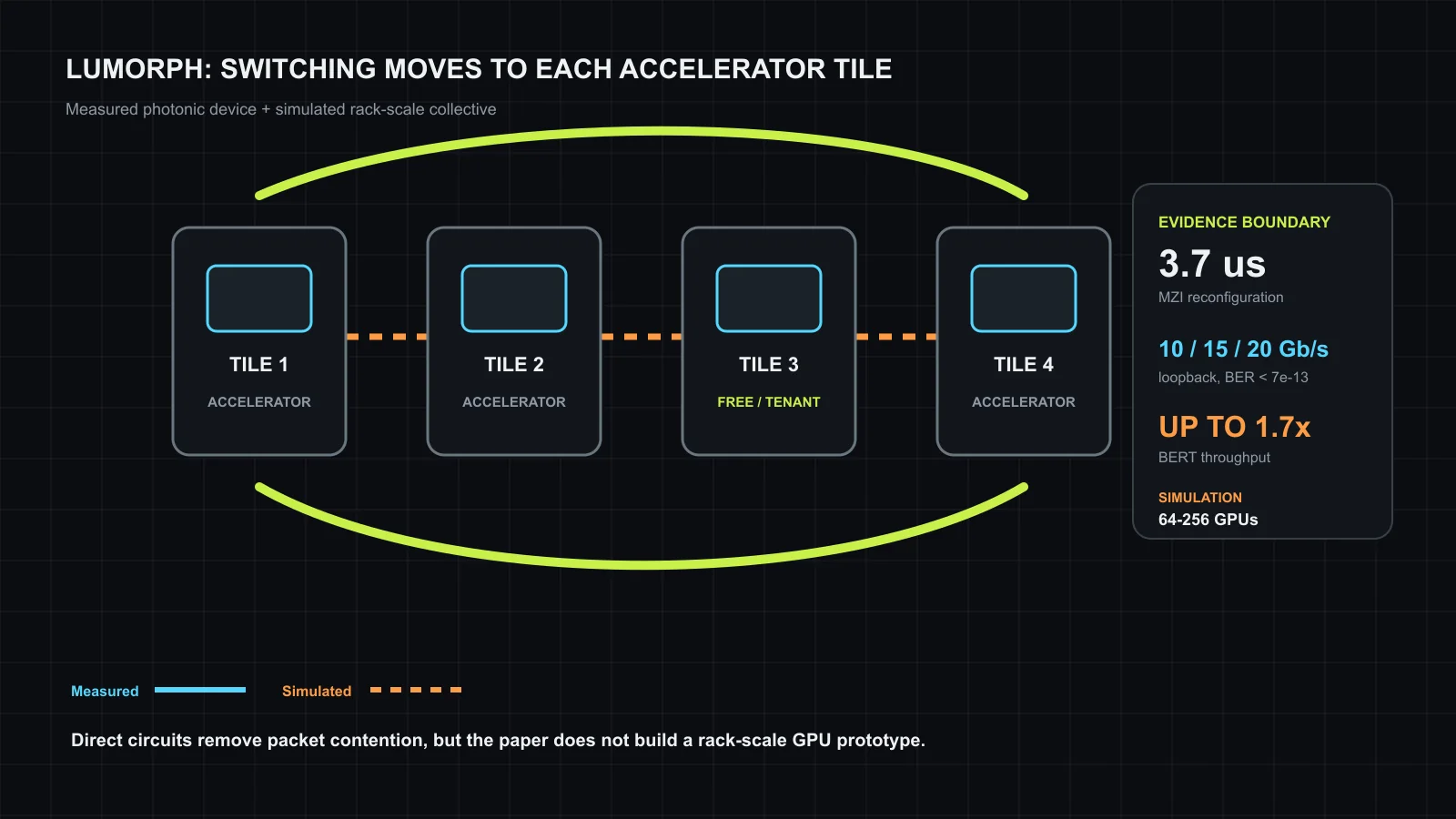
This is an architecture paper with a small photonic test vehicle and a larger simulation. Those evidence layers must remain separate. The authors measure a four-tile optical path, bit errors, and MZI reconfiguration time. They do not assemble the proposed rack with 64 to 256 GPUs. The collective and BERT results at those scales come from analytical modeling and simulation.
Fragmentation is a topology problem, not only a capacity problem
Multi-tenant accelerators are usually discussed as a bin-packing problem: find enough free GPUs with the right model, memory capacity, and locality. Direct-connect optics adds a graph constraint. If an existing fabric exposes only predetermined rings or cubes, a request can fail even when the count of unallocated chips is sufficient. Moving tenants after every request would recover capacity, but migration interrupts work and may copy model, optimizer, and checkpoint state.
LUMORPH treats the interconnect as another allocatable resource. Inside a server-scale substrate, each compute tile has transceiver banks connected to shared optical buses. An MZI-based 1x3 element can steer a signal toward different waveguide paths. Fibers attached to tiles extend those paths between servers. A controller therefore selects the chips for one tenant and programs direct circuits among exactly those chips. Another tenant can receive a different ring on the same physical rack.
That flexibility is most useful when collective requirements differ by job. A six-GPU allocation can use a ring without wasting two chips merely to reach a power-of-two size. An eight-GPU allocation can configure the hierarchy used by recursive halving and doubling. Both can coexist because the optical graph is not frozen at manufacturing time. The paper’s central contribution is this coupling of allocation and topology, not a claim that every ML flow should become circuit switched.
LIGHTPATH puts switching below the accelerator
The proposed substrate contains as many as 32 tiles. A tile represents a future location for a GPU or CPU mounted over the photonic layer and can carry multiple transmitter and receiver banks. The transmitter uses microring resonators to modulate wavelengths; the receiver separates the wavelengths and converts them back to electrical signals. Each tile supports as many as 16 wavelength-multiplexed laser channels in the described design. Waveguides carry those channels across the substrate, while MZI elements establish circuits among tile transceivers.
The hardware artifact is narrower than that description. The team fabricated LIGHTPATH in a GlobalFoundries CMOS-photonics process and drove it with a Xilinx VCU128 FPGA. A PRBS-7 pattern left the FPGA at 28 Gb/s-capable SerDes, entered an optical modulator, crossed four tiles and four configured switching networks, reached a germanium photodetector, and returned to the FPGA for error checking. This is a loopback through photonic devices, not GPU-to-GPU traffic.
At 10, 15, and 20 Gb/s, the reported bit-error rates were 6.96×10^-13, 6.62×10^-13, and 5.60×10^-14, respectively. Open eyes were confirmed at those operating points. Reprogramming the MZI switches took 3.7 microseconds. The latter number is important because LUMORPH changes circuits during a collective: a slow switch would make the topology programmable in principle but unusable between short communication phases.
Collective algorithms must spend reconfiguration carefully
Programmability alone does not make a fast collective. Every circuit change adds a fixed cost, while splitting a GPU’s egress bandwidth across several destinations raises the transmission time per connection. The authors express this tradeoff with the familiar alpha-beta model. Alpha includes startup and, for LUMORPH, the 3.7-microsecond MZI change. Beta captures the time per byte. A schedule with more parallel partners may use fewer rounds, yet each partner receives a smaller slice of the available bandwidth.
Finding a global optimum is non-convex in the number of links per GPU, so the paper adapts known collective structures. LUMORPH-2 implements recursive doubling and halving through circuits created on demand. LUMORPH-4 generalizes the idea to quadrupling and quartering, allowing a GPU to reach several peers in one round through different wavelengths. Allocations that are not powers of two can retain a ring. In other words, the fabric chooses among established algorithms and gives each one the temporary topology it expects.
The comparison baseline is deliberately strong: an ideal electrical switch with no queuing delay, running NCCL ring and tree algorithms. That removes the congestion that normally strengthens the case for circuits. Across 64, 128, and 256 simulated GPUs, the LUMORPH schedules complete selected all-reduce cases nearly 80% sooner than ring and tree on that idealized switch. The abstract summarizes the rack-scale collective advantage as 74% faster. The improvement is largest for small buffers because the number of serial startup steps, rather than raw link bandwidth, dominates completion time.
The 1.7x number belongs to a BERT simulation
For an application-level test, the authors use FlexFlow to construct a compute graph for BERT. The simulated electrical baseline runs ring all-reduce over an ideal switch. Both sides receive 300 GB/s of NVLink bandwidth in each direction. The electrical alpha is 0.7 microseconds; LUMORPH uses 4.4 microseconds after adding the measured 3.7-microsecond reconfiguration time. Despite that penalty, the optical topology reaches up to 1.7× the reported BERT training throughput.
The reason is not that light moves data 1.7 times faster. BERT issues many all-reduces with small buffers in the modeled parallelization plan. Ring is bandwidth optimal for large transfers, but its startup contribution grows with the number of GPUs. LUMORPH changes the communication degree and removes serial rounds. Thus the result applies when collective latency is dominated by fixed per-round cost. A workload dominated by long, bandwidth-saturating transfers would narrow the advantage and could favor a simpler ring.
The simulated result also assumes that the optical substrate can expose the modeled per-GPU bandwidth at rack scale. The paper does not measure a complete transmitter, receiver, laser, thermal-control, packaging, and fiber system at 300 GB/s per accelerator. The 20 Gb/s loopback validates switching and signal passage through a small path. It does not validate the rack bandwidth used by FlexFlow.
What a deployment still has to prove
First, the optical loss and power budgets are missing from the system comparison. A substrate with many crossings, MZIs, resonators, and inter-server couplers must deliver sufficient power to every configured receiver over temperature and manufacturing variation. The paper reports bit errors for one loopback but does not provide fleet-level laser power, heater power, coupling loss distribution, or total energy per delivered bit.
Second, control latency extends beyond 3.7 microseconds. A production path includes detecting that a collective phase is ready, selecting a topology, programming every affected switch, verifying optical state, training or validating links, and exposing the communicator to software. If one tile reports a stale configuration, the collective can hang. A versioned transaction and rollback path are therefore part of the architecture even though they are not photonic components.
Third, fibers and package assembly determine serviceability. Direct fibers between servers can create a dense physical graph. Area coupling may increase connection density, as the paper notes, but manufacturing yield, connector replacement, and routing through a rack remain unmeasured. Optical topology can be software defined only after the physical fiber graph is installed correctly.
Lastly, tenant isolation needs a data-plane proof. A circuit avoids packet contention while established, but a shared wavelength, resonator, or control operation could still couple tenants through loss, thermal drift, or erroneous configuration. Cloud deployment requires admission control and telemetry that can attribute a failed or degraded optical path to the correct job without disturbing its neighbors.
The useful idea is topology elasticity
LUMORPH should not be read as a finished replacement for a packet-switched GPU rack. Its strongest measured result is a fast, low-error photonic switching path across four tiles. Its strongest system result is a simulation showing that collective algorithms can exploit temporary higher-degree connections. The paper connects those layers with explicit assumptions, but a large gap remains between them.
Even so, topology elasticity is a consequential design direction. Fixed optical fabrics save energy and queueing overhead by specializing the graph. LUMORPH argues that specialization need not be permanent: a circuit fabric can specialize for one tenant and then specialize differently for the next. This changes the scheduler’s objective. It no longer chooses only where work runs; it also chooses the temporary communication graph that makes those locations useful.
The approach complements rather than duplicates Lightmatter’s later Passage M1000 presentation, which we analyzed separately. Passage focuses on a commercial photonic interposer and package-scale bandwidth. LUMORPH is a Cornell-led rack-architecture study with one Lightmatter coauthor, a small LIGHTPATH test vehicle, and collective simulations. Treating the two as one product claim would erase the paper’s most important evidence boundary.
Source and attribution
This article is an independent editorial summary prepared by Silicon & Systems from the OFC paper and its open author manuscript. Facts and results are restated in our own words. No source sentences, tables, or figures are reproduced, and the figure and card on this page were created for this article. Rights to the OFC proceedings paper remain with its authors and Optica Publishing Group.