A stacked-memory accelerator should be sized for the computation it can sustain after thermal constraints, rather than the bandwidth its interfaces could theoretically deliver. Adding channels can reduce a memory stall while enlarging controllers, consuming power and leaving less room for arithmetic. The resulting design may move more bytes per second at its nominal operating point yet complete fewer useful tokens once the temperature limit is enforced. This tradeoff matters when evaluating a proposed inference accelerator, particularly when a headline bandwidth figure is compared with a conventional GPU.
ATLAS makes that tradeoff an explicit part of architecture exploration[1]. The MICRO 2026 work includes researchers from Xi’an UniIC Semiconductors, Houmo AI, Peking University and HKUST[2]. Its contribution is a configurable evaluation method spanning memory organization, operator implementation, communication and temperature. The public source reviewed here is the April 2026 manuscript, whose title differs from the accepted conference title. The subsequently released artifact provides a way to inspect the modeling choices, although we have not independently reproduced its experiments[3][4].
A shorter data path and a shared thermal problem
During autoregressive decoding, a model repeatedly uses weights and a growing attention state to produce additional tokens. The amount of useful arithmetic per transferred byte depends on batching, model structure and data reuse. At modest batch sizes, increasing arithmetic throughput alone can have little effect because the units wait for data. Moving computation closer to memory is therefore attractive, provided that the application can use the resulting local bandwidth.
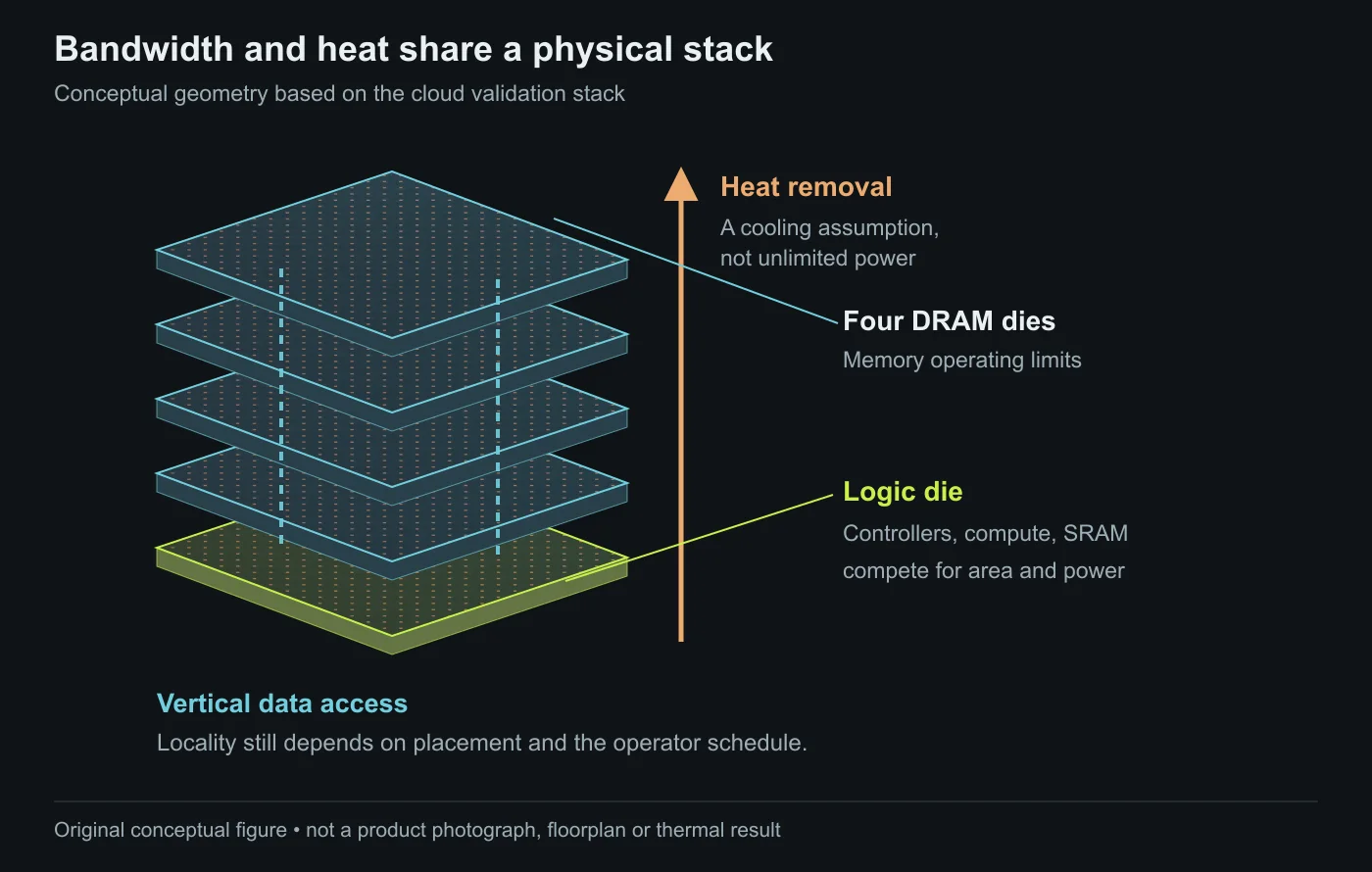
Hybrid-bonded DRAM places a memory die over a logic die and provides dense vertical connections. Multiple memory layers can extend the available capacity and data paths. However, the same physical proximity also couples the thermal behavior of memory and logic. Heat generated by computation must be removed without placing the DRAM outside its operating constraints. A memory interface is consequently part of an area and power allocation problem, not an independent resource that can be increased without affecting other components.
There are two different reasons a wider design can disappoint. First, a workload may not expose enough suitably distributed requests to use the additional channels. Second, an otherwise useful interface may consume resources that would have supported more computation or local storage. These effects require different remedies. A placement or tiling change can address the first; it cannot manufacture additional silicon area or cooling capacity for the second.
Local memory changes the meaning of placement
ATLAS models the relationship between physical banks, logical memory organization and the compute cores that access them. A core has direct access to the vertically aligned memory partitions assigned to it. Accessing another core’s data requires communication. This is a useful abstraction because it prevents the simulator from treating the entire stack as one uniform pool with an aggregate bandwidth number.
Consider a matrix operation partitioned across several cores. If each core owns the weights and inputs needed for its assigned output, much of the traffic can remain local. If the partition leaves repeatedly used data elsewhere, the operation must communicate or replicate that data. The same arithmetic count can therefore produce different latency and energy. A capacity-feasible placement is not necessarily a bandwidth-efficient placement, and a balanced arithmetic partition is not necessarily a balanced communication pattern.
Logical row organization and channel interleaving add another level of choice. They determine how an application’s contiguous accesses are distributed over the memory resources. A larger transfer can exploit parallel resources that remain idle for small accesses. Conversely, an arrangement optimized for a large matrix tile can be inefficient for narrow attention operations. The relevant quantity is delivered bandwidth for the actual access pattern, not the sum of the interfaces’ advertised rates.
This distinction is particularly important when moving a design between cloud and edge settings. A cloud workload can supply larger batches and larger tiles, while a latency-sensitive edge workload may have little parallel work to combine. Reusing the cloud memory organization without changing the operator schedule can preserve the hardware specification and lose the expected utilization. ATLAS’s separate explorations are valuable because they make this interaction visible rather than assuming one organization is generally optimal.
Software is an input to the architecture experiment
The framework expresses operator computation, memory movement and communication separately. This makes the schedule inspectable: a reported result depends on where tensors reside, which cores execute each portion and how intermediate values move. An architecture comparison can then hold the software strategy fixed or deliberately co-optimize it, instead of leaving that difference implicit.
The released implementation provides automatic model conversion and programmable operator frontends. Its documentation distinguishes hardware configuration, thermal adjustment, software description and simulation[3]. That separation is useful for reproduction. A researcher can identify whether a changed result came from the memory timing, operating frequency, model partition or operator implementation. Saving the generated task descriptions is as important as saving the final latency, because those descriptions explain what the simulated machine was asked to do.
However, programmability does not establish that a production compiler will find the same schedule. A manually selected operator partition can demonstrate an architectural opportunity while still requiring substantial compiler work. For deployment evaluation, one should distinguish a schedule expressible in the research model from a schedule produced reliably for changing shapes, sequence lengths and model versions. The gap is an engineering question that an architectural speedup alone does not answer.
The same caution applies to unsupported operators and execution overhead. A favorable matrix schedule is only one part of serving a request. Shape-dependent dispatch, data conversion, synchronization and fallback execution can change the benefit of a specialized accelerator. ATLAS supports more detailed reasoning about its modeled operator sequence; it does not remove the need to inspect the complete production path.
Apply temperature limits before comparing performance
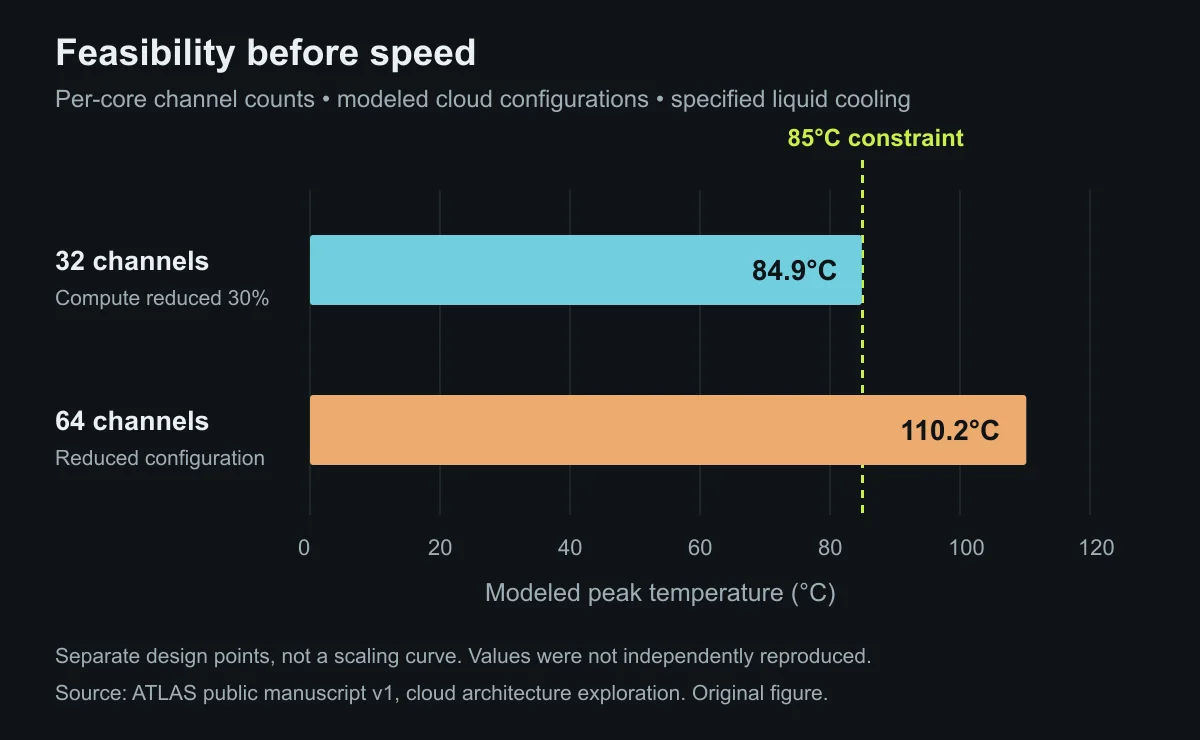
The thermal component modifies the candidate operating point before performance evaluation. The cloud exploration assumes an 85°C limit and liquid cooling with a heat-transfer coefficient of 10,000 W/(m²·K). With 32 channels per core, a 30% compute reduction brings the modeled temperature to 84.9°C. The 64-channel case remains at 110.2°C even after reducing its examined minimal-compute configuration to 0.1 GHz. These are conditional design projections, not temperature measurements of a delivered product[1].
The implication is stronger than saying that cooling matters. A design that violates the thermal constraint should not remain in the performance comparison at its unconstrained frequency. Counting its nominal bandwidth while omitting the required reduction in compute gives it resources that the physical design cannot simultaneously sustain. The ordering of the evaluation therefore matters: first identify feasible configurations, then compare their execution results.
At the same time, a result under one cooling configuration is not a universal limit of stacked DRAM. Different package dimensions, materials, power distribution or cooling arrangements can change the feasible operating point. The useful output is a conditional architectural result with explicit assumptions. It should not be recast as a blanket statement that a particular channel count is always impractical.
For an infrastructure buyer, this suggests a more precise discussion with a supplier. Ask which operating point supports the quoted throughput, what temperature and power limits apply, and how much performance remains when the workload stresses both memory and computation. For an architect, it suggests retaining rejected configurations in the experiment log. The reason for rejection explains why the chosen design is preferable and identifies which physical constraint a future technology would need to improve.
What silicon validation does and does not establish
The authors compare component-level simulator outputs with silicon measurements. Their reported worst relative errors are 7.11% for memory latency, 7.65% for memory bandwidth, 8.21% for compute and 8.57% for communication. The corresponding mean absolute errors are lower. This is valuable calibration evidence for the tested configuration and cases; it does not imply that every proposed design or future workload has an error bounded by 8.57%[1].
Validation and exploration answer different questions. Validation asks whether the model reproduces observed behavior at known points. Exploration asks what might happen after the architecture, workload or operating assumptions change. The greater the distance from the validated configuration, the more important it becomes to examine which model components are being extrapolated. A high correlation on one set of tests cannot alone certify that a new bottleneck has been modeled accurately.
ATLAS combines detailed memory and on-chip network models with more abstract treatment elsewhere. In particular, a simplified computation model and bandwidth/latency representation of inter-accelerator transfers do not capture every implementation detail of an execution pipeline or congested system network. This is a deliberate modeling tradeoff, but it matters when interpreting a result whose performance has shifted toward those components.
One practical response is to test the stability of the conclusion. If small changes to communication assumptions reverse the winning configuration, the result calls for better communication characterization before commitment. If the ranking remains stable across plausible variations, the architectural direction has stronger support even when the exact speedup remains uncertain. This sensitivity analysis is an editorial recommendation, not an additional experiment reported by the authors.
Baselines need equal scrutiny
The manuscript evaluates derived cloud configurations against an H200-based baseline and an instantiated prior stacked-memory design. The comparisons involve different process technologies, power budgets and hardware organizations. They are useful evidence about the modeled systems, but they are not a controlled experiment isolating only the effect of vertical integration. A speedup should remain attached to its model, workload and baseline conditions.
This also applies to comparisons with prior research. Implementing an earlier design within a common evaluation framework can improve consistency, yet the resulting comparison is between modeled configurations. It should not be described as a direct benchmark against another team’s physical chip. Differences in memory organization, local storage and thermal adjustment must remain visible because they can explain the reported advantage.
The workload distribution matters as well. Dense and mixture-of-experts models do not stress the same resources in the same proportions. Batching changes reuse, while attention length changes the amount of state accessed. The paper includes cases where the prior design remains competitive or wins. Those cases are informative: they identify conditions under which additional bandwidth is more valuable than the alternative allocation of area and power.
An average improvement therefore supports a particular operating mix, rather than every inference service. A deployment team should compare that mix with its own batch distribution and latency requirements. If a service rarely reaches the favorable batch sizes, the attractive average may describe an operating regime it cannot use. Conversely, a throughput-oriented deployment with sustained concurrency may be able to exploit a design that looks less compelling at batch one.
Edge deployment changes the best allocation
The edge exploration uses a different logic process, memory stack and cooling assumption from the cloud study. These differences are part of the experiment, not incidental implementation details. A small device has a different balance between local compute, external memory traffic and available heat removal. Its useful operator shapes and parallelism also differ.
Consequently, copying a cloud configuration into an edge product is not a justified shortcut. Even if the same modeling framework applies, the candidate architecture and workload inputs must change. The correct reuse is the evaluation method: represent placement, account for memory behavior, enforce the relevant thermal constraints and compare complete execution. Reusing the selected channel count without redoing those steps discards the main lesson of the work.
There is a broader implication for accelerator roadmaps. A product family may share an integration technology while needing different memory organizations and software schedules for distinct markets. The technology enables a design space; it does not select a universally optimal point. A reusable simulator is valuable precisely because it can expose these changes in the preferred allocation before fabrication.
A decision process that survives the headline number
ATLAS is most useful as an inspectable path from a workload to a physically feasible candidate. Start with the intended model shapes and service conditions. Make tensor placement and communication explicit. Identify the area and power assigned to memory access, local storage and arithmetic. Apply the selected thermal assumptions before reporting latency, and retain the baseline definitions alongside the results.
For a proposed investment, the remaining evidence should include implementation cost, compiler coverage, capacity limits and serving behavior beyond the modeled decoding workload. Those questions do not negate the architecture study. They locate its contribution within a larger decision: a promising arrangement of memory and logic must still become a programmable, manufacturable and operable system.
The central architectural judgment is that additional bandwidth is valuable only when the design retains enough computation, locality and cooling to use it. A smaller nominal interface can be the better system if it sustains a more balanced execution path. Conversely, a bandwidth-heavy configuration can remain appropriate when the workload benefits from it and its physical constraints are met. ATLAS supplies a method for making that choice conditional on evidence rather than on one specification.
Sources and copyright
This is an independent editorial analysis of the public author manuscript, not a reproduction of the publisher’s paper. The reviewed source is arXiv:2604.08044v1, released April 9, 2026. The official MICRO program uses the ATLAS conference title and lists the same fourteen authors as this manuscript; an author’s publication-list summary omits Yu Cheng, so credits here follow the manuscript and official program rather than that abbreviated listing. The final publisher version was not used to establish additional claims.
Copyright in the manuscript remains with its respective rights holders; its arXiv distribution license is not a general permission to reuse figures. No source figure or table was reproduced. All diagrams were created for this article, with their factual inputs attributed above. The generated material texture is conceptual and does not depict an actual device. The released software carries a separate Apache-2.0 license. Simulation results are attributed to the authors and were not independently rerun. Silicon & Systems has no authorship role in this paper.