Place and route has always been multi-objective, but most flows expose it as a sequence. Global placement first seeks a legal distribution with reasonable wirelength. Timing optimization then resizes, buffers, and moves cells. Routing reveals congestion, pin access, vias, and design-rule violations. Each stage repairs the previous stage’s approximation while creating new conditions for the next one.
Recent AI-assisted methods are changing where these consequences appear. C3PO optimizes timing, routability, and wirelength concurrently with differentiable objectives[1]. DCO-3D predicts congestion and spreads cells in a 3D implementation using a differentiable path[2]. A DAC 2025 router uses reinforcement learning to choose which local window should be ripped up and repaired next[3]. The shared idea is to return a downstream problem to the decision that can still change it.
Sequential optimization creates hidden debt
A placement with low half-perimeter wirelength may look efficient while putting many high-pin cells behind the same routing channels. A timing-driven move may shorten one critical path but concentrate buffers in an already congested region. A router can detour around that region, increasing wirelength, vias, capacitance, and delay. The final failure is visible during routing, but the cause may be an earlier placement objective.
Traditional flows manage this with repeated passes and carefully tuned penalties. The method works, but stage boundaries make credit assignment difficult. When end-of-flow timing improves, the team may not know whether the gain came from a better initial placement, a router heuristic, or more aggressive buffering. When a run fails, it can consume hours before the responsible region becomes clear.
A useful learned or differentiable system shortens this causal distance. It estimates congestion before full routing, propagates timing sensitivity to cell coordinates, or identifies a repair window whose local reroute is likely to remove violations. The result is still implemented and checked by conventional tools.
C3PO treats three objectives as a negotiation
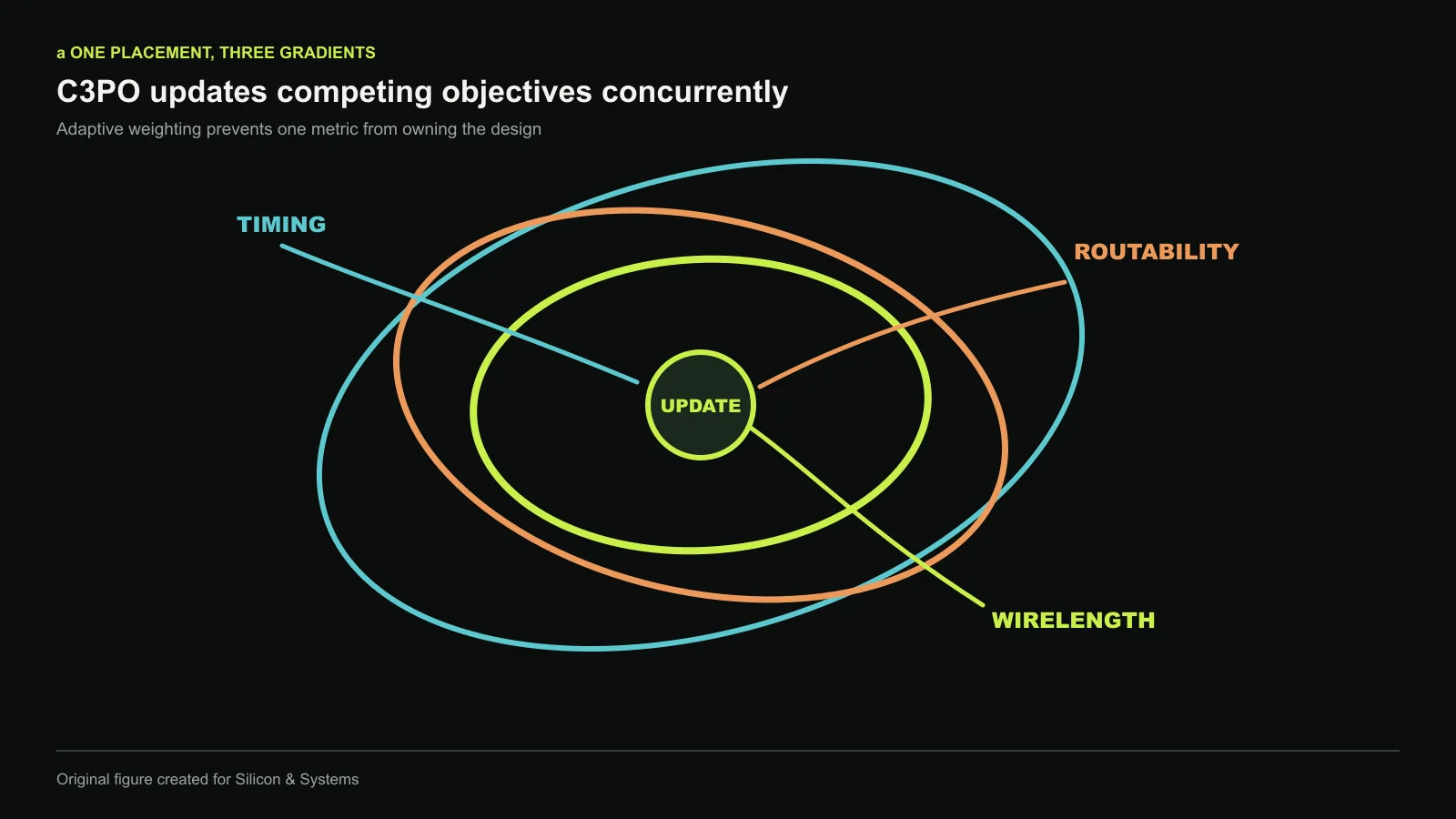
C3PO combines timing, routability, and wirelength in one GPU-accelerated global-placement process[1]. The objectives have different scales and can point in conflicting directions. Rather than commit to fixed weights, the method adapts their balance during optimization, following a multi-gradient strategy that seeks a useful joint direction.
This matters because no universal scalar can represent every design phase. Early placement may need stronger density control. A timing-critical block may spend wirelength to protect slack. A design approaching routability limits may accept a small timing loss to prevent a large detour later. Adaptive weighting makes these trade-offs part of the algorithm rather than a manual outer loop.
On eight ASAP7 designs from the TILOS and IWLS collections, C3PO reports up to 16.7% lower routed wirelength and 19.6% lower switching power than a commercial-tool comparison after a complete flow[1]. ASAP7 is a predictive 7 nm academic process design kit, not a commercial process node. The full-flow comparison is valuable, but the technology scope should remain attached to the result.
The next industrial test is transfer across macros, hierarchy, advanced-node rules, and proprietary libraries. Those conditions change the geometry of congestion and the timing sensitivity of movement. A production deployment also needs deterministic limits: maximum displacement, legal regions, power-domain boundaries, and rollback when a candidate degrades signoff.
DCO-3D makes vertical congestion differentiable
Three-dimensional integration adds another routing dimension without removing planar constraints. Cells assigned to different tiers still compete for intra-tier wires, while vertical connections consume bonding or via resources and affect timing. A placement that balances cell area can remain unroutable because demand accumulates around tier crossings or dense logic regions.
DCO-3D uses a Siamese U-Net congestion predictor and a differentiable spreading method to push cells away from predicted hot regions[2]. The use of paired information helps the model reason about relationships across the 3D structure. The optimizer then changes placement in response to that predicted map instead of waiting for a full routing failure.
The paper evaluates six industrial benchmarks in a commercial 3 nm technology using a common commercial placement seed. It reports up to 86% improvement in total negative slack and 4.8% lower total power at the end of the flow[2]. These values show that congestion relief can recover timing and power, not merely make a heat map look smoother.
The denominator is still design-specific. A 3D flow depends on partitioning, tier technology, inter-tier connection pitch, thermal limits, and clock delivery. Congestion optimization cannot choose those system assumptions by itself. It improves placement after the architecture and partition have defined where traffic must cross.
Detailed routing needs attention, not another global rewrite
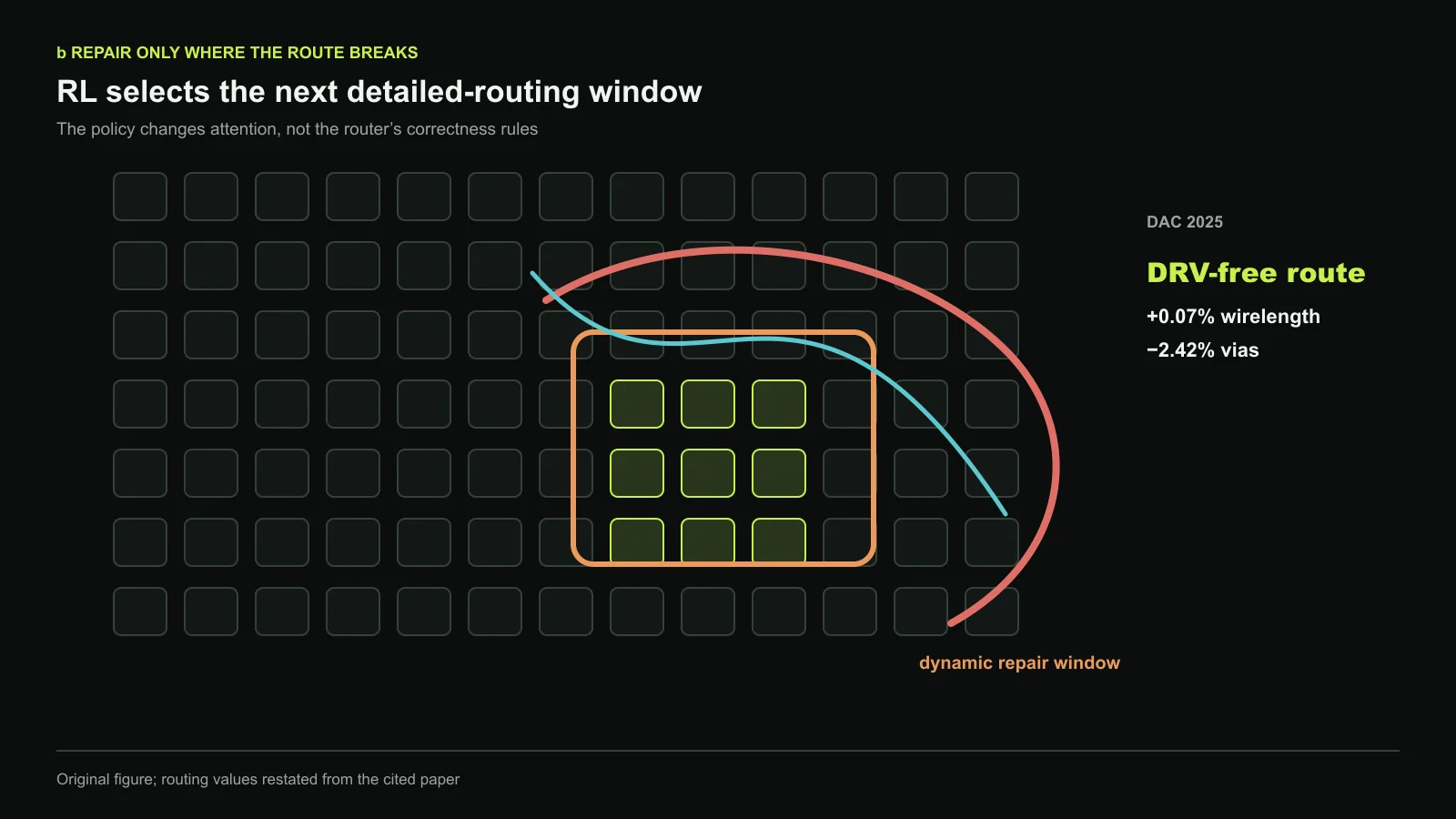
Once detailed routing begins, many problems are local. A cluster of design-rule violations may be removed by ripping up nets in one window and rerouting them. Selecting a window that is too small cannot escape the conflict. Selecting one that is too large destroys useful routes and expands runtime. The sequence of windows becomes a planning problem.
The DAC 2025 work formulates window selection as reinforcement learning[3]. The agent observes the routing state and chooses a region for the existing rip-up-and-reroute machinery. Compared with TritonRoute in the reported experiments, the method reaches a design-rule-violation-free result while adding only 0.07% average wirelength, reducing via count by 2.42%, and keeping similar average runtime.
The result is easy to overstate. The RL policy does not generate every wire or replace geometric design-rule checking. It decides where the conventional router should spend its next repair effort. This is a credible authority boundary because the action is local, the reward is measurable, and the router still enforces legality.
Placement and routing AI need different representations
Global placement benefits from continuous coordinates, density fields, timing graphs, and smooth approximations. Detailed routing operates on tracks, vias, blockages, and discrete design rules. A representation that works for one stage may erase the information required by the other.
This is why end-to-end claims should be treated carefully. Joining the stages does not require one neural network. It requires compatible interfaces. Global placement can emit uncertainty and predicted congestion. Routing can return localized failures and detour costs. Timing can provide sensitivity to both. Each solver may use the method that matches its state space.
The system also needs a shared identity for causes. If routing reports a hotspot, the flow should trace it to cells, nets, and the placement objective that created the region. Without this mapping, feedback becomes another scalar penalty and the next run may reproduce the same failure elsewhere.
Multi-objective scores should stay decomposable
Timing, power, congestion, wirelength, vias, and runtime are not interchangeable units. A weighted sum is necessary for some optimizers, but the weights should never be the only reported result. Engineers need the full vector and constraint status at each important checkpoint.
Pareto analysis helps because it keeps alternatives that trade one metric for another. A product can then choose based on its power envelope, frequency target, or manufacturing risk. Adaptive algorithms should record how weights evolved and which constraint became active. This makes a surprising result reviewable and prevents an optimizer from hiding a large regression behind a larger gain elsewhere.
Robustness also matters. Physical-design heuristics can be sensitive to random seeds and small netlist changes. A reported best run may not represent expected behavior. Evaluations should include multiple seeds, distributions, and failure rates, especially when the optimizer will be inserted into an overnight production flow.
The operational bottleneck is tool latency
An optimization method can be mathematically strong and still unusable if every reward requires a multi-hour place-and-route run. C3PO and DCO-3D address this by making important objectives differentiable and GPU-friendly. The routing-window policy acts locally so each decision does not require a global restart. Both reduce the cost of feedback.
Surrogates introduce a different cost: calibration. A congestion predictor trained on one tool version or node may drift after routing rules change. A timing approximation may preserve average rank while missing a new critical-path pattern. Production systems need periodic comparison with the authoritative tool and a threshold that disables automation when disagreement grows.
Compute allocation should follow uncertainty. Familiar blocks can use a fast predictor for most iterations and check only finalists. Novel topologies or out-of-distribution regions deserve more full-flow calls. The agent’s job includes deciding when the expensive oracle is necessary.
The adoption decision
The most credible P&R automation does not ask AI to draw a finished layout from scratch. It puts a fast, structured decision maker around tools that already know legality and signoff. Concurrent placement connects objectives earlier. Congestion prediction moves routing evidence upstream. RL window selection concentrates detailed repair where it matters.
A deployment review should ask whether the claimed improvement survives the complete flow, whether every objective remains visible, and whether the model knows when its prediction is unreliable. It should also verify that technology, library, seed, baseline, and runtime are comparable.
The strategic change is that place and route becomes a negotiation with memory. Each stage can return the reason for its cost to the stage that created it. When that feedback loop is fast enough, the flow spends fewer runs rediscovering the same physical conflict.
Source and copyright notice
This article is an independent editorial analysis of the three cited papers and official publication records. Technical claims and reported values were restated in our own words. No source sentence, table, route, layout, or figure is reproduced. Both explanatory figures were created specifically for this article. The cited papers are copyright their respective publishers and authors.