AI has not advanced uniformly across chip design. Public discussion often begins with natural-language RTL because the demo is easy to understand: write a prompt and receive Verilog. The stronger industrial evidence, however, is appearing in physical design. Timing analysis, gate sizing, and placement have objectives that can be measured repeatedly against established signoff flows. Their search spaces are enormous, but each candidate can produce structured feedback.
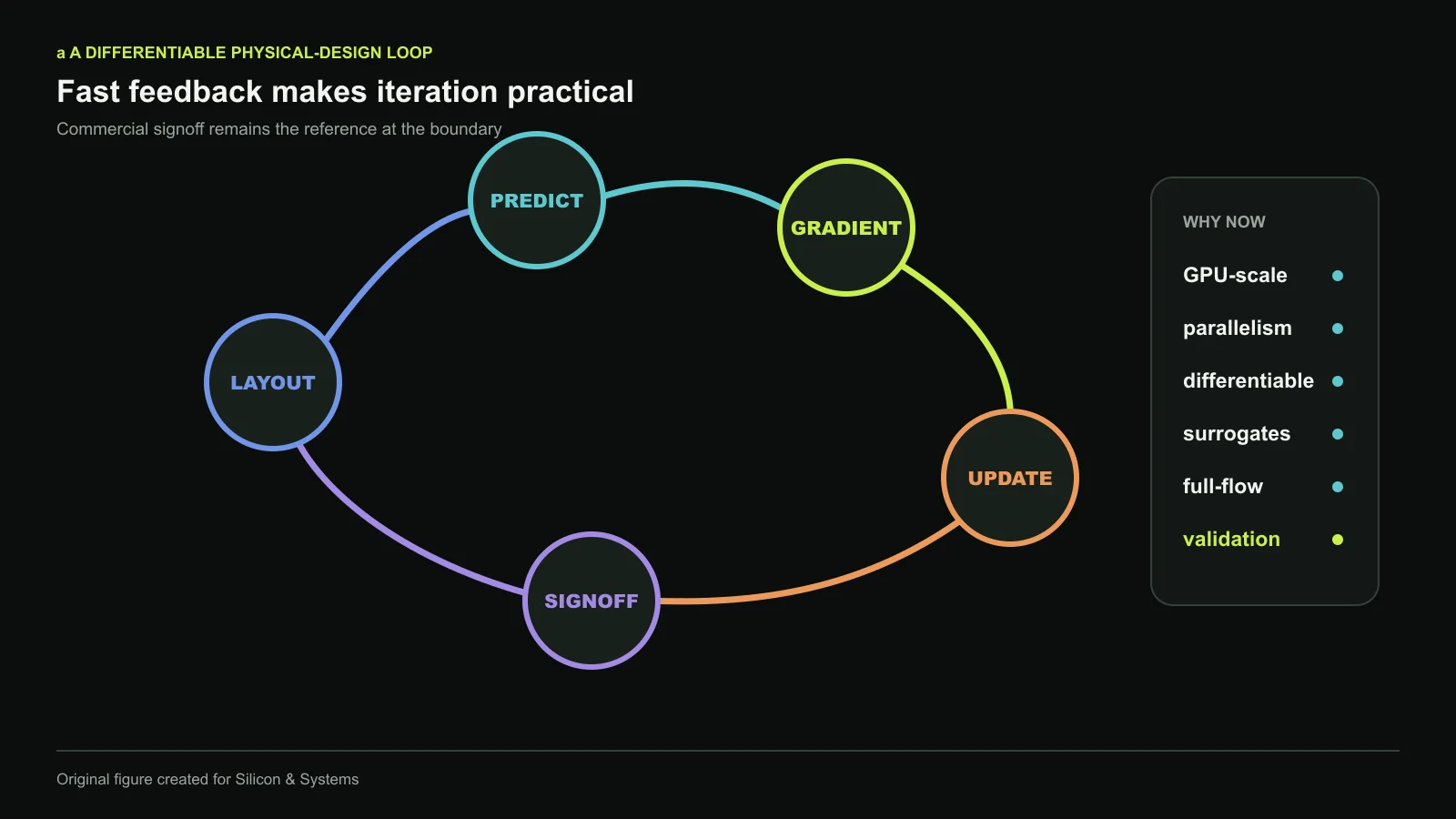
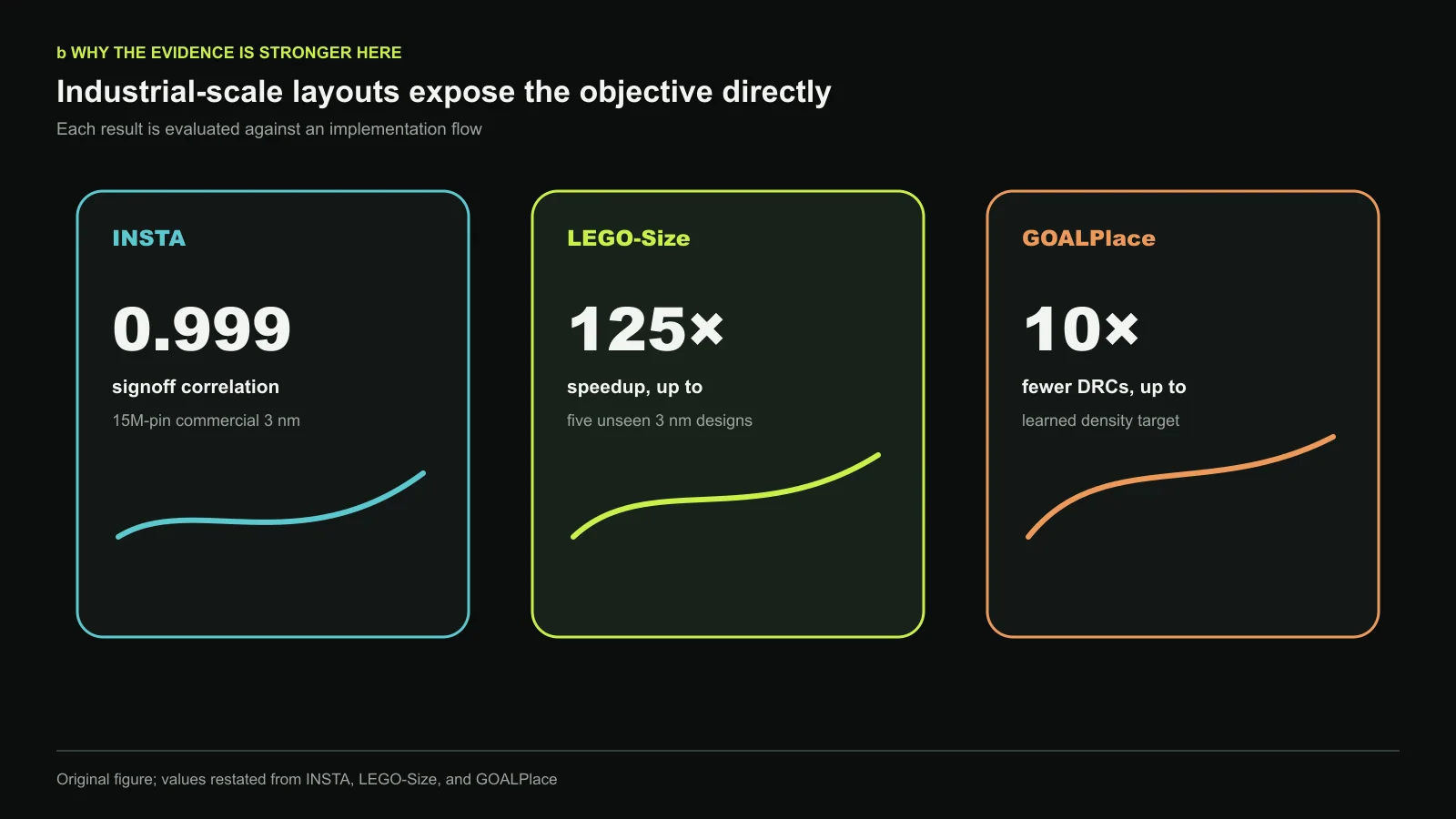
Three NVIDIA-led papers illustrate the pattern. INSTA builds a GPU-accelerated differentiable statistical timing engine and reports 0.999 correlation with an industry-leading signoff tool on a commercial 3 nm design with 15 million pins[1]. LEGO-Size connects differentiable timing to gate sizing and reports up to 125 times speedup on five unseen million-gate industrial 3 nm designs[2]. GOALPlace learns density targets from post-route results and reports up to ten times fewer design-rule violations with lower wirelength and better timing[3]. These are different tools, but all close the loop between a physical state, a fast evaluator, and an implementable correction.
The objective is visible at every iteration
Physical design turns a netlist into geometry under timing, routing, power, area, and manufacturing constraints. Each move has a measurable consequence. Moving a cell changes wirelength and congestion. Resizing a gate changes delay, slew, load, leakage, and local placement pressure. A density target changes available routing space. The problem is difficult because these effects interact, not because the objective is undefined.
This visibility makes learning useful. A model or differentiable engine can estimate which direction improves a metric, then the implementation flow can check the result. The correction does not need to be expressed as prose. It can be a cell displacement, a size choice, or a target map. The action is narrow enough to validate and cheap enough to repeat when the evaluator runs on GPUs.
Architecture search lacks this immediate closure. A cache or execution-width decision may require compiler, workload, RTL, physical implementation, and system measurement before its value is known. Physical design begins later in the stack, where many functional choices are fixed and the remaining trade-offs have concrete geometry.
INSTA turns timing into a fast optimization primitive
Static timing analysis determines whether data can travel through combinational paths within the clock budget. Traditional signoff engines are accurate but expensive to call inside every optimization step. A learned proxy can be fast but dangerous if small errors change the ranking of near-critical paths. INSTA addresses both sides by implementing statistical timing operations on GPUs and making the engine differentiable[1].
The reported 0.999 correlation matters because the evaluation includes a commercial 3 nm design with 15 million pins. It tests the engine at a scale where graph traversal, reconvergent paths, and memory access patterns become system problems. INSTA reports sub-0.1-second analysis and a 25 times acceleration for incremental timing. This makes timing feedback frequent enough to guide another optimizer rather than appear only at the end.
Correlation is not identical to signoff closure. A design fails on the worst paths, so absolute error and rank accuracy near the timing boundary matter more than an average trend. Process corners, on-chip variation, crosstalk, signal integrity, and constraint exceptions also determine deployment scope. The paper’s significance is that it brings a signoff-aligned timing signal into an optimization-rate engine; the commercial analyzer remains the final authority.
INSTA-Size and INSTA-Place show why differentiability matters. A timing engine that returns only a number tells an optimizer whether a candidate is better. A differentiable engine also estimates how individual changes affect the objective. The paper reports up to 15% better total negative slack with 68% fewer cells resized for INSTA-Size, and improvements up to 16% in half-perimeter wirelength and 59.4% in total negative slack for INSTA-Place on ICCAD benchmarks[1].
LEGO-Size couples a fast evaluator to a discrete action
Gate sizing is discrete: a standard-cell library offers specific drive strengths and threshold-voltage options. The timing response is also global because changing one gate alters the load and arrival time seen by others. Exhaustive search is impossible, while local heuristics can oscillate or fix one path by harming another.
LEGO-Size connects a GPU-optimized differentiable timing model to this discrete decision process[2]. The system uses gradients to identify influential cells, then selects legal sizes and evaluates the updated design. On five unseen million-gate industrial designs in a commercial 3 nm technology, it reports up to 125 times speedup and 37% better total negative slack than an industry-leading commercial signoff flow, with limited power and area overhead.
“Unseen” is important. A tool that works only on its training blocks may memorize placement patterns or timing distributions. Evaluating new designs tests whether the timing representation and update rule transfer. The result still belongs to the tested technology, libraries, constraints, and optimization objectives; transfer to another node or methodology requires new evidence.
LEGO-Size also demonstrates a deployment pattern. The AI component does not replace the standard-cell library, legalizer, or signoff tool. It accelerates candidate selection inside those fixed rules. This is a lower-risk insertion point because the output is a conventional netlist with legal cell choices, and the established flow can reject regressions.
GOALPlace learns the target that an analytic placer lacks
Global placement typically balances wirelength and density before detailed routing reveals whether the topology is actually routable. A uniform density penalty can be too coarse. Some regions need whitespace because pin access or routing demand is high; other regions can pack more tightly. The correct target depends on the design and the downstream router.
GOALPlace learns a density objective from post-route results produced by a commercial tool[3]. It does not merely predict congestion after placement. It transforms downstream evidence into a target that guides the next placement. The reported results include up to ten times fewer design-rule violations, 5% lower wirelength, 30% better worst negative slack, and 60% better total negative slack.
The mechanism is more important than any one percentage. Post-route quality is normally a late verdict. GOALPlace turns it into training data for an earlier stage. This reduces the mismatch between a mathematically convenient placement objective and the real constraints encountered by routing and timing closure.
The method also exposes a maintenance cost. A learned target reflects the router, technology rules, library, and design styles used to create it. When those change, the target distribution can shift. Production use therefore needs monitoring against fresh post-route results and a fallback to conservative placement objectives when uncertainty grows.
Differentiability is useful only when the gradient is actionable
A gradient can point toward lower loss in a continuous model while the legal design space remains discrete and constrained. Cells must stay in rows, macros cannot overlap, routing tracks are finite, and library choices are categorical. The optimizer needs a projection from the mathematical step to a legal physical action.
This is why the surrounding EDA machinery matters. Legalization, incremental extraction, library lookup, and routing estimation convert a suggested direction into an implementable candidate. If projection destroys the predicted gain, the loop must observe that outcome and adjust. A differentiable surrogate without this correction path can produce elegant gradients that do not survive implementation.
Multi-objective behavior creates another requirement. Improving slack by upsizing many cells can increase power, area, and congestion. Reducing wirelength can crowd a region and worsen pin access. The optimizer should preserve separate objectives and constraints rather than hide all trade-offs in one fixed scalar. Engineers need to see which resource paid for the improvement.
Industrial evidence needs a full-flow denominator
Academic placement and timing benchmarks are valuable for reproducibility, but a deployment claim needs industrial scale and downstream validation. Netlist size alone is insufficient. The flow should state technology, library, timing corners, routing stage, signoff reference, and whether the comparison starts from the same initial design. End-of-flow PPA is stronger than an early proxy.
The three papers provide complementary evidence. INSTA validates the evaluator against commercial timing. LEGO-Size applies the evaluator to an optimization action on unseen industrial designs. GOALPlace uses commercial post-route results to train an upstream objective. Together they cover prediction, correction, and downstream consequence.
No single result proves portability across all products. A GPU block, CPU core, and memory controller have different hierarchy, macro, congestion, and timing patterns. Advanced-node effects also change the relationship between placement and delay. A production rollout should begin with block families whose physical distributions resemble the training and validation set, then expand only after signoff deltas remain stable.
Why this does not eliminate physical designers
The optimizer works inside constraints that engineers define. Clock architecture, floorplan, macro placement, power delivery, hierarchy, and acceptable trade-offs determine the feasible region. A faster optimizer can expose a poor constraint more quickly, but it cannot decide the product intent from timing loss alone.
Physical designers also diagnose why a flow is stuck. Congestion may be caused by pin topology, a floorplan channel, synthesis duplication, or an unrealistic timing exception. Repeatedly moving standard cells treats only one layer. The strongest automation should surface the causal pattern and recommend when the problem must be escalated to logic, floorplan, or architecture.
This changes the engineer’s work rather than removing it. Less time is spent sweeping local options. More time is spent setting objectives, interpreting persistent violations, and deciding which upstream commitment must change. The human boundary moves from individual optimization actions to the structure of the optimization problem.
The adoption decision
AI reached physical design first because three ingredients align. The state is machine-readable geometry and timing. The objective can be evaluated repeatedly. The action can be checked by a conventional implementation flow. GPU acceleration then makes the loop fast enough to matter.
A buyer should evaluate the loop, not the model label. Ask which physical state the system observes, which signoff engine defines truth, how proposed actions become legal, how uncertainty is reported, and whether gains survive route and timing closure. Also ask how the model is recalibrated when libraries, nodes, or tool versions change.
INSTA, LEGO-Size, and GOALPlace show that learned and differentiable methods can enter industrial flows without pretending to own the entire chip. Their success comes from a narrow authority boundary and a strong feedback path. That is the transferable lesson for the rest of AI-assisted silicon design.
Source and copyright notice
This article is an independent editorial analysis of the three cited papers and official research records. Technical claims and values were restated in our own words. No source sentence, table, layout, or figure is reproduced. Both explanatory figures were created specifically for this article. The cited papers are copyright their respective publishers and authors.