Modern physical-design tools contain hundreds of options, effort levels, thresholds, and stage-specific switches. This flexibility is necessary because a CPU core, accelerator, and interface block do not fail in the same way. It also creates an operational problem: every new design can begin with another expensive search for a useful flow recipe.
Black-box optimization improves on manual sweeps, but it often treats each run as a point with a final score. It knows that one recipe was better, not why. When the next block has a different timing graph, congestion pattern, or power profile, the optimizer can return to a cold start.
InsightAlign and FastTuner propose two ways to carry experience forward. InsightAlign converts expert-style design health signals into a representation and learns to rank recipe sets for unseen designs[1]. FastTuner encodes the design graph, chooses parameter values sequentially with a Transformer-based reinforcement-learning policy, and uses an offline PPA estimator to avoid running the full physical flow for every reward[2]. The common goal is transfer: previous runs should become a reusable design asset.
A recipe is more than a parameter vector
The same option can have different effects at different stages. Higher placement effort may improve one block and amplify congestion in another. A timing optimization switch can reduce total negative slack by inserting cells that increase power and routing pressure. The useful meaning of a recipe therefore depends on the design state in which it is applied.
Engineers already reason this way. They inspect utilization, critical-path composition, density, fanout, buffering, hold pressure, congestion, and clock behavior before changing the flow. A transfer system must represent these conditions, not only the final PPA score. Otherwise it can memorize which knob values worked without learning the problem they solved.
This is the central difference between recipe learning and generic hyperparameter search. Hyperparameter optimization finds a point. Recipe learning tries to connect design evidence to an ordered set of actions that can work again.
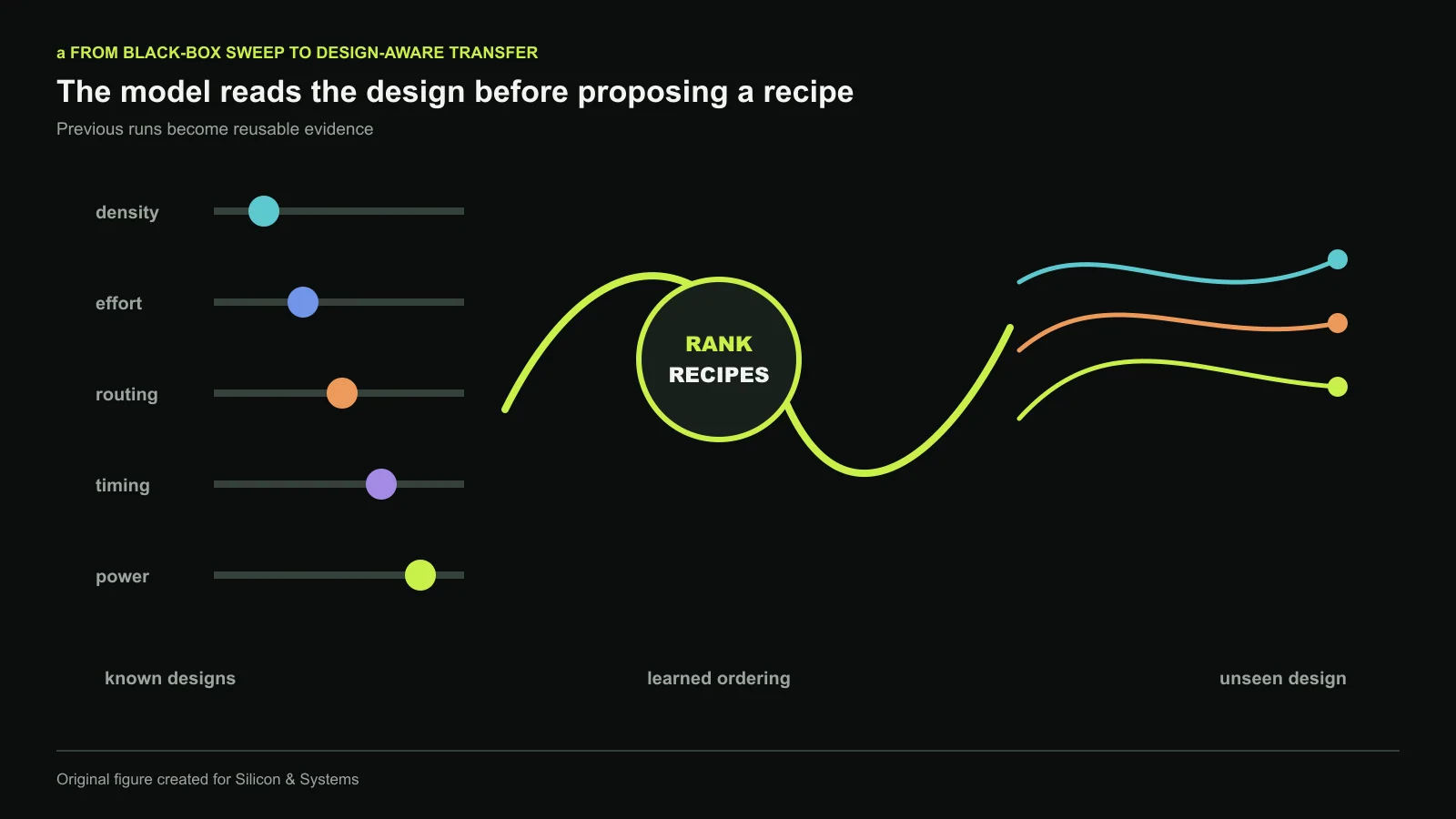
InsightAlign learns relative preference
Exact PPA prediction is difficult across designs, nodes, and flow stages. A one-nanosecond error has different meaning when two blocks have different clocks and timing distributions. InsightAlign avoids requiring one universal absolute predictor. It frames recipe recommendation as a ranking problem and adapts alignment techniques used in language models to prefer one recipe over another[1].
The input includes design insights derived from flow health, such as signals related to congestion, density, timing, and power behavior. Offline runs create pairs of better and worse recipes. A preference-style objective then teaches the model to order candidates in a way that reflects both the design condition and the intended QoR trade-off.
The evaluation covers 17 industrial designs spanning 45 nm to sub-10 nm processes and emphasizes zero-shot recommendation on unseen designs[1]. This is the right test for the product claim. A recommender that only improves blocks already present in training is an archive lookup. Zero-shot evaluation asks whether the learned representation captures enough design condition to guide a new case.
Ranking also matches how engineers use recommendations. The system does not need to predict the final slack and power perfectly. It needs to place promising recipes near the top so a limited number of expensive runs can verify them. The production metric should therefore include top-k success, runs to target, and failure probability, not only prediction error.
FastTuner replaces most rewards with a learned evaluator
Reinforcement learning fits parameter tuning because actions are sequential. A choice at placement affects which choices remain useful during clock and routing optimization. The reward appears after the sequence when final PPA is known. The naive formulation is too expensive because each trajectory can require a complete physical-design run.
FastTuner separates learning the evaluator from using the policy[2]. A graph neural network encodes design characteristics. A Transformer decoder selects parameter values conditionally, preserving the sequence of prior choices. An offline-trained PPA estimator supplies rapid rewards so the agent can explore without invoking the full P&R flow for every candidate.
The formal ACM journal version evaluates seven industrial TSMC 28 nm designs across multiple objectives. It reports improvements up to 79.38% in total negative slack and 12.22% in total power, with more than 50 times lower runtime than the compared design-space exploration methods[2]. The result demonstrates that design encoding and a learned reward can reduce both cold start and evaluation cost.
The estimator is also the main risk. If it ranks an unseen region incorrectly, the policy can exploit the surrogate instead of improving the real design. Production use requires periodic full-flow checks, uncertainty estimates, and a rule that returns the search to the authoritative tool when the candidate leaves the validated distribution.
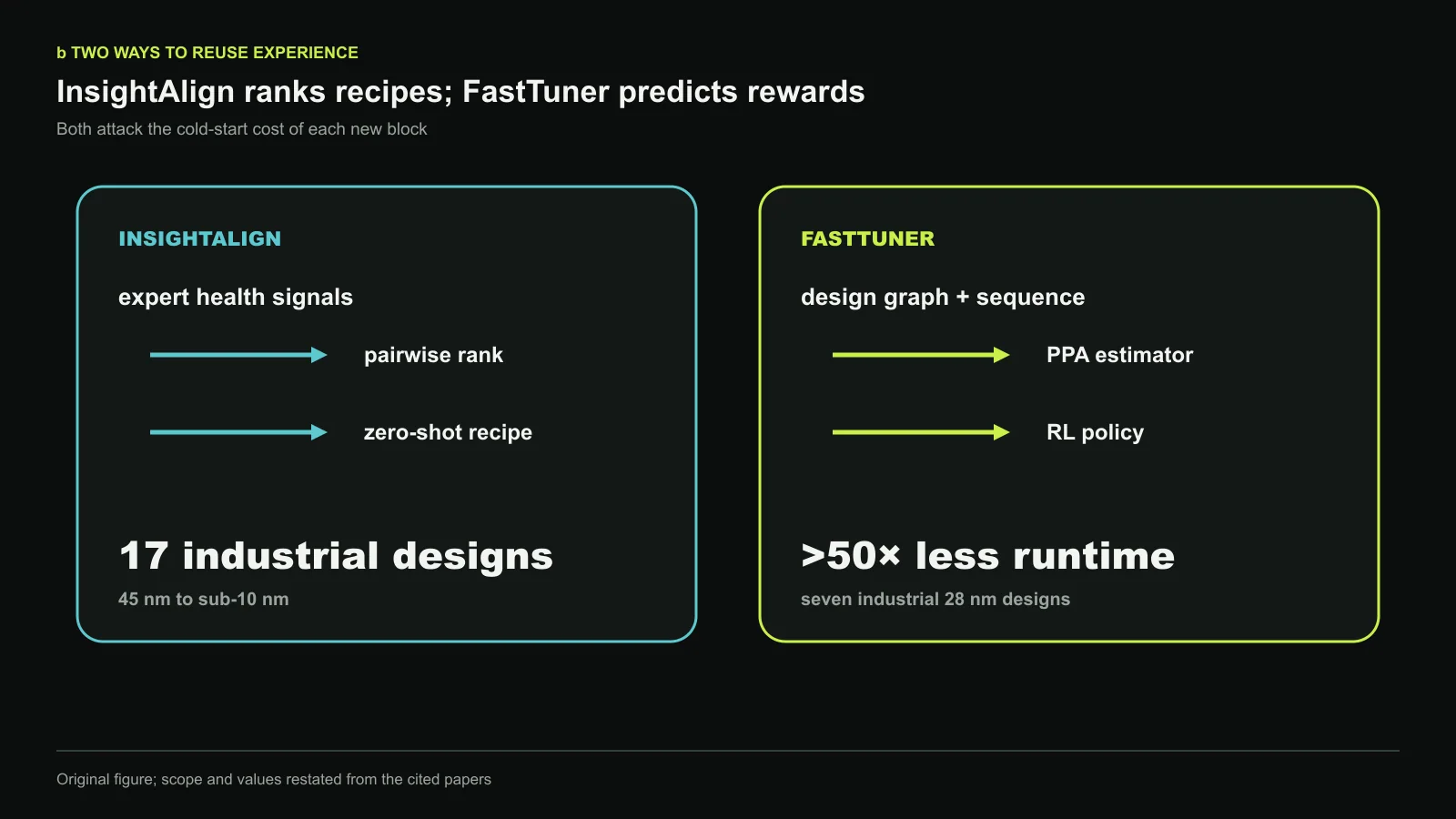
Ranking and reward prediction solve different costs
InsightAlign reduces the number of recipes that need evaluation. FastTuner reduces the cost of evaluating trajectories during policy search. These benefits can be combined conceptually, but they should not be confused.
A ranker is attractive when a company has a history of flow runs and expert diagnostics but does not trust a universal absolute PPA model. It can recommend a shortlist whose order is conditioned on the new design. An RL tuner is attractive when parameter interactions are sequential and the organization can train a reliable estimator from sufficiently broad data.
The data requirements differ. Pairwise preference learning needs consistent labels about which outcome was better under a stated objective. Reward modeling needs accurate final outcomes and design features across the region the policy may explore. Both require clean provenance: tool version, library, node, constraints, starting point, and run status.
Tool logs become a strategic dataset
EDA organizations already generate large volumes of runs, but logs are rarely organized for transfer learning. Failed jobs may be discarded. Parameter changes may live in engineer scripts without a reason. Different projects may name objectives and stages differently. This fragmentation prevents the system from learning which action solved which condition.
A useful dataset has four layers. The design layer captures structural and physical features. The recipe layer records ordered parameter settings by stage. The outcome layer stores timing, power, area, congestion, DRC, runtime, and failure status. The rationale layer links observations to the decision, including expert diagnoses or automatically derived health signals.
Failures should remain in the dataset. They define unsafe regions and teach the ranker that a superficially strong PPA value is irrelevant if the flow crashes or violates a hard constraint. Timeout, non-convergence, routing explosion, and signoff mismatch are different failure labels and should not collapse into one penalty.
Transfer has a boundary that must be measured
Moving between blocks in one technology is easier than moving between nodes, libraries, or tool releases. A feature that indicates congestion at 28 nm may have a different relationship to pin access in a sub-10 nm process. A parameter name may remain stable while its implementation changes between tool versions.
The system should report its transfer distance. Relevant dimensions include node, library family, design size, hierarchy, macro fraction, utilization, clock count, and workload activity. Uncertainty should rise as the new design moves away from the training set. This lets an engineer decide whether to trust a zero-shot shortlist, allow online adaptation, or start a guarded exploration.
Online learning also needs isolation. A bad run on one project should not immediately alter the global policy. Candidate updates can be evaluated in a project-specific layer, then promoted only after repeated evidence. This mirrors release engineering: local experiments, controlled validation, and versioned deployment.
The objective must remain a product decision
PPA is not one objective. Timing closure may be a hard constraint, power may be the product limit, and area may carry a cost curve rather than a fixed weight. A recommender trained on a blended score can quietly spend the wrong resource.
Both ranking and RL should accept an explicit QoR intention. The returned candidate should include the predicted trade-off vector and the evidence behind its rank. Engineers can then see whether the recommendation improves total negative slack by increasing leakage or whether a runtime gain comes from reducing exploration breadth.
Constraint handling is more reliable than extreme penalties. Illegal or non-convergent recipes should be removed from the feasible set. Product preferences then rank the remaining candidates. This prevents a large gain in one metric from compensating for a violation that makes the design unusable.
The operational product is a learning service
Recipe transfer should not be packaged as a model file handed to every project. It needs a service that ingests runs, normalizes tool metadata, scores distribution shift, proposes candidates, dispatches experiments, and records verified outcomes. The model is one component inside this lifecycle.
Reproducibility requires versioned recipes and environments. A recommendation should point to the exact tool build, library, constraints, seed, and starting database. The service should also preserve the rejected alternatives so a later tool upgrade can re-evaluate them.
Security and confidentiality matter because physical-design data reveals product structure and process assumptions. Training boundaries, access control, and retention policy should be defined before logs are centralized. A transferable model is valuable precisely because it encodes accumulated proprietary experience.
The adoption decision
The first question is whether a company has enough consistent run history to learn from. If the answer is no, standardizing logs and objectives will create more value than selecting an RL algorithm. The second question is whether the target designs share a meaningful distribution. Transfer cannot be assumed across unrelated nodes and methodologies.
For a mature flow, InsightAlign and FastTuner point to a practical progression. Begin with an offline ranker that proposes a small candidate set and leaves final evaluation to the existing flow. Add design-aware reward models only where prediction error and uncertainty are well characterized. Introduce online policy adaptation behind strict full-flow checkpoints.
The competitive advantage is not the recipe that wins one benchmark. It is the ability to recognize a new block, recall which past conditions are relevant, and reach a verified recipe with fewer expensive runs. That memory compounds across tapeouts, which makes it a more durable EDA asset than another isolated optimization script.
Source and copyright notice
This article is an independent editorial analysis of the two cited papers and their official publication records. Technical claims and values were restated in our own words. No source sentence, table, training layout, or figure is reproduced. Both explanatory figures were created specifically for this article. The cited papers are copyright IEEE, ACM, their authors, and affiliated institutions as applicable.