A hard latency guarantee is a budget. A network can spend the full budget carrying a burst through several hops, or it can spend some time before the first hop to make the flow smoother. Smoothing delays the first bytes, but every downstream link then sees less concentrated demand. The correct choice is often between no smoothing and the maximum possible smoothing.
A 2024 IEEE/ACM Transactions on Networking paper by researchers affiliated with Washington University in St. Louis, Google, and ByteDance formalizes this trade[1]. It considers flows described by deterministic token buckets and fixed routes. Each flow has a hard end-to-end delay bound. The objective is to choose ingress reprofiling, per-hop service guarantees, and link capacity so the network meets every deadline with minimum total bandwidth.
The result is not a general claim that delaying traffic always saves capacity. It applies to a defined network-calculus model with Service Curve Earliest Deadline first (SCED) scheduling. The paper provides an exact nonlinear formulation for small cases and a practical Greedy heuristic for larger ones. The heuristic comes close to the exact result in tested small configurations and shows double-digit gains over simpler policies in selected application-derived networks.
Token buckets turn burstiness into an enforceable contract
A deterministic traffic profile must bound what a source can send in any interval. The paper uses a token bucket with long-term rate r and burst allowance b. Over an interval of length t, the flow may inject at most b + rt after the initial instant. The rate describes sustained demand. The bucket permits a bounded burst above that rate.
This contract is stronger than a measured average. A network can reserve service against the worst traffic allowed by the bucket and then derive a hard delay bound. The cost is that a loose profile can require substantial bandwidth even if most observed traffic is smooth. Tightening the profile can reduce the reservation, but the regulator may need to hold packets at ingress.
Reprofiling replaces the original arrival curve with a smoother one. In practical terms, the network accepts the user’s token-bucket contract and applies another regulator before admission to the path. The smoother profile lowers the instantaneous service required at shared links. The waiting time introduced by this regulator counts against the same end-to-end deadline.
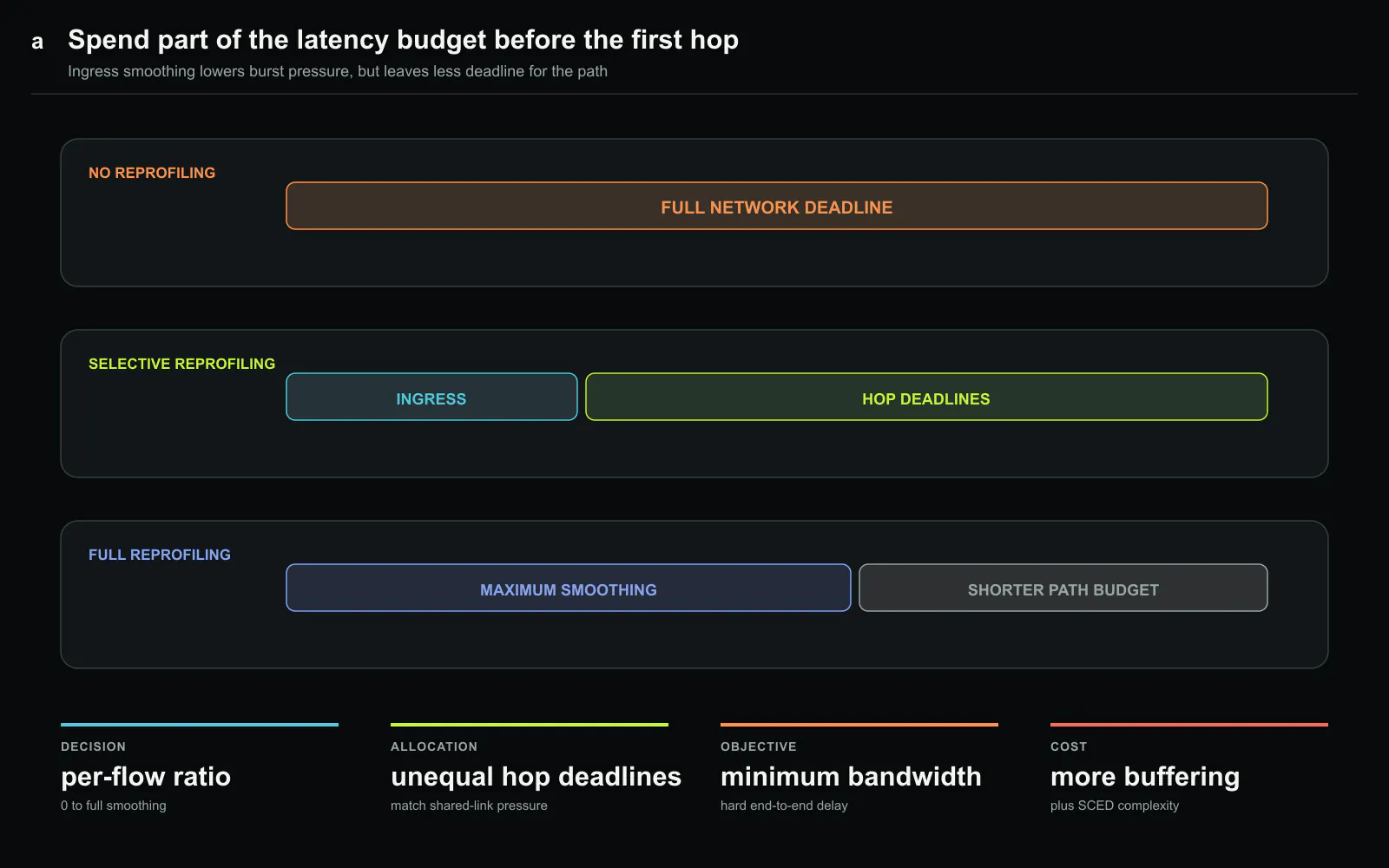
Two extremes are easy to define. No Reprofiling (NR) sets ingress delay to zero and leaves the entire deadline for the network. Full Reprofiling (FR) spends as much of the available budget as possible to reduce the flow toward its long-term rate, then divides the remaining delay across the path. Both policies are plausible, and neither is generally optimal in the multi-hop case.
Why multiple hops change the answer
With an optimal EDF scheduler on one link, earlier work shows that reprofiling is unnecessary. Delaying traffic before the scheduler removes scheduling flexibility without creating another place where smoothing pays back. The multi-hop case changes the accounting.
Ingress delay is paid once. A smoother flow can reduce burst pressure at every link it traverses. If a path crosses several shared links, the same smoothing decision can lower capacity requirements repeatedly. However, allocating more delay to ingress leaves less time for the network, forcing tighter per-hop service curves. The optimizer must balance repeated bandwidth benefit against reduced scheduling flexibility.
This explains why an intermediate solution can beat both extremes. A partially smoothed flow may remove the costly part of a burst without consuming the full ingress allowance. Unequal hop deadlines can then assign more time where a flow competes with difficult traffic and less time on lightly loaded links.
The effect depends on path overlap. Smoothing a flow that crosses one uncongested link offers little shared benefit. Smoothing a bursty flow that crosses several links with different competitors may reduce reservation at each bottleneck. The best ratio is therefore a network-wide decision, not a property of the source alone.
SCED makes the guarantee explicit and the implementation demanding
SCED generalizes earliest-deadline scheduling from packet deadlines to service curves. Each flow receives a service guarantee, and the scheduler prioritizes work according to the deadline implied by that guarantee. When the schedulability condition holds, the required aggregate link rate can be derived from the sum of service demands.
This framework lets the optimization reason about each flow’s arrival curve, ingress regulator, local service curve, and end-to-end delay. It also makes the model boundary important. A production switch must approximate or implement the required scheduling semantics. A network that exposes only a few strict-priority queues cannot be assumed to deliver arbitrary per-flow service curves.
The paper limits service curves to a tractable family and assumes fixed topology and routing. Buffers are large enough for lossless operation. Traffic is analyzed primarily as a fluid, with standard adjustments needed for packets. These assumptions allow a clean bandwidth optimization, but a deployment must account for packetization, finite queue memory, scheduling granularity, and route changes.
The network also needs per-flow or aggregated profile state. A regulator must know the allowed rate and burst, hold traffic when it exceeds the new profile, and account for the added delay. The scheduler must enforce the local guarantee at every hop. This is a control-plane and data-plane contract, not a central planner producing capacity numbers by itself.
The exact optimization reveals structure but does not scale
The exact formulation jointly chooses ingress reprofiling delay and local service curves. Its objective can minimize total bandwidth, maximum link bandwidth, or a weighted sum. The paper focuses on total bandwidth. The decision space is nonlinear and piecewise because the ordering of service-curve segments changes as flow parameters move.
For a small tandem network, a nonlinear programming solver can search this space. When three flows cross two to ten links, the exact solution uses less bandwidth than Greedy, but the gap stays below 3% in the reported tests. Runtime separates much faster than solution quality as the number of links rises.
When the path has two links and the flow count rises from two to five, the heuristic’s average distance from the nonlinear result is roughly 0.5%. At five flows, its runtime advantage exceeds six orders of magnitude. The exact method becomes impractical even though the evaluated instance is still small by network standards.
These comparisons do not prove a worst-case approximation ratio. The paper explicitly describes the closeness as empirical. Different internal configurations can also produce nearly equal bandwidth, suggesting a relatively flat objective around the optimum. A production planner should not assume the heuristic always finds the same profile assignment as the exact solver.
Greedy searches the smoothing ratio, then repairs local pressure
The heuristic begins with several candidate global reprofiling levels, including the two extremes. It evaluates network bandwidth for those levels and narrows the search around a promising interval. This exploration estimates how much of each flow’s available reprofiling delay should be used.
An adjustment phase then changes individual flow decisions and local deadline allocation where they reduce link pressure. The implementation can aggregate flows that have an identical route and service class, which bounds practical runtime for application-derived topologies. The resulting policy can choose full smoothing for one traffic class, partial smoothing for another, and little smoothing for a third.
This two-stage structure is operationally attractive because it separates a coarse global choice from link-specific repair. However, it depends on stable profiles and routes. If flow mix or routing changes faster than the planner recomputes, the installed reprofiling policy may solve yesterday’s sharing pattern.
The planner therefore needs a validity interval. Inputs should record profile version, route, deadline class, and expected number of flows. A change beyond a defined tolerance should trigger recomputation or fall back to a conservative policy. Otherwise, a lower planned bandwidth can become an overload when actual sharing differs.
The reported bandwidth gains keep their denominators
The first application-derived case uses a Time-Sensitive Networking topology based on the Orion Crew Exploration Vehicle. It contains 31 end devices and 47 directional links for bandwidth accounting. Traffic classes and hard deadlines reflect the selected vehicle network scenario. SCED is not itself part of the TSN standard, so this is an evaluation topology rather than evidence of a deployed SCED vehicle network.
Across the tested Orion configurations, Greedy reduces bandwidth by up to 16% relative to full reprofiling and by up to 73% relative to no reprofiling. The benefit over full reprofiling grows with the number of flows because more deadline combinations create more scheduling flexibility for an intermediate policy.
The second case models a North American inter-datacenter network with 11 nodes and 23 bidirectional links. It uses Web, Cache, and Hadoop traffic classes derived from published flow-size and duration distributions, then assigns illustrative end-to-end deadlines of 10, 50, and 200 milliseconds. The workload mix is synthesized under stated assumptions because the source distributions do not provide complete paired profiles.
For this US-Topo case, Greedy uses about 8% less bandwidth than full reprofiling and 46% less than no reprofiling. With a fixed total bandwidth, it admits 8% more flows than full reprofiling and 90% more than no reprofiling in the evaluated scenarios. These are different comparisons: reserved bandwidth at a given demand and admitted demand at a given capacity.
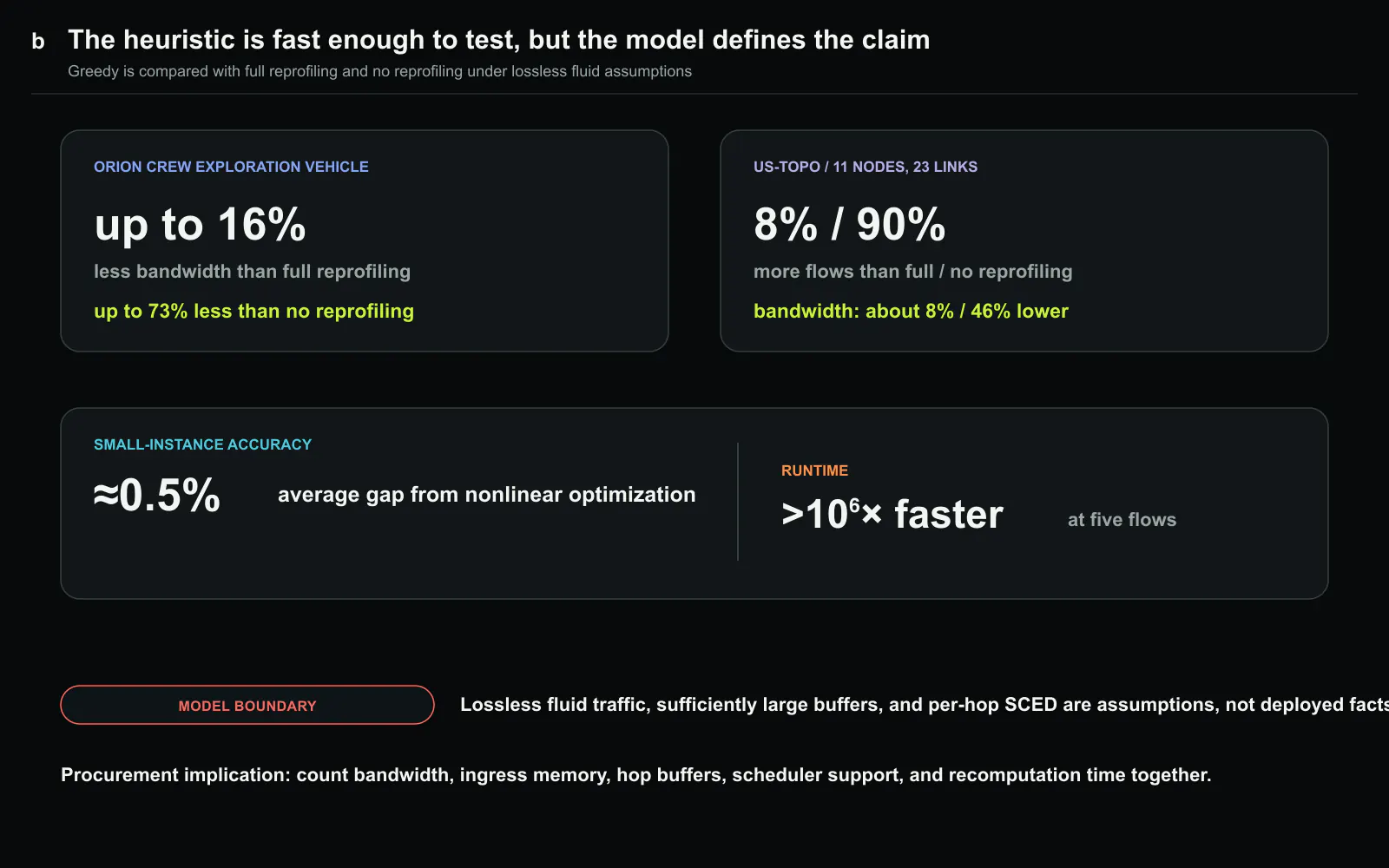
The large percentage against no reprofiling partly reflects the weakness of that baseline under bursty deterministic bounds. The smaller gap against full reprofiling is the stronger evidence for joint optimization. It shows that spending the maximum possible ingress delay can also be wasteful because it removes too much scheduling flexibility.
Bandwidth is not the only resource being purchased
Ingress smoothing requires memory. A regulator must buffer the burst it delays, with an upper bound related to the original bucket. In-network reprofiling and scheduling can require additional per-flow and shared buffers. The paper derives buffer bounds and reports extended results in its appendices, while the main evaluation emphasizes bandwidth.
A buyer should therefore convert the bandwidth saving into a multi-resource balance. Count ingress memory, per-hop buffer, scheduler state, queue count, shaping precision, and computation time. A solution that saves 8% of wide-area capacity may be attractive even with additional edge memory. The same policy inside a switch with scarce on-chip buffer and limited flow state may not be.
Delay is also a resource. Reprofiling intentionally holds traffic before the path. A hard bound ensures the worst case remains within contract under the model, but application-visible latency may increase for traffic that would otherwise encounter an empty network. The policy trades typical immediacy for lower reserved capacity while preserving the hard maximum.
Operational complexity completes the balance. Profiles must be admitted, versioned, and monitored. A source that violates its contract needs policing. A change in route or link capacity can invalidate local deadlines. The control plane must update related hops consistently and maintain a safe configuration during transition.
Fixed routes and hard bounds define a narrow deployment region
The formulation assumes routes are known. Modern datacenter fabrics use ECMP, adaptive routing, packet spraying, or traffic engineering that can change the links a flow traverses. A per-hop deadline plan tied to one route may not survive a different path length or sharing set.
One approach is to plan against the worst allowed path. This preserves the guarantee but can erase bandwidth gains. Another is to restrict deterministic traffic to engineered paths and use separate service for elastic traffic. A third is to integrate path selection with reprofiling, which creates a larger optimization problem and a more complicated transition protocol.
Hard delay bounds are also an extreme requirement. The paper notes that they fit safety-critical settings such as the Orion case, while inter-datacenter services may prefer a lower percentile guarantee or statistical service objective. Statistical guarantees could reduce reserved bandwidth without requiring every allowed token-bucket sequence to meet the same bound. They also weaken the deterministic assurance that motivates the method.
SCED availability is perhaps the largest practical boundary. An operator must verify whether NICs, hosts, and switches can provide the required service curves at the relevant scale. Approximation with priorities or weighted queues changes the guarantee. Part II of the research program targets simpler schedulers, but the measurements in this article belong to the SCED-based Part I model.
A deployment test should separate model, compiler, and hardware
First validate the model on a small topology. Compare Greedy with the exact solver and both baselines. Repeat with fixed end-to-end deadlines as path length changes, not only with deadlines that grow per hop. Vary profile heterogeneity and path overlap, because these create opportunities for intermediate solutions.
Second validate packet behavior. Replay traffic that conforms to the token buckets, including worst-case bursts near the regulator boundary. Measure ingress waiting, per-hop queueing, packetization error, scheduling jitter, and end-to-end tail latency. Confirm that finite buffers stay below the derived bound.
Third validate recomputation. Add and remove flows, change a route, fail a link, and modify one deadline class. Measure the time to compute, distribute, and activate a consistent policy. During that interval, verify which guarantee applies and whether the system reserves temporary headroom.
Fourth test contract violations. Send a flow above its token-bucket profile and verify that policing protects conforming traffic. Exhaust regulator memory and scheduler state. Confirm that overload fails in a defined way instead of silently breaking another flow’s hard deadline.
Lastly, report the economic denominator. Compare the cost of reserved bandwidth and ports with the cost of edge memory, hardware scheduling support, and control software. Include the value of admitting additional traffic under fixed capacity. An 8% reduction on a costly constrained link can outweigh substantial software work, while the same percentage on an idle internal link may not.
Reprofiling changes where the network pays for burstiness
Without reprofiling, each hop must be prepared for a source’s allowed burst while meeting the remaining delay. Full reprofiling pays almost all available delay at the edge and sends a smooth flow into a network with little scheduling freedom. Selective reprofiling moves only the expensive part of burstiness to ingress and keeps enough time for shared links to schedule efficiently.
The paper’s main contribution is the multi-hop accounting. One ingress delay can create capacity benefit at several downstream links. That makes a policy that was unnecessary on one optimal hop useful across a path. The result also shows why neither extreme should be the default.
For datacenter and AI infrastructure, the immediate lesson is not to deploy SCED everywhere. It is to treat burst shape, latency budget, path length, and reserved bandwidth as one design problem. When deterministic service is genuinely required and routes are controlled, reprofiling can be a capacity tool. When routing, traffic, and scheduling are dynamic, its assumptions must be demonstrated before the percentage gains enter a procurement model.
Source and copyright notice
This article is an independent editorial digest by Silicon & Systems. It restates the paper’s model, algorithms, results, and limitations in original language. No paper sentences, tables, equations, or figures are reproduced. Both illustrations were created specifically for this article with deterministic graphics. The authors provide a public preprint through arXiv; the version of record is available at the DOI. Copyright (c) 2024 IEEE for the version of record.