The stiffest parts of an advanced package receive most of the attention: silicon chiplets, copper interconnects, glass cores, and heat spreaders. The package survives because softer materials fill the spaces between them. Underfill transfers load around microbumps, molding compound protects dies, adhesives hold dissimilar layers, thermal interface materials conduct heat across rough surfaces, and organic dielectrics carry wiring. Their behavior cannot be described by one modulus and one glass-transition temperature.
A NIST-led IEEE T-CPMT perspective, written with contributors from NREL, Intel, ASE, Innocentrix, and academia, explains why packaging polymers remain a measurement problem.[1] The article grew from a 2024 NIST workshop and does not claim one new device benchmark. Its contribution is a map from molecular conversion and process history to warpage, stress, adhesion, moisture response, and lifetime prediction.
A package is a history-dependent material system
An epoxy begins as reactive molecules and becomes a cross-linked network during cure. Temperature and time determine when gelation creates a spanning network and when vitrification slows further reaction. Two samples with the same nominal formulation can finish with different conversion, free volume, residual stress, and glass-transition temperature (Tg) if their cure paths differ.
The perspective gives a striking sensitivity example: a one-percentage-point change in conversion between 90% and 100% can shift Tg by about 5°C in one epoxy system. A datasheet that reports a single final Tg therefore cannot identify how a partially cured material behaves during assembly. The reaction path needs to be measured or modeled.
Gelation and vitrification also determine when stress becomes locked into the package. Before gelation, the material can flow and relax. After a network forms, chemical shrinkage and thermal mismatch increasingly produce stress. When the material vitrifies, relaxation slows further. The final room-temperature warpage remembers this sequence.
Tg is a measurement condition, not a universal point
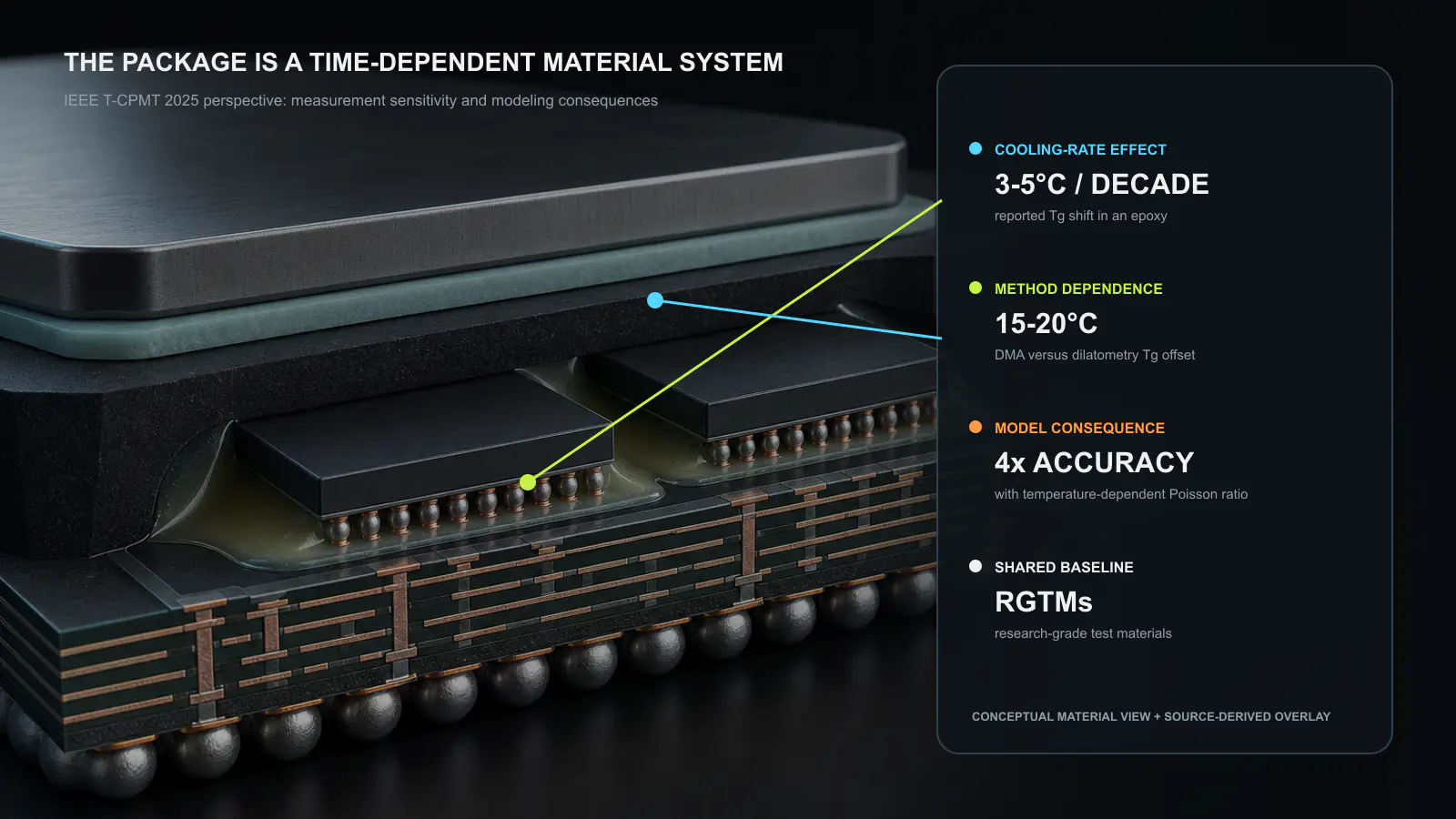
Glass transition is a range in which molecular mobility changes on the timescale of the experiment. A faster thermal scan gives the network less time to relax and can produce a higher apparent Tg. The paper cites a shift of roughly 3 to 5°C for each decade change in cooling rate in an epoxy example.
The instrument also changes the reported value. Dynamic mechanical analysis (DMA) detects a change in viscoelastic response, while dilatometry or thermomechanical analysis follows dimensional expansion. At a 1°C/min condition, a loss-tangent DMA Tg can be 15 to 20°C above the value inferred from dilatometry. Neither value is automatically wrong. They answer different operational definitions.
This matters when suppliers and simulation teams exchange data. A model calibrated to a DMA peak cannot silently compare that number with a coefficient-of-thermal-expansion transition measured by another method. The record needs specimen geometry, frequency or scan rate, cure history, moisture conditioning, atmosphere, and the criterion used to select Tg.
Viscoelasticity changes package warpage
Polymers respond differently to a fast load and a long hold. Their modulus and relaxation time vary sharply across temperature. A purely elastic model assumes stress depends only on present strain, so it cannot represent cure shrinkage relaxing during a dwell or stress rebuilding during cooling.
The perspective highlights temperature-dependent Poisson’s ratio as another overlooked input. Using a variable value instead of a constant improved the accuracy of one thermal-warpage prediction by a factor of four. The exact gain belongs to that model and package, but it demonstrates that a seemingly secondary polymer property can dominate the error budget.
The system implication is direct. As packages become larger and thinner, small errors in modulus, expansion, cure shrinkage, or Poisson’s ratio accumulate over longer distances. Chiplet packages and panel-level flows also combine materials with different time constants. A model can match one room-temperature bow while predicting the wrong stress at the bond interface or the wrong shape at reflow.
Moisture couples chemistry to mechanics
Packaging polymers absorb water from storage and the environment. Moisture can plasticize a network, lower its effective Tg and modulus, swell the material, alter adhesion, and vaporize during heating. The resulting hygroscopic strain adds to thermal and cure strain.
This coupling makes preconditioning part of the experiment. A dry coupon measured immediately after bake is not representative of a package that spent days on a factory floor or years in a humid service environment. Hygrothermal cycling can also expose interface damage that a monotonic temperature test misses.
Moisture transport is spatial. Thick molding compound, thin underfill, exposed edges, and metallized surfaces create different diffusion lengths and boundary conditions. Average water uptake cannot identify the local concentration near a vulnerable copper-polymer or silicon-polymer interface. Models need diffusivity and solubility as functions of temperature and cure state, together with interface-sensitive validation.
Metrology must follow the process in time
The paper surveys a set of complementary methods rather than naming one universal instrument. Differential scanning calorimetry tracks cure heat and transitions. Rheology shows flow, gelation, and viscosity. Raman and infrared spectroscopy follow chemical groups and conversion. Nuclear magnetic resonance can probe network structure and mobility.
Mechanical and dimensional tools add another layer. DMA measures frequency-dependent modulus and damping. Thermomechanical analysis captures expansion. Digital image correlation maps surface strain and warpage. Brillouin light scattering and laser frequency-domain methods can probe local elastic properties. Fiber Bragg gratings can remain embedded to report strain during processing. Small-angle and ultra-small-angle X-ray scattering reveal nanoscale structure.
The methods answer different questions and operate at different length and time scales. Their results become useful when the same material and cure history link them. An isolated coupon test can be precise yet irrelevant if the production package sees a different ramp, pressure, thickness, or moisture state.
In-situ measurement is particularly valuable. Observing cure and stress while the package follows the real thermal cycle separates chemical shrinkage from later thermal contraction. It also reveals when a process crosses gelation and loses its ability to relax. Those events are more actionable than a final room-temperature number.
Proprietary formulations block shared learning
Commercial underfills and molding compounds are complex and often proprietary. Suppliers may disclose values needed for procurement while withholding composition, cure kinetics, fillers, coupling agents, and processing aids. Researchers then compare different black-box materials and cannot tell whether disagreement comes from the method or the formulation.
NIST proposes research-grade test materials (RGTMs) as transparent, nonproprietary baselines. The first targets include underfills and molding compounds. A shared formulation would let laboratories compare instruments, protocols, cure models, and round-robin results without the formulation changing underneath the comparison.
An RGTM is not intended to replace a production material. It provides a transfer standard for methods and models. Once a laboratory can reproduce the shared baseline, it has a stronger basis for measuring a proprietary formulation under a nondisclosure agreement. Equipment vendors can also use the same material to identify systematic offsets.
Standardization must preserve the important variables
A useful standard cannot compress polymer behavior into a single room-temperature modulus. It should define specimen preparation, storage, moisture conditioning, thermal history, scan rate, loading frequency, strain range, and uncertainty. For cure measurements, it should report conversion and distinguish gelation from vitrification.
Package modeling also needs a common way to exchange Prony-series or other viscoelastic parameters, cure shrinkage, thermal expansion, Poisson’s ratio, and moisture properties over the relevant range. Data should identify whether values were directly measured, fitted, or extrapolated. Otherwise, simulation decks can look complete while hiding incompatible assumptions.
Round-robin studies are essential because polymer measurements are sensitive to instrument fixtures and analysis choices. Agreement on the same RGTM would expose laboratory bias and give industry an uncertainty range. A standard that reports uncertainty is more useful than a precise-looking number produced by an undocumented method.
AI and HPC packaging raises the cost of a bad model
AI accelerators combine large silicon area, HBM stacks, organic substrates, interposers, lids, underfills, and high heat flux. Fine-pitch interfaces leave less compliance, while large package dimensions amplify warpage. High power creates broad temperature excursions and gradients. A polymer model that is adequate for a small conventional package can fail at this scale.
The economic consequence is also larger. One assembled module contains several expensive known-good dies and memory stacks. A void, delamination, bump crack, or lid-separation event can discard the whole module. Conservative design can avoid failures but add excessive material, process time, or cooling pressure. Better polymer data narrows that guard band.
Chiplet reuse increases the need for portable material models. The same compute die may enter packages with different molding compounds, substrates, lids, and thermal cycles. A model tied only to one successful stack cannot predict the next combination. Chemistry-aware and history-aware measurements give packaging teams a more transferable description.
Qualification should connect coupons to packages
The first layer is a well-documented material coupon. It establishes cure kinetics, Tg definitions, viscoelastic response, thermal expansion, Poisson’s ratio, moisture transport, and adhesion under controlled conditions. The second layer uses simple bonded structures to isolate interfaces and residual stress. The third layer validates a representative package under the actual assembly cycle.
Correlation must follow the same observables. If the model predicts warpage, measure the full spatial shape at several temperatures. If it predicts interfacial stress, use fracture or strain measurements sensitive to that interface. If moisture drives the failure, control and record the humidity history. Passing an unrelated reliability test does not validate the material model.
The final evidence is predictive. Calibrate parameters on one set of cycles or geometries, then predict another without refitting. A model that reproduces only its calibration vehicle may be descriptive rather than transferable. The perspective’s metrology program is valuable because it makes that distinction testable.
Adoption time is a system constraint
The authors note that new packaging materials can require more than 10 years and sometimes 25 years to reach high-volume production. The delay is not simply industry conservatism. A new polymer must fit supplier capacity, handling, dispensing or molding equipment, cure windows, contamination rules, inspection, repair, and long reliability programs.
AI product cycles are much shorter. Packaging teams therefore need two paths: improve the characterization and models of qualified materials now, while developing transparent baselines and accelerated qualification for new formulations. RGTMs can help both paths by making method improvements portable across organizations.
The practical goal is not to make every material public. It is to make measurement protocols, uncertainty, and model forms interoperable enough that proprietary data can enter a trusted workflow.
What we take from it
The NIST-led perspective changes the unit of analysis from a polymer datasheet to a material history. Cure conversion, thermal rate, measurement method, moisture, and load duration decide which modulus or Tg applies. The reported 3 to 5°C rate sensitivity, 15 to 20°C method offset, and fourfold modeling improvement are not universal constants. They are evidence that omitted conditions can be larger than the design margin.
For advanced packaging, soft materials are not passive fillers. They determine whether fine-pitch interfaces meet, whether a large module stays flat, and where stress accumulates over time. Shared research-grade materials and in-situ measurements offer a path from impressive simulations to models that another laboratory and another package can trust.
Source and copyright notice
This article is an independent editorial digest written in our own words from the official NIST-hosted publication. No sentences, figures, or tables are reproduced. The figure was created for this article and uses deterministic labels derived from the source. As an official NIST contribution, the work has no United States copyright protection. The IEEE publication record and DOI identify the original article.