One or two prime cores, cross-process synchronous dependencies, and 8.3 millisecond frame deadlines make fair thread scheduling conflict with mobile responsiveness. The paper studies this problem in an industrial system where the cost is paid across a fleet rather than inside one isolated benchmark. A local mechanism can look efficient while moving delay, memory, power, or operational risk into another layer, so the analysis begins with the complete path.
MUSCHED traces interaction dependency chains, assigns critical threads to a VIP class, and loads policy modules from userspace through an eBPF-based interface. The architecture turns information already present in the workload or platform into an explicit control signal. Its value comes from joining that signal to a bounded action and retaining a fallback when the prediction, resource, or dependency is unavailable.
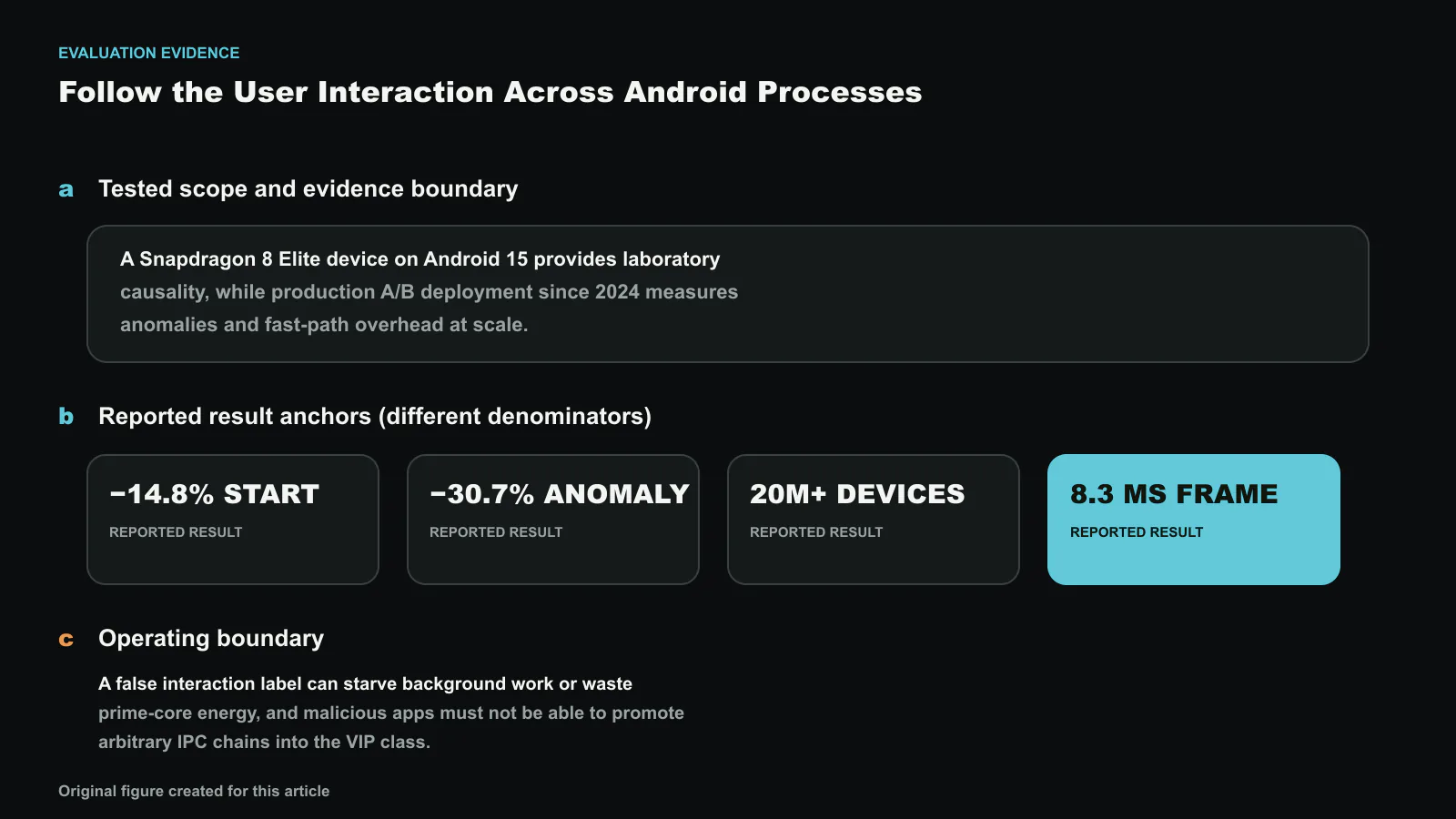
Cold-start time improves 14.8% in controlled tests and startup anomalies fall more than 30.7% across a deployment exceeding 20 million devices. These measurements establish feasibility for the reported environment. They do not erase topology, scale, implementation maturity, or workload distribution from the result, and the relevant purchasing or operating decision must preserve those conditions.
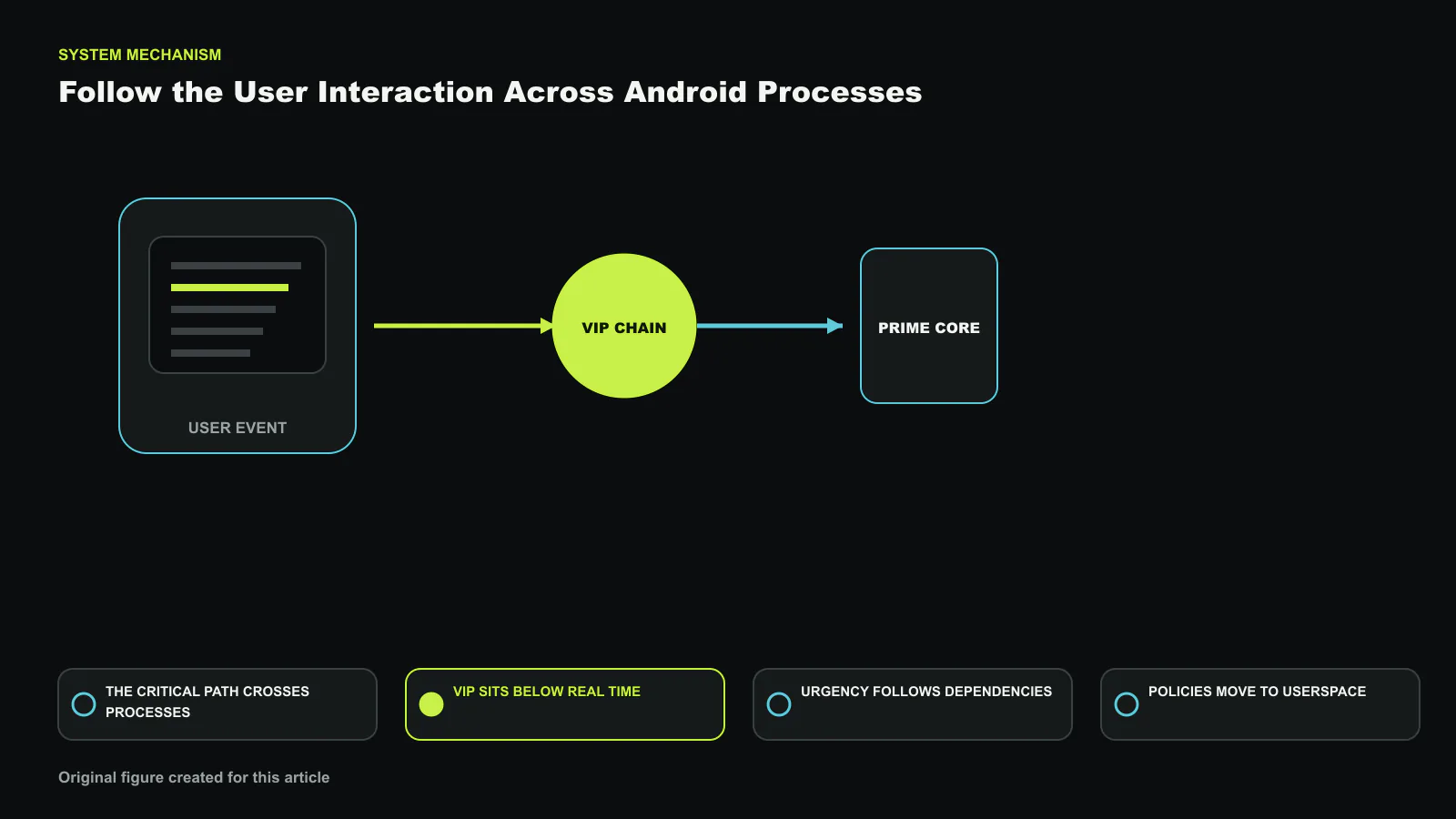
The critical path crosses processes
A touch can block through application, system server, binder IPC, and lock owners. Raising only the foreground thread leaves a low-priority dependency on the path.
The design significance is the boundary it chooses. MUSCHED traces interaction dependency chains, assigns critical threads to a VIP class, and loads policy modules from userspace through an eBPF-based interface. This keeps the optimization attached to the state that can justify it, rather than treating a local utilization number as the system objective. An operator should record the input state, the action taken, and the downstream service metric so the causal chain remains auditable.
VIP sits below real time
Interaction-critical tasks can preempt ordinary CFS work without receiving unrestricted real-time authority. The class preserves a stability ceiling.
This step also creates a control-plane obligation. The implementation must distinguish missing telemetry from a genuine zero, reject stale state, and remain idempotent when a retry follows a partial failure. Capacity reserved for the mechanism should be priced against use semantic scheduling when interaction dependencies can be identified safely and vip admission is bounded so background progress, thermals, and stability remain protected. because a faster internal stage is useful only when it advances the end-to-end objective.
Urgency follows dependencies
The framework identifies synchronous IPC and lock relationships and temporarily propagates interaction status to the serving threads.
The result depends on workload shape. A deployment with different locality, request size, hardware generation, or contention can cross a threshold where the same mechanism loses value. The safe interpretation is therefore conditional: preserve the evaluated configuration, expose the variables that change marginal benefit, and canary each policy before broad rollout.
Policies move to userspace
An eBPF-based plug-in path updates scheduling choices without recompiling the commercial kernel. Isolated execution supports staged A/B policy rollout.
The operational interface matters as much as the algorithm. Metrics need to identify the affected tenant or job without disclosing payloads, and rollback must restore a known state rather than merely disable future actions. This is how the mechanism becomes a service feature instead of a one-time benchmark optimization.
Reading the evaluation without flattening it
A Snapdragon 8 Elite device on Android 15 provides laboratory causality, while production A/B deployment since 2024 measures anomalies and fast-path overhead at scale. A headline ratio should be tied to its baseline, resource count, data set, and percentile. Average throughput cannot establish a tail-latency objective, and a latency improvement does not establish lower cost if it requires more replicas or accelerators. The result should therefore be stored with both the numerator and the resources held during measurement.
A second question is whether the comparison isolates the proposed mechanism. Production traces give realism but include changing traffic and hardware; controlled experiments improve attribution but can omit correlated failures and queue bursts. Together they support a deployment hypothesis, not a universal constant. Teams should reproduce the smallest decisive scenario on their own topology and then compare realized fleet behavior with the paper’s causal explanation.
Failure and trust boundary
A false interaction label can starve background work or waste prime-core energy, and malicious apps must not be able to promote arbitrary IPC chains into the VIP class. The fallback must be tested under partial failure, not only total disablement. Messages can be duplicated, workers can restart with stale metadata, and storage or network partitions can leave two controllers with different views. A safe design identifies the authority for each transition, fences an old owner, and makes reconciliation observable.
Security and privacy follow the control data. Profiles, prompts, object names, VM state, or telemetry can reveal tenant behavior even when application payloads are absent. Access should be scoped to the minimum fields needed by the mechanism, with retention and audit rules equal to those of the resource being controlled.
A deployment ledger turns a result into policy
For a canary, record build and hardware identity, workload class, offered load, allocation before and after, control-loop period, fallback count, failures, and the end-to-end service metric. Predeclare stop conditions for correctness, P99 latency, memory, power, and cost. A change that meets one target while violating another should roll back automatically.
Longer observation should separate one-time migration or construction cost from steady state. It should also measure unused preparation, prediction misses, operator interventions, and time to recovery. Those values determine whether the mechanism remains beneficial after the favorable benchmark window has passed.
Use semantic scheduling when interaction dependencies can be identified safely and VIP admission is bounded so background progress, thermals, and stability remain protected. That is the decision this research can support. It should not be converted into a mandate to copy the implementation without its measurement contract, safety boundary, and organizational owner.
From mechanism to an accountable service
The proposed path can enter production only when its decision state has a durable owner. In this case, the observable problem is one or two prime cores, cross-process synchronous dependencies, and 8.3 millisecond frame deadlines make fair thread scheduling conflict with mobile responsiveness. The controller responds through the following mechanism: MUSCHED traces interaction dependency chains, assigns critical threads to a VIP class, and loads policy modules from userspace through an eBPF-based interface. Those two statements should become separate service-level indicators. One indicator reports whether the triggering condition is present; another reports whether the action improved the end-to-end outcome. Combining them into one success counter would hide false positives, ineffective actions, and delayed harm.
The evidence contract also needs to preserve the paper’s evaluation boundary. A Snapdragon 8 Elite device on Android 15 provides laboratory causality, while production A/B deployment since 2024 measures anomalies and fast-path overhead at scale. Accordingly, a reproduction should retain the workload unit, arrival pattern, resource topology, software revision, and comparison policy. If one of those fields changes, the result belongs to a new cohort rather than the original benchmark. This treatment prevents a fleet-wide average from concealing a model, tenant, or hardware generation that has crossed the mechanism’s useful range.
An accountable rollout assigns authority for admission, actuation, and rollback to named components. Admission validates that the request satisfies the assumptions. Actuation records the exact resource and policy transition. Rollback fences stale work, restores the last valid state, and confirms that dependent systems have observed the reversal. The sequence must remain inspectable after a controller restart, because an optimization that cannot explain its most recent action is not safe enough to manage shared infrastructure.
Questions for the design review
The first review question is whether the reported metrics answer the business or service objective. The paper highlights −14.8% START, −30.7% ANOMALY, 20M+ DEVICES, 8.3 ms FRAME, but each value has a denominator and an operating point. Reviewers should ask which resource became available, which latency percentile moved, what quality guardrail stayed constant, and whether a second bottleneck absorbed the saved capacity. A favorable ratio can justify a canary; it cannot by itself justify a capacity-plan change.
The second question is how the mechanism behaves outside its preferred workload. A false interaction label can starve background work or waste prime-core energy, and malicious apps must not be able to promote arbitrary IPC chains into the VIP class. The design review should turn that limitation into a fault injection, a saturation test, and a stale-state test. It should also define a conservative mode that does not depend on prediction quality. If that mode consumes too much capacity or violates availability, the optimization has no credible safety net and should remain an experiment.
Lastly, ownership must survive the paper implementation. Use semantic scheduling when interaction dependencies can be identified safely and VIP admission is bounded so background progress, thermals, and stability remain protected. The production version therefore needs a documented configuration range, a versioned decision policy, dashboards for both benefit and harm, and an escalation path for tenants. A quarterly replay against current traces can detect drift before an outage or cost regression does. This operating discipline is the difference between reproducing a result and adopting a system.
Source and copyright notice
This article is an editorial analysis by Silicon & Systems. It restates the source’s mechanisms, measurements, and limitations in our own words. No source sentence, table, or figure is reproduced; the figure was created for this article. The paper is available from the official publication page. Copyright remains with the authors, 2026.