A topology diagram is not a deployable network. Every intended link must become two matching port configurations. Address blocks must be divided into device, loopback, interconnect and service prefixes. BGP peer groups, route filters and communities must reflect device roles without creating a path that violates policy. At hyperscale, this translation is too large and too repetitive to remain a manual document.
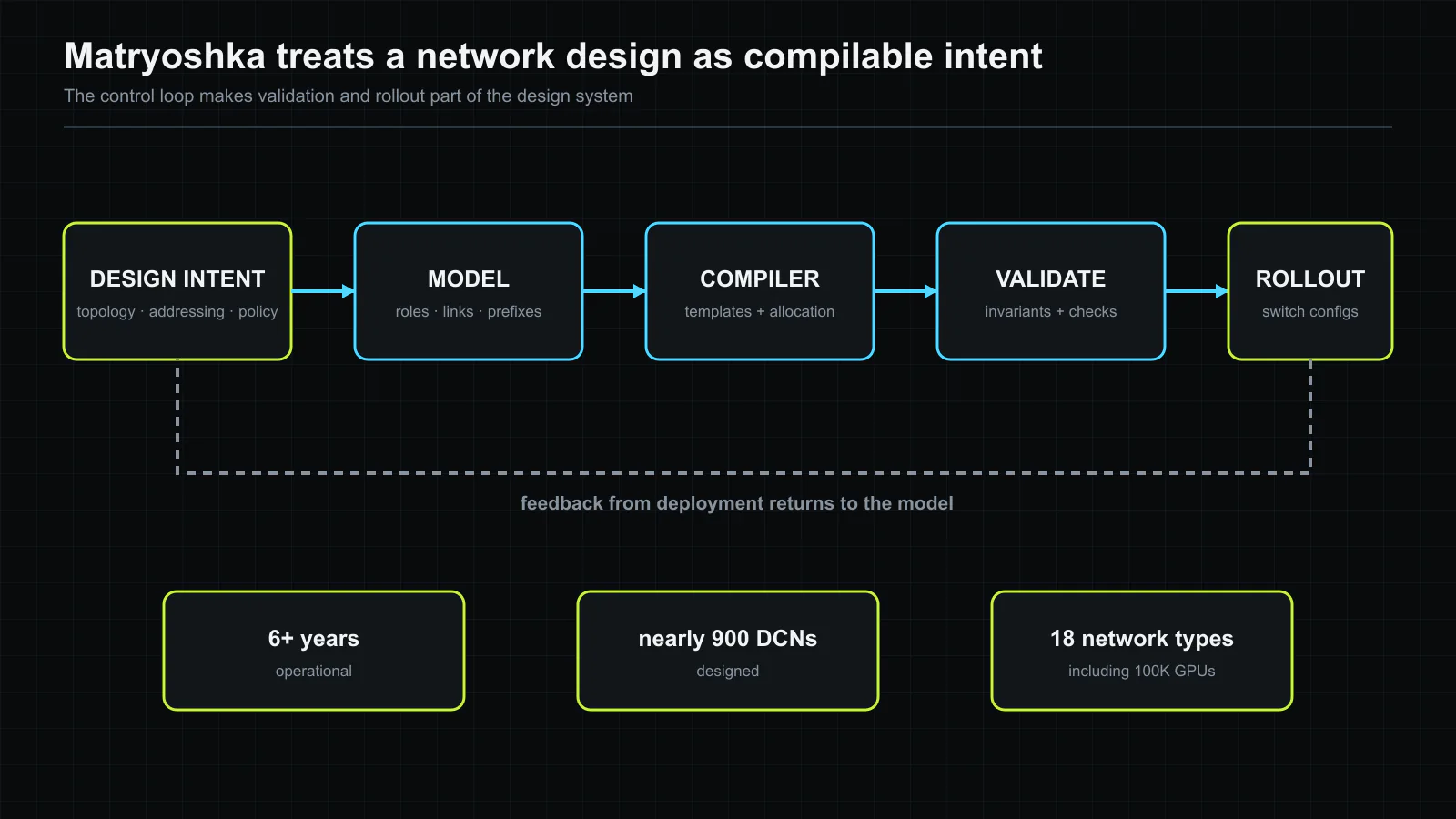
Meta’s Matryoshka treats the translation as compilation. A high-level model describes network roles, connectivity and policy. The system allocates concrete resources, renders switch configuration, checks invariants and controls rollout. Meta reports that Matryoshka has operated for more than six years, supported nearly 900 datacenter networks across 18 types and generated the design for its 100K-GPU AI supercluster[1].
The model is the source of truth
Matryoshka represents devices by role rather than enumerating each switch as a special case. Links connect compatible role ports, and templates translate role pairs into interface and BGP behavior. Prefix allocation follows categories, separating infrastructure addresses from load-bearing application ranges. Routing policy remains an explicit input, while the compiler applies it consistently to the members of a design.
This approach matters because AI networks change quickly. A new accelerator generation can alter server density, rail count and switch hierarchy. Editing thousands of configurations directly would mix the architectural change with its mechanical consequences. Updating the model lets Matryoshka regenerate those consequences and show which concrete outputs changed.
Validation belongs inside the compiler
Generation alone can reproduce a mistake at machine speed. Matryoshka therefore validates the model and output before deployment. The paper describes checks on connectivity, address allocation, configuration structure and rollout state. Staged deployment limits the failure domain and provides feedback before the same change reaches the rest of the fabric.
This is the network equivalent of a software build pipeline. The input is reviewable intent, the output is a deterministic artifact, and validation runs before release. The comparison is useful but incomplete: a switch configuration changes a physical forwarding system, and one incorrect route policy can affect many racks immediately. Thus, rollback, incremental rollout and observability are part of the compiler contract.
The 100K-GPU case changes the design cadence
Meta used Matryoshka while deploying a supercluster with more than 100,000 GPUs. The paper describes fast iteration on topology and configuration as the key benefit, rather than claiming that generated configuration increases link speed. At that scale, the time between an architectural decision and a safely running network is itself an infrastructure metric.
The reported history across nearly 900 networks is valuable because configuration systems often look clean in a single greenfield design. Eighteen network types imply that the model had to represent heterogeneous generations rather than one uniform fabric. Six years of use also means the system encountered migrations, partial deployments and operational exceptions.
The paper does not claim that intent removes expert judgment. Engineers still define topology, routing policy, capacity and rollout constraints. Matryoshka makes those decisions explicit and reproducible. A wrong intent can still generate many wrong configurations, so review quality and validation coverage become the new control points.
Configuration is part of fabric architecture
AI fabric discussions often separate hardware topology from operations. Matryoshka shows why the boundary is artificial. A topology that cannot be translated, validated and changed safely is not an operational architecture. Conversely, a model-driven pipeline makes more complex designs feasible because their repeated details no longer require repeated manual work.
The broader implication is that fabric scale depends on abstraction quality. Switch radix and optical reach determine what can be connected. The design system determines how quickly that possibility becomes a reliable network and how safely it can change afterward. For a 100K-GPU cluster, both are capacity planning.
A network design has several representations
Physical connectivity, logical addressing and routing policy answer different questions. The physical layer says which ports and fibers exist. The logical layer assigns subnets, loopbacks and roles. Policy expresses which routes may be exported, preferred or rejected. Operators often store these layers in separate tools, making the final device configuration an informal join performed by scripts and people.
Matryoshka treats the join as a compilation problem. A higher-level design model describes intent and the system lowers it into concrete switch configuration. The compiler must preserve relationships across layers: a link role constrains address assignment, an address family constrains policy, and the selected switch platform constrains syntax and feature support. Generating text that parses is the last step, not the definition of correctness.
The name reflects nesting. Reusable components describe smaller network structures, which combine into pods, clusters and datacenters. Parameterization lets one design family cover different sizes without copying every configuration. However, a parameter is safe only when its permitted range is explicit. A larger radix, different link speed or new switch family can invalidate assumptions hidden inside a previously valid template.
Intent needs types and invariants
An intent such as “provide redundant reachability” is too broad to compile directly. The system needs typed objects for devices, ports, links, prefixes, roles and policies, plus invariants that can be checked before deployment. Examples include unique address assignment, compatible endpoints, bounded route export and sufficient independent uplinks. These checks turn an architectural rule into a machine-verifiable condition.
Types also contain heterogeneity. Two switches may implement similar routing functions with different limits or syntax. The common model should express the required semantics, while a platform back end selects supported commands or rejects the design. Silently dropping an unsupported feature would create a configuration that looks complete but violates the original intent.
Validation must occur at multiple levels. Static checks catch malformed or contradictory inputs. Compilation checks ensure every intent maps to a target construct. Network-wide analysis can test reachability, isolation and path redundancy after all devices are combined. Finally, staged deployment observes actual hardware state. No one level replaces the others because a logically valid plan can still fail through cabling, firmware or inventory errors.
Configuration generation is also change management
A new datacenter can be compiled from a clean model, but a production network changes incrementally. Adding a fabric plane, replacing a switch or changing address allocation can produce transient states that are unsafe even when the final configuration is correct. The system needs an ordered plan that respects dependencies and limits the blast radius.
Small canaries provide evidence before wider rollout. Device and network telemetry should verify expected sessions, routes and reachability after each stage. If an invariant fails, rollback must account for state created by the partial deployment rather than simply restoring a text file. A configuration compiler that cannot manage transition states leaves the hardest operational step outside its model.
Six years of operation and nearly 900 datacenters across 18 types indicate that Matryoshka handles repeated evolution, not only first-time provisioning[1]. The 100,000-GPU cluster is a demanding instance because it combines large radix, several network tiers and rapid capacity change. Still, the paper does not claim that one template describes all 18 types. Reuse likely occurs through common components and validation logic with explicit variations.
The model becomes a governance boundary
Central intent improves consistency and also concentrates authority. An error in a shared component can affect many generated configurations. The repository therefore needs review, testing, ownership and versioning comparable to software that controls a production service. A change should identify which datacenters and device classes it can alter before it is merged.
Versioned inputs make results reproducible. Operators investigating an incident need to reconstruct the model, inventory, compiler and platform back end that produced a device’s configuration. If any dependency is mutable without history, the generated output cannot explain why a rule exists. Provenance is especially important when emergency manual changes are allowed.
Manual edits create configuration drift. They may be necessary during an incident, but the system must either import the change into intent or deliberately overwrite it after review. Treating the generated file as authoritative without detecting out-of-band state can erase a valid emergency fix. Treating the device as authoritative can allow inconsistent policy to persist. Matryoshka’s operational value depends on making this reconciliation explicit.
AI clusters raise the cost of one design error
An AI training fabric carries tightly synchronized jobs. A routing or cabling error that removes one rail can slow every rank even when general reachability remains. Consequently, validation must include capacity and symmetry properties, not only “can endpoint A reach endpoint B.” Equal-cost paths should exist where the collective plan expects them, and failure domains should match placement assumptions.
Address and policy scale also matter. Large clusters create many interfaces and route entries, while heterogeneity grows as generations of switches coexist. Compilation can consistently allocate this state, but hardware limits remain. The model needs resource accounting for table capacity, port breakout, queue configuration and supported telemetry. A design that is semantically correct but exceeds one platform’s table size is not deployable.
Rapid expansion makes inventory accuracy a first-class dependency. The compiler can validate the wrong topology perfectly if port identities or cable records are stale. Closed-loop checks should compare intended links with neighbor discovery and optical diagnostics. Differences must block or quarantine the affected stage before policy is rolled out across the fabric.
What can and cannot transfer to another operator
The general method transfers well: represent network intent in typed models, compile it through platform back ends, validate invariants and deploy in stages. The exact model does not. Meta’s device roles, topology families, addressing conventions and failure procedures reflect its fleet and organization. Another operator should reuse the discipline, not copy an internal schema it cannot sustain.
Adoption cost is substantial because the compiler needs authoritative inventory and integration with configuration, verification and deployment systems. A partial implementation that generates templates but leaves manual exceptions untracked may add another source of truth rather than remove one. The business case is strongest where network families repeat enough for validation and reuse to repay the platform work.
Matryoshka’s key result is organizational as much as technical. It makes the translation from architecture to switch state a reviewed, testable artifact and has applied that method over six years. The 100,000-GPU design demonstrates the upper scale of the approach, while the 18 network types demonstrate that controlled variation matters. For AI infrastructure, the compiler is part of the fabric because it determines whether the intended topology actually exists.
Source and copyright notice
This article is an independent editorial summary of the open-access NSDI 2026 paper and official USENIX presentation page. We restated the architecture, deployment history and limitations in our own words. No source text, table or figure is reproduced. The explanatory figure was created specifically for this article. USENIX states that authors retain copyright to NSDI works; the paper is (c) its authors 2026.