Replacing a GPU can leave a training program functionally intact while changing the cost of almost every important decision inside it. Threads still execute, tensors still arrive, and a loss value still appears. However, an embedding update that relied on inexpensive atomics can become a bottleneck, while additional memory can remove work that the previous device had to repeat. A useful migration must identify both effects before deciding which models belong on the new hardware.
Meta and AMD investigate this problem through production recommendation training on MI350X. Across ten models, their reported geometric-mean throughput reaches 101.2% of a B200 baseline at matched batch sizes and GPU counts. Individual ratios range from about 82% to 130%, so the average describes a portfolio with materially different outcomes. The paper’s separate maximum improvement of 1.5× compares an optimized model with its initially ported version, not with B200.[1]
Those distinctions determine what a reader can conclude. The study supports the feasibility of an alternative training platform after substantial engineering. It does not establish that every workload transfers at parity, that the systems consume equal power, or that a compiler can erase architectural differences. We examine the decisions that turn compatibility into sustained performance, including the cases where the new platform remains slower.
The comparison begins at the deployed system
Meta evaluates an air-cooled configuration with MI350X limited to 1,000 W and B200 to 750 W. The devices provide 288 GB and 180 GB of HBM, respectively, in the configurations described. Equal GPU count therefore does not mean equal memory capacity or power. The paper explicitly acknowledges B200’s performance-per-watt advantage; its throughput comparison answers a deployment question rather than an efficiency question under identical electrical limits.[1]
The evaluated jobs use 8–128 GPUs. Meta also describes a much larger installed MI350X population, but fleet size and the scale of an individual benchmark are different quantities. Similarly, recommendation training provides the main evidence. The authors mention large LLM training deployments while reserving a detailed LLM analysis for later work. A result for irregular embedding and recommendation workloads should not become an unsupported claim about all frontier-model training.
The baseline is a mature software platform, which makes parity meaningful. It also makes the migration effort inseparable from the result. Several layers change before the final comparison: library dispatch, collective communication, custom kernels, compiler heuristics, and training configuration. An organization evaluating the same GPU needs to determine which changes are already available in its software releases and which still require integration into its own models.
Source translation leaves execution assumptions behind
CUDA-to-HIP translation addresses the ability to build and execute code. It cannot, by itself, choose the best work decomposition for a different device. NVIDIA’s 32-thread warp and AMD’s 64-thread wavefront are one example: a mapping designed around short rows can leave lanes idle after translation, even though every output remains correct. Increasing concurrency can help one kernel while increasing registers or local-memory pressure in another.
Recommendation models make this problem visible because their operators are heterogeneous. Sparse embedding access, dense matrix multiplication, attention over variable-length histories, and gradient updates stress different resources. Forward gathers can be limited by data movement; backward updates can serialize on repeated addresses. Classifying both as an embedding operation hides the reason one transfers well and the other does not.
The appropriate unit of migration is therefore an operation under a distribution of shapes, data types, and access patterns. A successful benchmark on a dense matrix does not validate an irregular gather. Nor does a faster forward pass guarantee that the backward path benefits from the same instruction configuration. The paper reports a matrix-instruction tuning choice that helps forward execution but regresses backward execution, illustrating why each transformation needs an explicit scope.[1]
Chiplet locality changes which work should meet
MI350X contains eight compute dies, or XCDs. AMD specifies 32 active compute units per XCD and 4 MB of L2 shared by the units inside that XCD, with a separate device-wide Infinity Cache. This distinction matters: neighboring tiles can reuse data efficiently only when scheduling places their work in a useful cache domain.[2] A sentence in the manuscript’s attention discussion is inconsistent about the L2 sharing scope; we use AMD’s explicit hierarchy and the paper’s own earlier per-XCD description.
The first opportunity is to place related matrix tiles together. A default linear assignment of work identifiers can spread tiles across compute dies and reduce reuse. Remapping those identifiers changes where nearby outputs are computed, allowing shared input regions to remain useful in the local cache. This is a scheduling transformation rather than a change to the matrix operation’s mathematical result.
The second opportunity concerns contention. When many threads update one counter, the logical operation is small but coordination can dominate. Combining partial values locally and issuing fewer global atomic updates reduces that shared bottleneck. For updates to multiple addresses, a small register cache can merge repeated contributions before they reach global memory. These mechanisms exploit different patterns and should not be treated as interchangeable fixes.
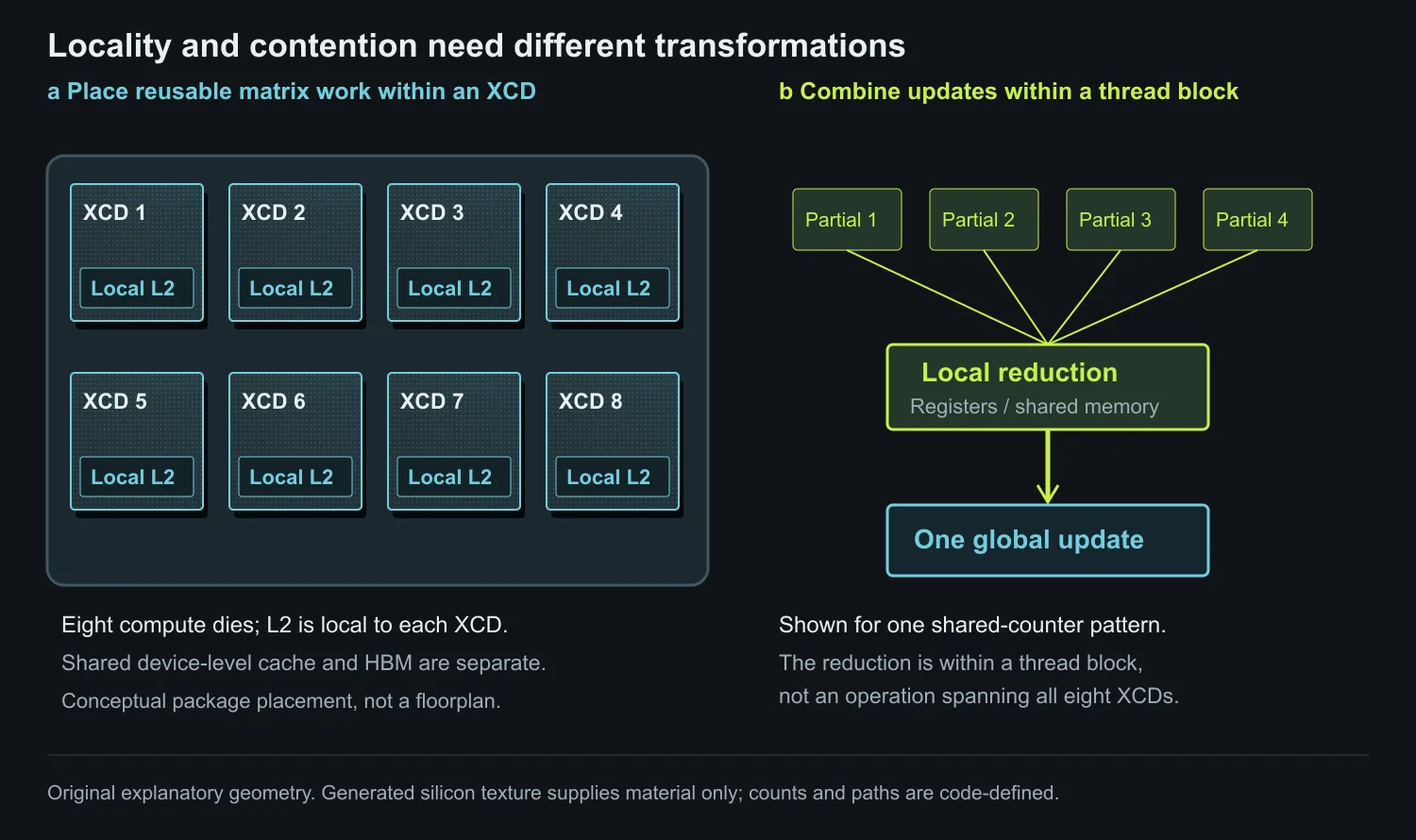
The bounds-check case provides a concrete limit to the improvement. For 30 embedding tables and 13.8 million indices, a 10% violation test falls from approximately 9.0 ms to 2.1 ms after local reduction. That high violation rate stresses the counter; it is not an assertion that ordinary production inputs are routinely invalid. With little contention, local aggregation introduces overhead without removing much coordination. The correct adoption criterion is the observed access pattern, not the largest reported speedup.[1]
Choosing a kernel without measuring every possibility
Many production matrix shapes make exhaustive offline tuning expensive to maintain. Origami estimates the cost of candidate tile arrangements from their computation, memory traffic, and scheduling behavior. It considers where data can be reused, which memory level limits progress, and whether the final group of work leaves compute units idle. The resulting selection can happen quickly when a shape reaches the runtime.[1]
A useful feature is the inclusion of memory-issue limits. Bandwidth is not the only constraint on data movement: enough lanes must issue requests to approach that bandwidth. Larger tiles improve reuse but can reduce parallelism, while smaller tiles create more concurrent work at the cost of additional traffic. A model that considered only HBM capacity or peak bandwidth could choose the wrong side of this trade-off.
The reported 93% average selection efficiency is relative to exhaustive tuning on the evaluated shapes and configurations. It is not a statement that all latency predictions are 93% accurate, nor that the selected kernel is optimal for every future operator. Analytical selection works particularly well when tiling and access are regular enough to model. New hardware still requires calibrated constants, and irregular behavior still needs measurements.
For an operator team, this suggests a division of responsibilities. Use the model to avoid expensive repeated searches over familiar structure, then retain targeted benchmarking for new shapes and cases that violate its assumptions. Performance regressions become evidence about model coverage rather than a reason to abandon measurement. Maintaining those boundaries is part of keeping the fast selection path useful after compiler and hardware updates.
More HBM creates a choice, not a free multiplier
Additional memory can improve training even when it does not make an individual instruction faster. A larger local batch can amortize overhead and improve utilization. Retaining activations can avoid recomputation during backward execution. Keeping embeddings in HBM can remove host transfers, while less aggressive sharding can reduce communication. The same capacity can instead support longer histories or a larger model for a quality objective.[1]
These uses compete for bytes. A model that spends the extra capacity on a larger batch cannot assume that all of it remains available for embeddings and retained activations. The proposed configuration must account for parameters, gradients, optimizer state, activations, temporary buffers, and communication allocations together. A memory estimate taken from one isolated operator will miss the overlaps that determine whether a complete step fits.
The paper separates a matched-batch hardware comparison from examples that redesign the training recipe. That separation should survive procurement analysis. Keeping batch size fixed makes kernel shapes comparable; changing it can reveal useful system capacity, but may also change optimization behavior and convergence. Examples per second alone cannot establish the time required to reach a specified quality target when the recipe changes.
The feed-ranking case reaches 1.26× after a combination of batch, activation, and placement changes, and 1.5× when kernel work is included. These are nested results from the reported optimization process. Adding their percentage gains or multiplying them as independent improvements would double-count contributions. The practical conclusion is that memory allocation and software tuning interact, so they must be assessed in one complete job.[1]
Communication must leave room for computation
A collective can become faster in isolation while harming a training step if it occupies resources needed by concurrent computation. Meta’s RCCL work addresses transport behavior, packet organization, routing, and GPU occupancy together. The number of queue pairs is chosen by collective type rather than applied as one universal setting. A packet format aligned to the relevant cache-line operation addresses a different problem from batching peer transfers.[1]
The paper also changes how communication work consumes compute units and registers. Such choices influence whether network progress can overlap with dense computation without causing excessive contention. Consequently, peak collective bandwidth is an incomplete objective. The relevant quantity is communication that remains exposed on the step’s critical path after overlap, together with the effect on work executing beside it.
This explains an important limitation in the trace breakdown. Summing all kernel durations counts concurrent work more than once. A communication category can appear expensive in a trace while contributing little exposed delay because another stream hides it. Conversely, a seemingly small operation can delay every participant at a synchronization point. The study explicitly cautions that category totals do not directly reconstruct end-to-end throughput.
The average leaves a deployment portfolio to choose
The ten-model comparison contains both wins and losses. GEMM remains a weakness in several cases, including TF32 execution that MI350X implements through multiple BF16 operations. Irregular matrix shapes also expose differences in library maturity. Model A reaches about 82% of B200 throughput, while other models benefit from embeddings, handwritten attention kernels, or communication behavior.[1]
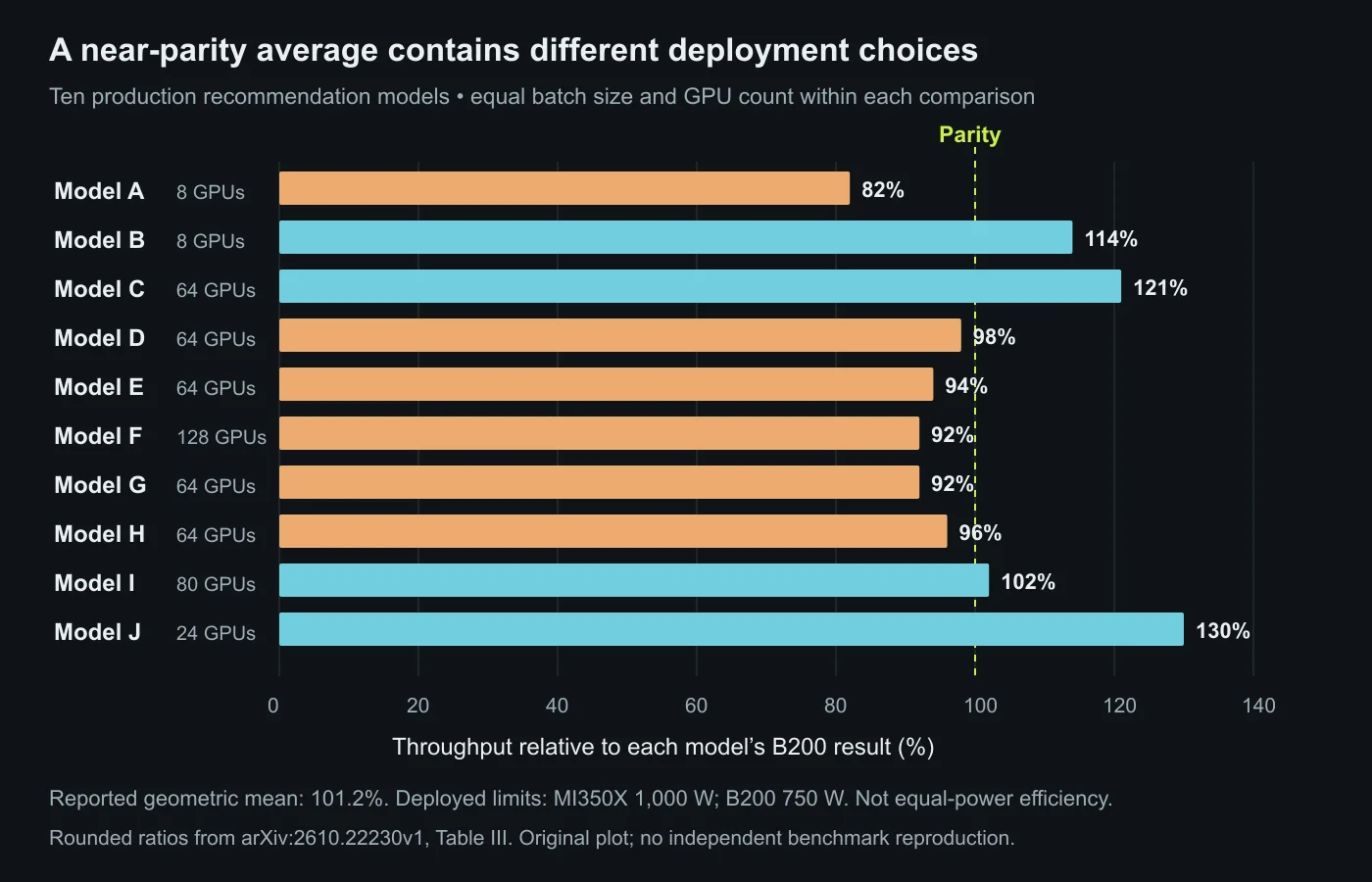
A portfolio average is useful for planning only if its workload mix resembles the jobs that will actually be assigned. A service dominated by the unfavorable model can lose capacity even when the published geometric mean exceeds parity. A scheduler that assigns suitable models to each platform can reach a different outcome from a policy that requires every job to run equally well everywhere.
That distinction creates two reasonable deployment objectives. One is broad interchangeability, which requires stronger coverage of the slow cases and stable support across the model population. The other is selective placement, which values a second vendor for the subset where it offers useful cost, availability, or memory capacity. The paper supplies evidence for engineering those choices; it does not remove the need to define which objective matters locally.
Correctness and power remain operating responsibilities
Agentic kernel optimization extends expert work by encoding transformations with triggering conditions and numerical checks. This study uses KernelEvolve infrastructure for AMD-specific skills; our existing KernelEvolve review covers the broader search system. Here the important question is whether an accepted transformation remains valid for the model’s actual shapes, tolerances, and execution environment. A faster approximation or reordered reduction requires more than successful compilation.
Fleet correctness adds another layer. Meta describes checksums and replay, comparisons among devices, quarantine, and qualification tests for silent corruption. The reported failure-rate improvement is relative to a prior peak, without enough absolute availability data to derive an external service guarantee. These controls are evidence of production work, and their existence also shows why a throughput result alone cannot qualify a new accelerator fleet.[1]
Power excursions are similarly conditional. A brief compute phase can exploit provisioned electrical and thermal headroom between lower-power phases. The paper reports up to 1.33× in a controlled microbenchmark but 3–6% in complete production training. The platform’s provisioned margin and controller behavior are part of the mechanism. Applying the largest microbenchmark result to sustained dense computation would ignore both the time window and the surrounding workload.
The final decision should therefore use the organization’s own accepted training jobs. Record the model and quality target, input distribution, batch and sharding recipe, software versions, power configuration, and failure behavior. Compare both fixed-recipe execution and justified recipe changes, then account for engineering and operational costs. Meta’s study demonstrates that a second GPU platform can become productive through this work. Its more transferable lesson is how to identify the work that the hardware specification leaves unfinished.
Source and copyright notice
This independent editorial review uses the authors’ October 15, 2026 arXiv v1 manuscript, associated with MICRO 2026 Industry Track, and AMD’s product brief for cache-hierarchy clarification. The manuscript is © the authors 2026 and distributed under CC BY 4.0. The source DOI identifies the reviewed report. We use original prose and newly constructed figures; no source table layout, code, or manuscript figure is reproduced. System-adoption recommendations are our analysis, not additional experiments performed by the authors. No final publisher-version review is claimed.