Meta describes more than 1,500 recommendation models running across NVIDIA GPUs, AMD GPUs, and proprietary MTIA accelerators. A missing or slow kernel can force an operator back to CPUs, add network crossings, or block a model launch. KernelEvolve treats that combinatorial maintenance problem as a measured search rather than a one-shot code-generation prompt[1].
Generate, execute, select, remember
The system represents optimization as a graph of candidate states. Agents retrieve documentation and production code, generate Triton, CuTe DSL, or lower-level implementations, compile and run them, check correctness, measure fitness, and expand promising branches. A persistent knowledge base carries hardware rules that a general model could not have learned, including proprietary accelerator constraints.
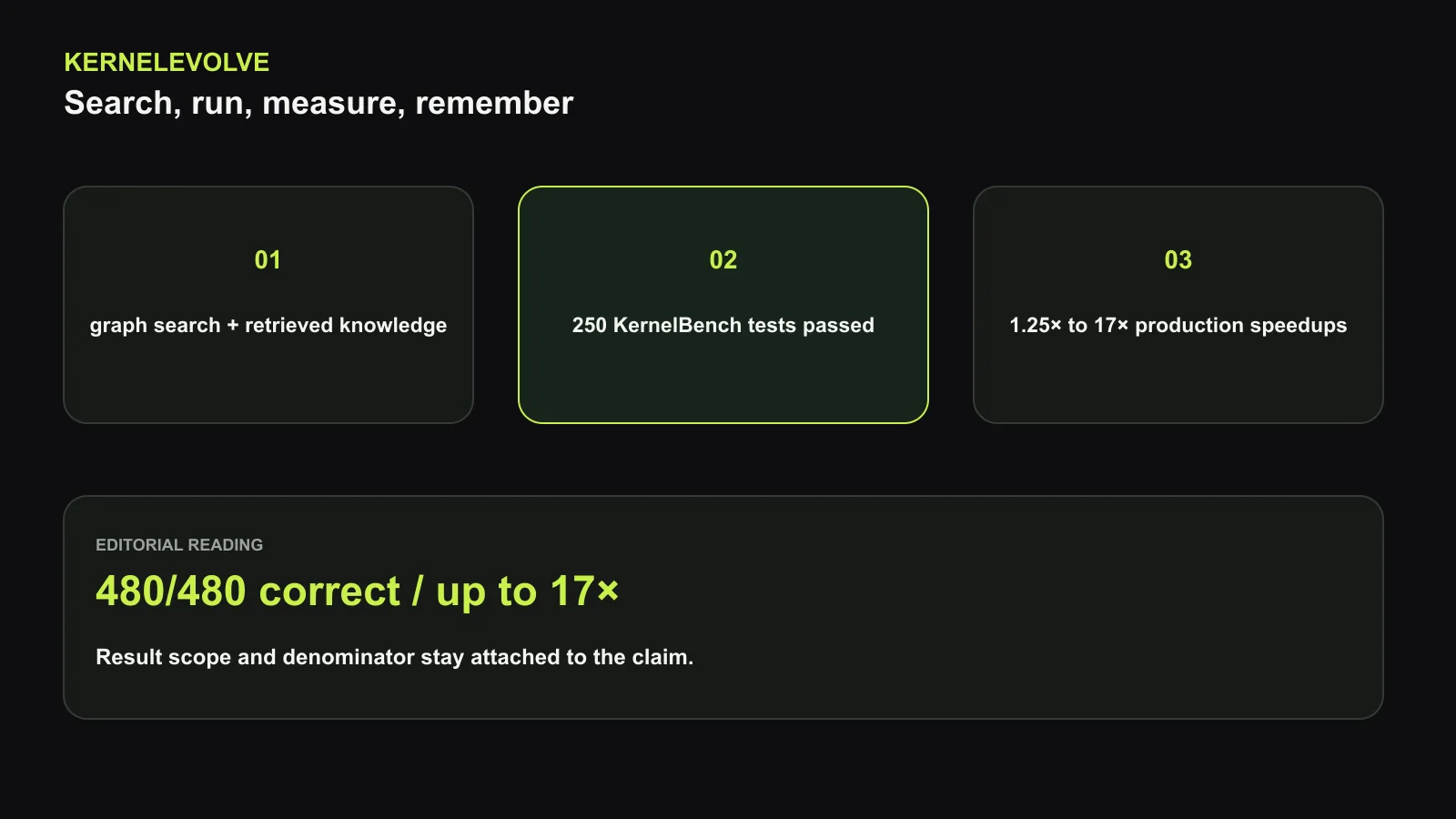
KernelEvolve passed all 250 KernelBench problems and all 480 combinations of 160 ATen operators across three platforms. Reported production speedups range from 1.25× to 17× over PyTorch baselines, while development cycles fall from weeks to hours. The paper also reports shape-specific regressions, which is why candidate acceptance uses production distributions rather than one benchmark input.
Kernel coverage is a Cartesian-product problem
An operator name does not identify one implementation problem. Input shape, layout, data type, sparsity, fusion boundary, accuracy tolerance, accelerator generation, compiler version, and surrounding graph can each change the best kernel. Meta’s deployment also spans NVIDIA GPUs, AMD GPUs, and MTIA, with programming options ranging from portable PyTorch decompositions to Triton, CuTe DSL, and lower-level device code. Multiplying these axes turns a list of operators into thousands of performance regions.[1]
Expert teams usually prioritize the most expensive combinations and leave a generic fallback for the rest. That policy is rational until an uncovered shape appears in a high-volume model or a new chip changes the ranking. A fallback may cross the CPU boundary, launch several small kernels, or move tensors through a less efficient layout. The resulting cost can be larger than the isolated operator time because graph fusion, memory residency, and network placement change with it.
KernelEvolve treats each optimization target as a distribution rather than a single contest input. Production traces define the shapes and weights that matter. A candidate that wins one large matrix but loses frequent small cases should not replace the incumbent. This is the first safeguard against optimizing a benchmark while regressing the fleet.
Search state is more useful than a long prompt
The system organizes candidates as a graph. A node contains an implementation and its measured state; edges represent transformations, repairs, or alternative strategies. Agents can expand several promising branches instead of repeatedly editing one program in place. This structure preserves diversity: a locally worse candidate may expose a layout or synchronization idea that becomes useful after another change.
Generation is grounded in retrieved documentation, existing production kernels, compiler constraints, and accelerator-specific notes. The model is not expected to remember proprietary instructions or the current compiler behavior. Retrieval also lets the organization update one rule when a platform changes rather than relying on knowledge frozen into model weights. The persistent store records successful and failed approaches, so a later campaign can avoid rediscovering the same invalid optimization.
Search still requires a budget. Compiling and benchmarking thousands of kernels consumes accelerator time and can overload shared test infrastructure. The controller must decide when improvement has saturated, which branches deserve more trials, and whether a promising result is robust enough to evaluate on additional shapes. Thus, the optimization objective includes experiment cost and confidence, not only the fastest observed execution.
Correctness is a sequence of gates
Generated device code is unsafe until it survives execution. A kernel can produce the right value for a convenient shape while reading beyond bounds, racing on another tile size, overflowing an accumulator, or violating an alignment assumption. KernelEvolve places compilation, execution, numerical comparison, and performance measurement in the loop so invalid programs do not become parents solely because their source looks plausible.
One oracle is not enough. Exact operations can require bitwise agreement, while reduced-precision math may need absolute and relative tolerances tied to the production contract. Tests need empty dimensions, tails that do not fill a tile, noncontiguous layouts, extreme values, aliasing cases, and the actual distribution of sizes. Repeated execution can expose nondeterministic races that a single comparison misses. Memory checkers and compiler diagnostics add evidence but do not replace output validation.
The 250 KernelBench successes and 480 correct operator-platform pairs demonstrate broad coverage under the reported harness. They do not prove correctness for every shape, driver, or future compiler. Deployment must preserve the tested preconditions and rerun the gates when code generation, toolchains, or hardware revisions change.
Performance measurement needs production context
Microbenchmarks are vulnerable to warm caches, clock boost, asynchronous launch timing, and measurement noise. A candidate should run enough warm-up and repeated trials, synchronize at the correct boundary, and compare against the same software and power state as the baseline. Very short kernels may be dominated by launch overhead, while a fused candidate can shift work from one measured operator into another.
End-to-end validation is therefore necessary after isolated improvement. A faster kernel may increase temporary memory, reduce overlap with communication, prevent graph fusion, or monopolize a resource used by a concurrent stream. Shape-specific regressions reported by the paper are evidence that these interactions are real. Weighting latency by observed production frequency is more informative than taking either the maximum speedup or the unweighted average.
The 1.25× to 17× range should be read as a portfolio. Large values often indicate an especially weak fallback or a newly covered accelerator path, not a 17× acceleration of the entire model. The system-level gain is bounded by the fraction of execution time that the operator previously consumed. Capacity planning should use end-to-end model throughput and tail latency after the replacement.
Persistent knowledge is the cross-generation asset
A kernel campaign produces more than winning code. It learns which tile sizes fit a memory hierarchy, which synchronization constructs compile efficiently, which data types trigger conversion overhead, and which shapes expose a compiler defect. Encoding these findings as searchable, versioned knowledge lets future agents begin from tested constraints instead of generic accelerator advice.
Provenance is essential. Each note should identify the device, driver, compiler, library, and benchmark range for which it was observed. A rule such as “larger tiles are faster” can reverse when register allocation spills on a new chip. Expired knowledge must be downgraded or revalidated rather than silently guiding new candidates. Proprietary accelerator details also require access control because retrieval inputs can contain confidential architecture and product information.
Failures belong in the knowledge base as well. Recording that a transformation produced rare numerical error or a regression for one layout prevents repeated unsafe proposals. Negative evidence is especially valuable when several agents work independently; without shared memory, parallel search can spend most of its budget rediscovering the same dead ends.
Portability means shared process, not shared code
The three evaluated platforms do not execute one universal kernel language. Triton can cover many GPU patterns, CuTe exposes different primitives, and MTIA requires internal knowledge unavailable in public model training. KernelEvolve’s portability comes from a common search-and-validation workflow whose generators and constraints change per target.
This distinction protects performance. Forcing every accelerator through the same abstraction can hide memory engines, tensor instructions, or synchronization behavior that makes a device valuable. Conversely, writing an unrelated optimization system for each chip duplicates orchestration, testing, experiment tracking, and rollout logic. A shared control plane with platform-specific back ends keeps the expensive safety process common while allowing native code paths.
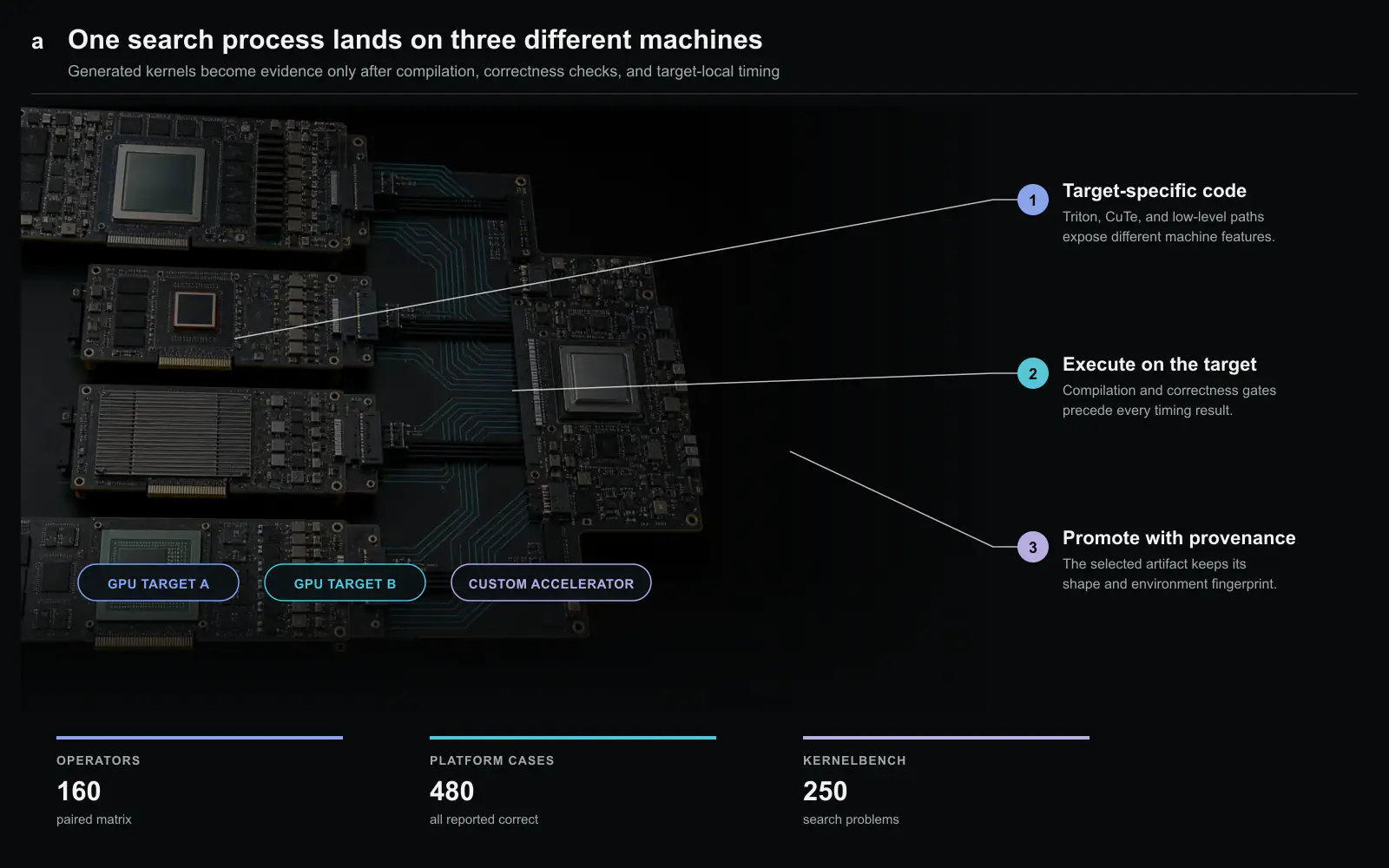
Cross-platform comparison also needs a stable workload contract. Passing the same operator name is insufficient if layouts, precision, or fusion differ. The reported 160-operator matrix demonstrates that the system can execute a broad paired evaluation; purchasers should still compare end-to-end models, power boundaries, and quality requirements before ranking accelerators.
Deployment needs a reversible promotion path
An accepted candidate should first enter a registry with its supported shapes and environment fingerprint. Shadow execution or sampled duplicate computation can compare outputs without serving the generated result. A canary population then exposes real concurrency, thermal, and input variation. Only after these stages should the kernel become the default, and the previous implementation must remain available for rapid rollback.
Monitoring should include correctness alarms, latency distributions, compilation failures, memory use, and the fraction of calls that fall outside the optimized region. A new model may shift shapes and route most traffic back to the generic path even though the optimized kernel remains fast. The registry must therefore treat coverage as a live metric.
Security matters because generated kernels run with direct access to accelerator memory. Sandboxed compilation, signed artifacts, restricted tool access, dependency scanning, and review of source provenance reduce the chance that retrieved code or a malformed candidate reaches production. Correct numerical output on test vectors does not prove absence of out-of-bounds access or data leakage.
The remaining bottleneck is specification
KernelEvolve can search only over an objective and a correctness contract that humans define. If tolerances are too loose, it can select numerically unacceptable code; if benchmark shapes omit a production tail, it can optimize the wrong region. Conflicting goals such as latency, throughput, power, memory, and determinism need explicit weights or separate Pareto candidates.
Some operators also have little optimization freedom, and search may cost more than expert implementation. Others depend on undocumented hardware behavior that changes across firmware. The system should be able to stop with “no safe improvement” rather than rewarding any positive noise. Human experts remain responsible for new algorithms, test-oracle design, deployment scope, and exceptions whose consequences cross the operator boundary.
The organizational decision is therefore whether to build a measured kernel factory, not whether to let a model write code. The factory needs curated knowledge, execution capacity, rigorous oracles, artifact governance, and production feedback. KernelEvolve shows that once these components exist, generation can scale expert attention across a much larger operator and hardware surface.
A fair comparison separates automation from search budget
Development time falling from weeks to hours combines several effects: code generation, automated compilation, parallel experiments, a prepared test harness, and access to accumulated implementation knowledge. An expert comparison should receive the same correctness suite, hardware time, documentation, and baseline code. Otherwise, the result measures an integrated platform against an unaided individual rather than isolating which component improved productivity.
Search budget also affects the winning kernel. More candidates increase the chance of finding a fast outlier and of overfitting noise. Reports should include candidates attempted, device-hours consumed, failed compilations, correctness rejections, and repeated-measurement confidence. A 5% gain found after thousands of trials may be uneconomic for a low-volume operator, while the same campaign is justified for a kernel consuming millions of accelerator-hours.
The strongest operational metric is amortization. Add the engineering and search cost, divide it by the accelerator time saved over the kernel’s expected lifetime, and include the probability that a model or compiler change invalidates it. Persistent knowledge improves that equation because later campaigns reuse validated constraints. This makes the system valuable even when one particular search finds no faster code.
Compiler interaction can create false victories
Generated source is not the executed kernel. Compiler passes choose instruction sequences, allocate registers, schedule memory operations, and may change across versions. A candidate can appear faster because it triggers an accidental optimization or because the baseline missed a newly available pass. The artifact registry should store generated source, compiler intermediate representation when practical, final binary, toolchain hash, and device target.
This record enables two important tests. Recompile both baseline and candidate with the new toolchain to determine whether the advantage remains, and run the old binary where compatibility permits to separate compiler drift from hardware drift. It also helps experts promote a broadly useful transformation into the compiler or library, where many kernels can benefit without repeating search.
Long-term success is therefore measured by how often local discoveries become stable platform knowledge. A generated kernel is one deliverable; a repaired compiler rule, stronger test oracle, or reusable tiling constraint can be more valuable because it shrinks the next search space.
The platform should publish its rejection funnel internally. Teams need to know whether candidates fail because generation produces invalid syntax, the compiler lacks an optimization, numerical tests are underspecified, or performance has no headroom. Each category suggests a different investment. Better prompting will not repair a compiler backend, and more search will not fix a missing correctness oracle.
This funnel also guards against selection bias. Reporting only successful kernels makes automation appear universally effective and hides the operators for which experts still outperform it. Coverage, experiment cost, and no-improvement outcomes should be tracked beside speedups so roadmap decisions reflect the whole portfolio.
The same record shows whether later toolchain improvements expand the addressable set or merely accelerate cases that were already easy.
What we take from it
Agentic coding becomes infrastructure only after execution closes the loop. Retrieval supplies private hardware knowledge, tests reject incorrect code, performance measurements replace stylistic preference, and persistent state survives long campaigns. The headline speedups are workload-specific; the more important result is an operational process that can maintain coverage across changing chips without trusting generated code before it runs.
Acceptance, not generation, decides whether search pays
KernelEvolve can produce many candidates, but production value begins only after one candidate survives an acceptance pipeline. That pipeline needs numerical checks across representative shapes and dtypes, compile and runtime stability tests, memory-safety checks, performance variance across repeated runs, and a rollback path tied to the model and compiler versions. A kernel that wins one benchmark while failing a rare shape or changing accumulation error is not an optimization that a fleet can safely deploy.
Search cost should be charged to the accepted artifact. Operators should report accelerator-hours spent generating, compiling, testing, and rejecting candidates, then amortize that cost across the calls served by the promoted kernel. This changes the comparison between agentic search and expert tuning. A frequently used stable operator can justify a large search, while a rapidly changing model or low-volume operator may not. The durable procurement metric is verified performance gain per search dollar under the organization’s own release cadence.
Source and attribution
This digest uses original wording and two new deterministic figures. It reproduces no paper prose, code, figure, or table. Meta provides the full technical report publicly; the ISCA proceedings version is © IEEE 2026.