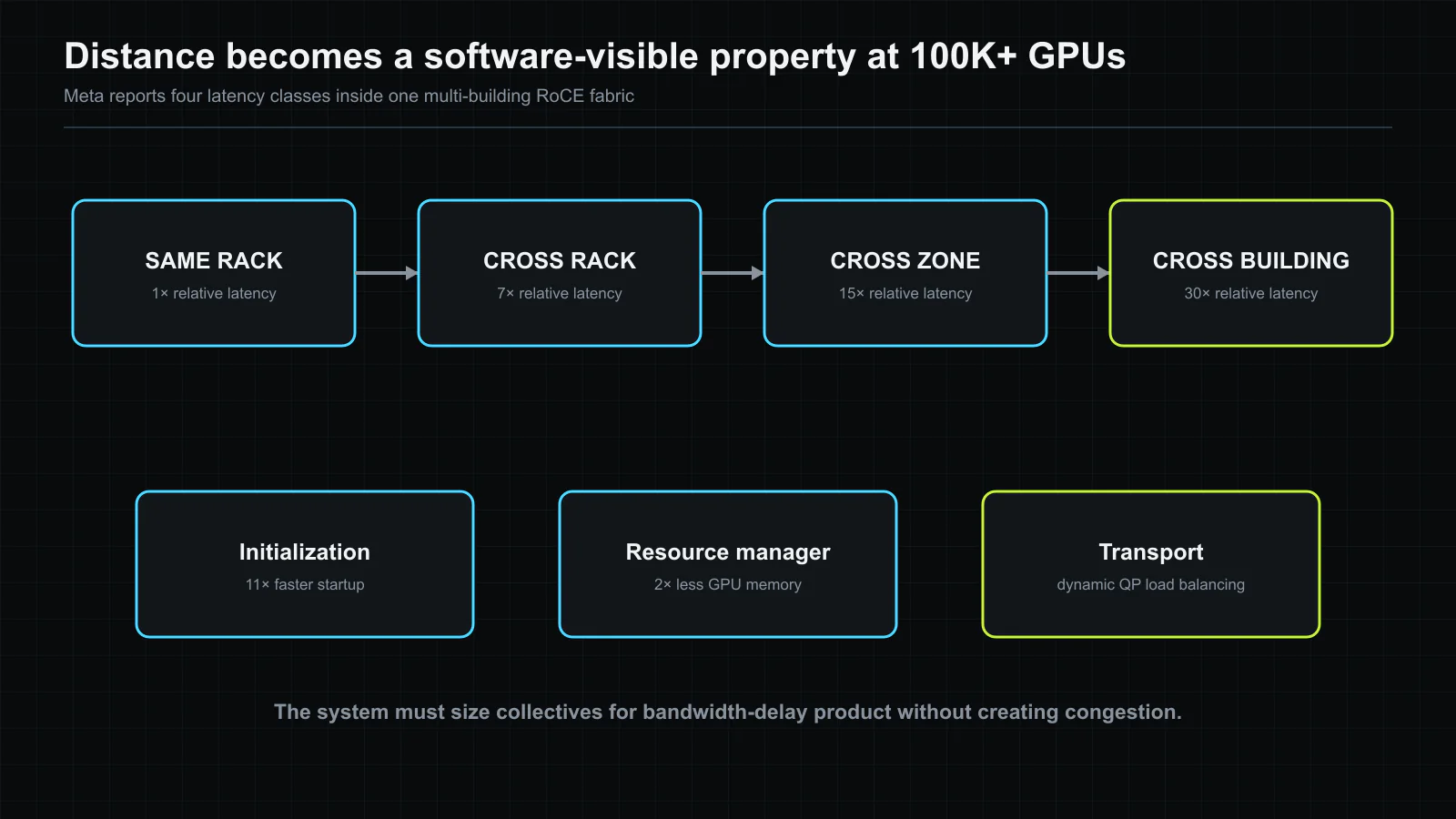
A 100K-GPU cluster is not one large rack. Meta’s production RoCE fabric spans multiple AI zones and datacenter buildings, creating four communication distances inside the same job. Relative to GPUs in one rack, the paper reports roughly 7× latency across racks, 15× across AI zones and 30× across buildings[1][2]. The communication library must therefore understand physical distance while exposing one collective interface to the model.
This scale also changes what counts as overhead. Creating process groups, discovering topology and reserving communication buffers may look negligible on tens of nodes. Repeating those operations across more than 100,000 GPUs can delay startup and consume enough memory to reduce the model’s usable capacity. Meta’s SIGCOMM 2026 paper presents NCCLX as a stack designed around those non-payload costs.
The lesson for operators planning beyond rack scale is that initialization state, buffer reservations, and topology knowledge become capacity variables, not setup details. This review follows how NCCLX changes each mechanism and keeps Meta’s production measurements separate from choices that another cluster would have to revalidate against its own distance classes and traffic mix.
The bandwidth-delay product changes with every boundary
Collective operations need enough outstanding data to fill the path. A message sized for a rack may underfill a cross-building connection, while sending too much can amplify congestion when multiple jobs share the fabric. Mixture-of-Experts models add bursty all-to-all traffic, so a static route or queue-pair choice can create short-lived hotspots even when aggregate capacity is available.
Meta addresses this with a custom transport layer and dynamic queue-pair load balancing. Multiple virtual paths are observed and work is shifted toward healthy ones instead of binding an entire transfer to one unlucky path. The objective is not only average throughput. At training scale, one slow rank determines collective completion, so the tail path determines GPU utilization.
Startup becomes a distributed-systems problem
The paper reports an 11× reduction in startup time from two changes: eager process-group creation and O(N) topology discovery[1]. Eager creation sounds counterintuitive because it does work earlier. However, it replaces repeated, poorly coordinated setup during execution with one planned initialization phase. Linear topology discovery avoids pairwise behavior that grows too quickly at cluster scale.
Resource management follows the opposite timing rule. Communication state that is not immediately needed should not occupy GPU memory. NCCLX allocates selected resources on demand and reports a 2× reduction in GPU memory consumption[1]. The two choices are consistent: create global structure early when coordination is expensive, but delay per-operation state when memory is expensive.
This distinction is useful beyond Meta. Communication libraries were historically judged by steady-state bandwidth and latency. At frontier scale, time-to-first-step and metadata footprint are production metrics because failed jobs restart, parallel groups change and model configurations evolve.
Production evidence, with a narrow comparison boundary
Meta states that the stack is deployed on a RoCE fabric connecting more than 100,000 GPUs across buildings and supports production LLM training[1]. That is stronger evidence than simulation alone. However, the paper does not create a vendor-neutral contest between RoCE, InfiniBand and proprietary scale-up links. The gains are measured against Meta’s previous software paths within its topology and operational environment.
The failure model also matters. At this population, hardware faults are expected during long runs. Dynamic path use and operational tooling reduce the probability that one link event ends the job, but they do not remove the need for checkpointing or fault-tolerant training. The network stack can preserve communication progress only within the failure modes it observes and routes around.
The fabric is partly software state
The durable lesson is that a large AI fabric cannot be described by switch radix and link speed alone. Its effective topology includes process groups, queue pairs, memory allocations, discovery algorithms and failure telemetry. Meta reports improvements of 11× and 2× in startup and GPU-memory use without changing the advertised port speed. Those gains come from removing coordination and state bottlenecks that appear only after the physical network is built.
Thus, the scaling limit moves upward through the stack. First the cable must carry the bits. Then transport must spread them across paths. Lastly, the library must create and remember just enough global structure to use those paths. At 100K GPUs, all three are fabric design.
Distance creates several communication regimes
A 100,000-GPU cluster does not have one representative latency. Meta describes paths whose GPU-to-GPU latency rises as communication moves from a local rack through successively wider network scopes, reaching roughly 30 times the intra-rack value across buildings[1]. Bandwidth-delay product grows with that distance, so a transport tuned for a short path can leave a long path underfilled. The problem is not solved by one larger buffer because excessive buffering can turn bursts into long queueing delays.
Collective algorithms must therefore know more than the number of ranks. A ring that looks balanced in a flat topology can place too many stages on expensive links. Hierarchical collectives first reduce or gather traffic within a nearby group, then cross the scarce upper tier with fewer transfers. The grouping must match actual rail, rack and building boundaries. A logical rank order that ignores physical placement can convert an otherwise efficient algorithm into repeated wide-area traversals.
The topology also changes during operation. A failed link, switch or GPU can remove a preferred path and shift traffic onto a surviving tier. Static tuning based on an ideal topology will then produce different bandwidth and congestion. NCCLX treats topology discovery and resource setup as lifecycle functions because the execution plan must reflect the cluster that exists at job start, not only the one in a design document.
Startup is a distributed-systems workload
At small scale, communicator initialization appears to be a prelude to the real computation. With more than 100,000 endpoints, sequential metadata exchange, connection setup and group creation can become a substantial job phase. A procedure that performs work proportional to every pair would grow quadratically and become infeasible. Meta instead reports linear-scale topology discovery and eager process-group creation, reducing startup time by 11 times in its environment[1].
Eager creation spends resources earlier to avoid serialized work later. That trade is useful when the set of groups is predictable, but large models can define many overlapping parallel dimensions. Tensor, pipeline, data and expert parallel groups do not all communicate at the same time. Creating every transport resource at maximum size would consume GPU memory before training begins.
The on-demand resource manager addresses the other side of the trade. Meta reports a twofold reduction in GPU memory used for communication resources by allocating them when required[1]. Correct reclamation is as important as allocation. A late request must not wait on a global synchronized path, and a resource cannot be destroyed while another stream still references it. These constraints make startup and memory management part of the communication runtime rather than administrative tooling.
MoE traffic invalidates a steady-flow assumption
Dense data-parallel training produces large collectives with patterns that are comparatively regular. Mixture-of-Experts layers route tokens according to model decisions, creating all-to-all exchanges whose destinations and sizes vary by batch. Several senders can target the same receiver for a short interval, creating a hotspot even when average link utilization looks moderate. A monitoring interval that smooths the burst can miss the queueing event that delays the step.
Dynamic Queue Pair Load Balancing responds below the collective algorithm. Multiple queue pairs give the transport alternative paths or scheduling opportunities, and the runtime can shift traffic when one path underperforms. The objective is not merely equal packet counts. Reordering, congestion state and receiver behavior determine whether spreading traffic improves completion time. A policy that reacts too quickly can move flows repeatedly; one that reacts too slowly leaves expensive links idle.
The paper reports production use rather than a clean laboratory comparison across every model. That strengthens the evidence that the mechanisms operate at scale, but it also means the gains are workload-dependent. Model shape, expert count, batch size, placement and network health affect the result. Buyers should not transfer the 11× startup or 2× memory figures to a different stack without matching those conditions.
Failure frequency changes the objective
When a job uses a few GPUs, hardware failure during one step is unusual. At 100,000 endpoints, some component is likely to be degraded or unavailable during a long run. The communication layer must distinguish a slow path from a slow rank, expose actionable telemetry and decide whether to reroute, retry or restart. Maximizing peak all-reduce bandwidth on a healthy fabric is therefore only one objective.
Initialization needs failure containment as well. If one rank cannot join, a naive global barrier can hold the entire allocation without explaining which dependency failed. Large jobs benefit from staged validation that identifies topology, connection and device errors before expensive model state is loaded. During execution, timeout values must account for the wider latency range without waiting so long that a real fault wastes minutes across the full cluster.
Operational tooling completes the design. Transport counters need to map back to jobs, process groups, queue pairs and physical links. Otherwise an operator can see a congested port without knowing which collective created it, or see a slow training step without locating the path. The paper’s value lies partly in treating these joins as part of the production stack rather than leaving diagnosis to separate teams.
Evidence needed beyond Meta’s deployment
The strongest evidence is deployment on a fabric that exceeds 100,000 GPUs and supports current large-model work. The public paper also identifies concrete improvements in startup and memory allocation. However, it does not make the network a universal reference design. Meta controls the datacenter topology, host software, model runtime and operational procedures, allowing optimizations that a multi-tenant cloud may be unable to assume.
A broader comparison would report collective completion distributions by message size, path distance and failure condition. It should separate healthy steady state from reconfiguration, and show GPU memory, CPU overhead and network utilization together. For MoE workloads, per-step tail latency is more informative than average bandwidth. For initialization, elapsed time should be broken into discovery, connection, group creation and validation.
The architectural conclusion is that scale changes the communication stack’s job. It must compile physical hierarchy into collective plans, allocate scarce endpoint state, absorb irregular bursts and keep failures diagnosable. Faster links remain necessary, but they do not remove any of these responsibilities. Connecting 100,000 GPUs is primarily a coordination problem implemented on top of a high-bandwidth fabric.
Source and copyright notice
This article is an independent editorial summary of the Meta and Harvard SIGCOMM 2026 paper and its public preprint record. We restated the architecture, measurements and limitations in our own words and did not reproduce source text, tables or figures. The explanatory figure was created specifically for this article. The conference paper is (c) its authors and ACM 2026 according to the proceedings terms.