A 100K-GPU training fabric is not built by drawing a larger Clos network. The drawing must become port assignments, cable endpoints, IP addresses, routing relationships, policy parameters, and vendor-specific switch configuration. Each artifact must agree with the others before the first packet can cross the fabric. When the design changes, the operator must know which state changed, why it changed, and whether the new state still preserves the network’s invariants.
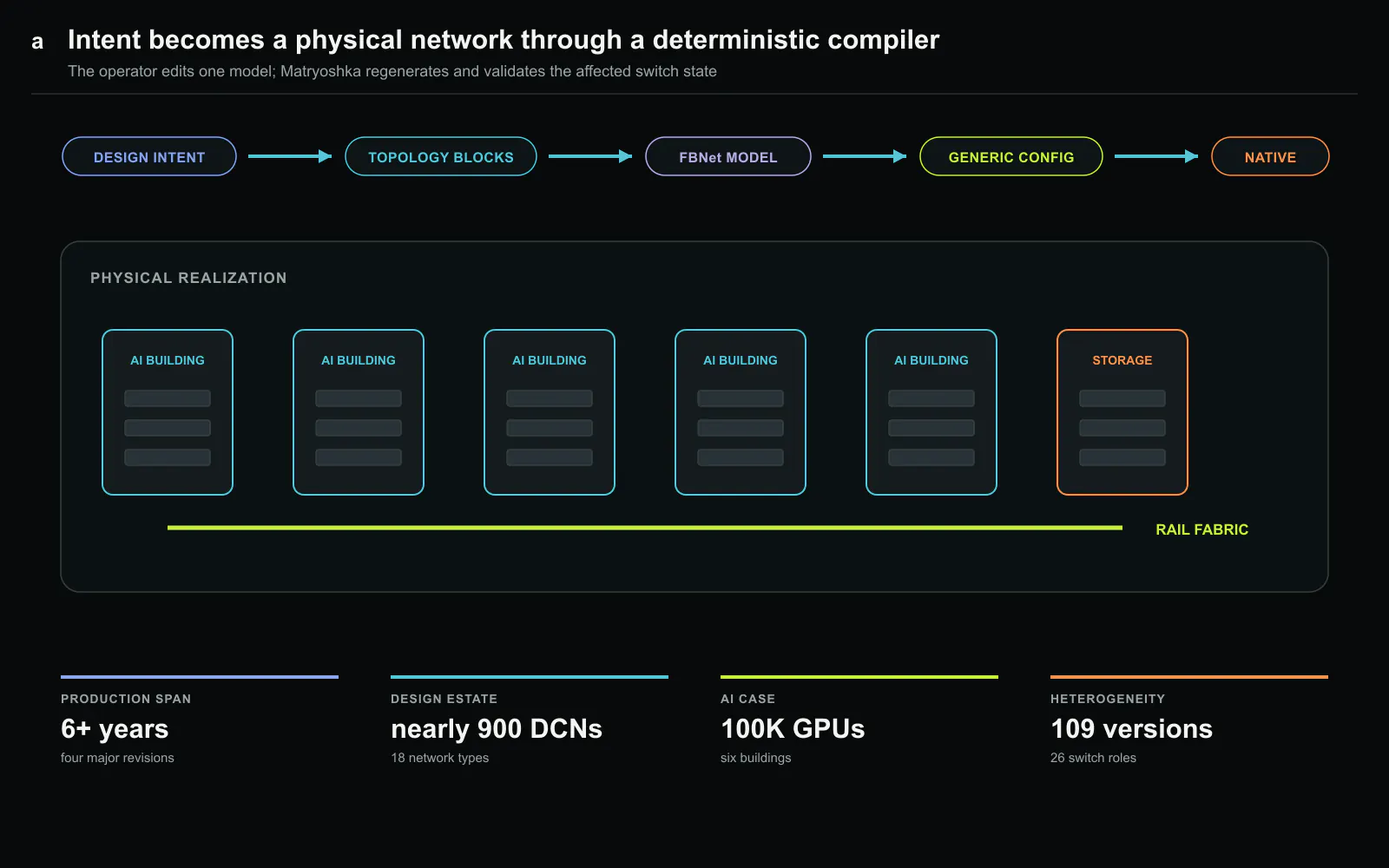
Meta’s Matryoshka treats that translation as a compiler problem[1]. A high-level network intent enters a model-driven workflow. Reusable topology blocks describe physical and logical structure. A database materializes the intended network. A generic configuration layer separates product-independent meaning from a switch vendor’s native syntax. Validation runs at several boundaries before a staged rollout reaches hardware.
The scale gives this software architectural weight. Matryoshka has operated for more than six years, gone through four major code revisions, and guided the design of nearly 900 datacenter networks across 18 types. Its latest case spans more than 100,000 GPUs in six buildings. The reported AI environment contains 109 cluster versions and 26 switch roles. At that point, configuration generation is not clerical automation. It is the executable specification of the fabric.
The missing layer sits between a topology and a running switch
Network research often separates logical design from physical deployment. A topology paper decides which devices connect. A routing paper decides how traffic should move. A deployment system records inventory and cable state. None of those artifacts alone produces a complete configuration for every switch.
The gap grows with heterogeneity. Meta describes five generations of datacenter networks across a footprint of more than 70 regions. The current estate includes front-end networks, fabric-aggregator networks, RoCE training clusters, regional fabrics, and specialized roles. The largest share in the reported breakdown is the datacenter packet-forwarding environment at 47.3%, followed by fabric aggregation at 18.5% and RoCE training clusters at 12.2%. A single tool must express common ideas without pretending these networks are identical.
Manual templates fail in two directions. If each network type owns a separate template, fixes and policy changes diverge. If one universal template contains every exception, a change for one design can affect an unrelated design. The difficult part is not string substitution. It is deciding which concepts are stable, which are parameters, and which must remain explicit product-specific behavior.
Matryoshka therefore uses an intermediate representation. The input captures intent rather than complete command lines. Topology models describe devices, roles, ports, and links. Routing policy models describe relationships and required behavior. The compiler turns these into database entities and then into a Generic Switch Configuration (GSC). Product adapters convert the GSC into native switch syntax.
This separation resembles a software compiler for a practical reason. The source language should remain readable and reviewable. Intermediate state should be deterministic. Backend differences should not leak into every high-level model. Validation should reject an invalid program before execution. A network compiler adds one more obligation: the compiled target is a physical system whose existing state, cable plant, and rollout order can affect correctness.
Reusable blocks control complexity without erasing differences
The paper’s central modeling choice is a library of topology blocks. A block is a standard group of devices and links with defined composition rules. Larger networks assemble these units rather than restating every connection. Full-mesh and Clos structures become reusable building material, while parameters select device counts, port mapping, or a network generation.
Reuse matters because physical and logical structure evolve at different rates. A new switch platform may change radix and port layout while the role hierarchy remains familiar. A new AI cluster can preserve rail-oriented communication while changing the number of racks or the building boundary. A new routing policy may apply to several physical variants. Separating these axes prevents one change from requiring a rewrite of the entire specification.
The database is more than an inventory. Meta’s FBNet stores the materialized network model and its associations. Matryoshka computes a desired state, compares it with the stored state, and applies the necessary database transaction. Foreign-key relationships provide structural checks. The database then becomes a common reference for configuration generation and for systems that consume network state.
Deterministic recompilation is a deliberate trade. An incremental generator can appear faster because it processes only a requested change. However, its result depends on the sequence of earlier operations and on hidden residual state. Matryoshka regenerates intended configuration from the model, so the same input should produce the same output. That property makes review, rollback, and diff analysis easier. It also shifts optimization toward efficient database comparison and bounded output generation.
This design reduces operator ambiguity. A reviewer can ask whether the intent changed, whether materialized topology changed, whether generic behavior changed, or only whether a backend rendered different syntax. Those are distinct failure domains. Combining them in one template makes the cause of a diff difficult to identify.
The 100K-GPU case is a heterogeneity test, not only a scale test
Meta’s regional AI supercluster covers six buildings. Five buildings contain AI capacity and one provides storage. The design separates front-end traffic from a dedicated back-end training network. Inside the training fabric, switches serve rack, cluster, and aggregation roles. A rail-oriented topology keeps corresponding accelerator positions connected through the hierarchy so collective traffic can use predictable paths.
The building count is important because a datacenter boundary is physical. Fiber distance, available conduits, rack power, cooling, construction schedules, and failure domains constrain topology. A logical diagram that treats 100,000 GPUs as one uniform rectangle hides those limits. Matryoshka must express the relationship between a regional supercluster and the building-level networks that compose it.
The cluster catalog shows why copying one configuration is insufficient. The reported environment has 109 cluster versions. It spans multiple accelerator generations, network interface variants, rack designs, and cabling patterns. Some designs use Top-of-Rack connectivity. Others use End-of-Row switching. A common intent system must encode the stable role of those elements while retaining the different port and link realization.
There are 26 device roles in the AI network landscape. A role is not merely a label. It determines which neighbors are legal, which routing adjacencies should exist, which policies apply, and which configuration features are required. If a device is assigned the wrong role, syntactically valid commands can still create a behaviorally wrong network.
The compiler therefore owns cross-layer consistency. Adding a rack changes device inventory, port assignments, physical connections, addresses, and routing relationships. A change that updates four of those five surfaces is incomplete. Matryoshka’s value is that one intent change drives the related artifacts through a defined workflow.
Validation must distinguish output correctness from behavior
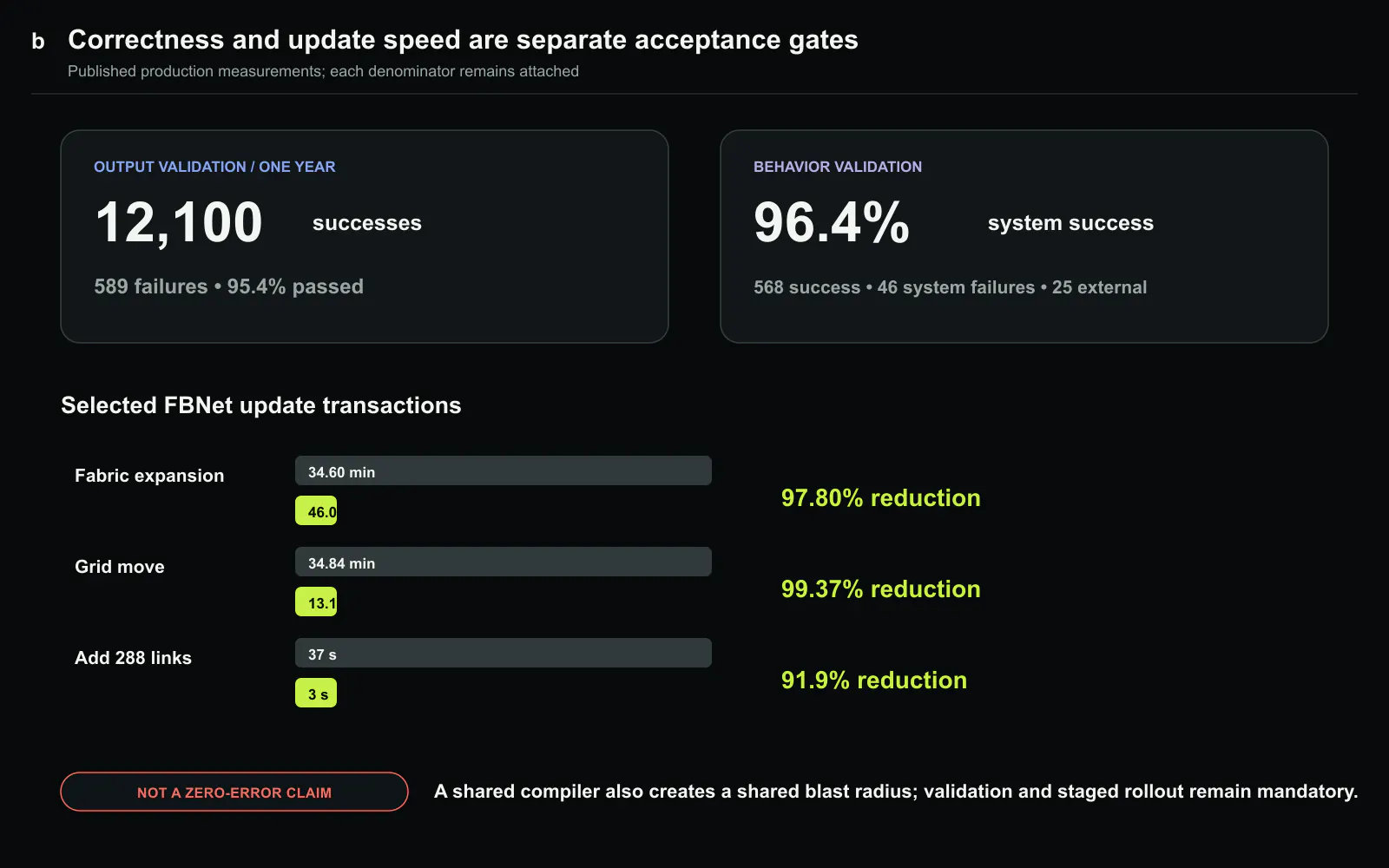
The paper reports two success measures, and they should not be collapsed. Output validation checks whether generated configurations pass the verification process. Over one recent year, 12,100 cases succeeded and 589 failed, for a 95.4% pass rate. A failure here is evidence that the gate rejected a problem. It is not automatically a production outage.
Behavior validation asks whether the resulting network intent and behavior pass system checks. From October 23, 2024 through the reported measurement window, 568 cases succeeded, 46 failed due to the system, and 25 failed for reasons outside the system. Excluding those 25 external cases, the paper reports 96.4% success. The denominator differs from the output-validation denominator.
Neither percentage justifies a zero-defect claim. A configuration compiler can be useful precisely because it catches failures before rollout. Acceptance depends on which defects escape, how quickly operators diagnose them, and whether a failed validation blocks only the intended network. The most dangerous bug is not a visible parser error. It is a plausible configuration that preserves syntax while violating a cross-device invariant.
Independent checks reduce that risk. Database schema validation can confirm entity relationships. Topology checks can confirm expected degree, role, and port constraints. Generic configuration checks can assert routing and policy invariants without relying on vendor syntax. Native configuration validation can catch backend-specific errors. A staged rollout can then compare hardware behavior with the intended model.
Full recompilation still needs fast state transactions
Determinism does not remove the need for performance. Meta reports 800 to 2,000 Matryoshka operations in a typical week, and eight new datacenter network types were added in 2024. Slow generation would turn a correctness tool into a deployment bottleneck.
The paper describes database-update optimizations that compare the desired and current entity graphs before applying changes. In one fabric-aggregator expansion, transaction time falls from 34.60 minutes to 46 seconds, a 97.80% reduction. A grid-move operation completes in 13.19 seconds instead of 34.84 minutes, a 99.37% reduction. Adding 288 links falls from 37 seconds to 3 seconds, a 91.9% reduction. Another operation that adds 88 switches and hundreds of links falls from 200 to 60 seconds.
These measurements concern the FBNet update stage. They do not mean a physical network expansion completes in 13 seconds. Configuration generation, review, upload, device application, convergence, and post-change validation remain separate steps. The correct conclusion is narrower: graph-aware database transactions remove one software bottleneck from a full-intent workflow.
The paper’s generation breakdown also shows that generic configuration generation and upload can dominate some jobs, while database queries and compilation consume smaller shares. Optimization should therefore follow the specific network type and operation. Faster database writes do not help if a backend serializes thousands of device outputs.
For operators, latency has two relevant percentiles. Interactive design needs a short feedback loop so engineers can inspect diffs. Production rollout needs predictable tail time because a partially prepared change occupies locks, review capacity, and a maintenance window. Median generation alone does not reveal whether rare network types or large expansions become operational outliers.
A shared compiler creates a shared blast radius
Centralization removes duplicated logic, but it also connects networks that were previously isolated by separate tools. The paper describes a 2020 incident in which a change accidentally deleted IPv6 prefixes used for inter-fabric connectivity. It also notes that changes introduced for newer AI back-end designs affected logic for traditional datacenter networks.
Those incidents are not arguments against one compiler. They define the conditions under which one compiler is safe. Common code should express truly common invariants. Network-type-specific behavior should sit behind explicit interfaces. A test matrix must include old and new network generations. A change for an AI fabric should prove that unrelated front-end and regional networks produce identical output.
Snapshot testing is useful but insufficient. If the expected snapshot already contains a mistaken policy, matching it preserves the error. Semantic tests should ask questions such as whether every required prefix remains reachable, whether each redundant path survives one link failure, whether an End-of-Row variant maps the correct ports, and whether the number of configured peers matches the topology model.
The model also needs version governance. A database schema migration, a topology-library update, a generic-policy change, and a vendor-backend change have different rollback paths. Recording the compiler version and model version beside every generated artifact makes an incident reproducible. Without that lineage, deterministic code cannot reproduce the state that actually reached hardware.
Rollout should be progressive by construction. First generate and validate without writing. Then compare the intended diff with the live network. Apply to a limited canary set, check routing and traffic invariants, and expand by failure domain. A kill switch should restore a known configuration or pause before the change crosses another building. Compilation makes the plan repeatable; the rollout controller limits its authority.
The compiler interface becomes a hardware procurement interface
A new switch is not deployable merely because its forwarding capacity is sufficient. The platform must expose configuration semantics that the generic model can represent and the backend can render. Unsupported policy features, inconsistent telemetry, slow apply time, or weak rollback can make a nominally compatible switch expensive to integrate.
Procurement should therefore request a compilation contract. Which port and breakout modes are machine-readable? Can configuration be validated offline? Does the platform support atomic replacement or only imperative command sequences? How does it report rejected state? Can an operator identify the running configuration version? What happens when only part of a multi-device update succeeds?
Topology flexibility also has a software cost. A high-radix switch can reduce physical tiers, but a new role, port map, and failure model must enter the compiler library. A vendor-specific feature may improve one path while increasing backend complexity and regression surface. The architectural comparison should include the ongoing cost of modeling and validating the device, not only capital cost and bandwidth.
The same logic applies to optics and cabling. A model that knows logical links but not connector, reach, or media constraints can generate a topologically valid design that cannot be built. Physical inventory must carry enough attributes for the compiler to reject an impossible assignment. At multi-building scale, those attributes include distance and patching boundaries, not just a port identifier.
What an acceptance test should measure
The first test is reproducibility. Compile the same intent twice with an unchanged database snapshot. Every generic and native output should be byte-identical or differ only in explicitly ignored metadata. Then change one parameter and verify that the diff stays within the intended network and role.
The second test is invariant coverage. Remove a required link, duplicate an address, assign an illegal role, exceed a port capacity, delete a routing prefix, and introduce a vendor feature that the generic model cannot represent. Each case should fail at the earliest appropriate gate with an actionable explanation.
The third test is scale. Measure model construction, database comparison, generic compilation, backend rendering, upload, device apply, and behavioral validation separately. Report median and tail latency for a small rack addition, a building expansion, and a policy change affecting many devices. A single end-to-end number hides the subsystem that will limit the next generation.
The fourth test is rollback and mixed state. Interrupt deployment after a subset of switches applies the new configuration. Verify that the controller detects the split version, prevents an unsafe continuation, and reaches a known state. Repeat with one unreachable device and with a backend that rejects only one command.
Lastly, test organizational scale. Require two teams to add different network types without changing shared code unnecessarily. Review whether the model makes the stable abstraction obvious or merely moves template complexity into a programming language. A compiler succeeds when it narrows the number of places where an engineer can express the same policy differently.
Matryoshka’s lasting contribution is not one topology. It is the claim that a hyperscale network design is incomplete until it has a deterministic, validated path from intent to physical configuration. The 100K-GPU case makes that claim visible because the number of buildings, cluster versions, and device roles exceeds what a human review can hold in working memory. The compiler supplies consistency, but its own interfaces, invariants, and rollout authority must be treated as part of the fabric’s fault model.
Source and copyright notice
This article is an independent editorial digest by Silicon & Systems. It restates the system architecture, production counts, measured validation results, and limitations in original language. It does not reproduce source sentences, tables, or figures. Both illustrations were created specifically for this review; the first is a conceptual hardware-aware plate rather than a product photograph, floor plan, or manufacturing drawing. The paper is publicly available from the USENIX presentation page. Copyright (c) 2026 the authors. USENIX states that copyright to individual works in the NSDI proceedings is retained by the authors.