Distributed training communicates the gradients that determine the next model state, then a conventional checkpoint often asks every worker to copy that state again. The second movement blocks computation or competes for GPU, host, network, and storage resources. FlowCheck observes that the all-reduce stream already contains enough information to update a separate checkpoint copy. It mirrors that stream to CPU nodes and removes checkpoint dumping from the training process.
This is a strong separation of planes. GPU workers run their normal collective and optimizer path. Switches duplicate selected packets toward checkpoint nodes. Those nodes identify complete gradient updates, recover losses on the mirror path, and apply the updates to stored training state. The training network does not wait for the checkpoint copy, so checkpoint work can continue independently.
A checkpoint derived from an update stream
Suppose a checkpoint node holds model and optimizer state from a known training step. For each subsequent step, the distributed workers produce gradients and exchange them through all-reduce. If the checkpoint plane observes the complete reduced gradient in the right order and knows the optimizer operation, it can advance its copy to the same logical state without reading every parameter back from GPU memory.
The idea resembles state-machine replication, but the input is high-rate numerical traffic rather than a compact transaction log. Packets can be segmented, reordered, duplicated, or dropped on the mirror link. Several data-parallel rings may run concurrently, and tensor-, pipeline-, or expert-parallel communication can share the same network. FlowCheck must distinguish the gradient bytes needed for one checkpoint update from unrelated traffic.
The system uses packet-counting-based identification to recognize the relevant flow and determine completeness. It adds redundancy recovery because switch mirroring does not provide the retransmission behavior of the original reliable transport. Checkpoint nodes receive traffic through DPDK and use CPU and memory capacity, including Intel I/OAT in the released implementation, to move and reconstruct data efficiently.
Why the mirror cannot be treated as a reliable log
Port mirroring is attractive because it does not require the sender to issue another copy. It is also deliberately weaker than the original transport. If the monitor port or checkpoint node is congested, mirrored packets can disappear without affecting training. The source does not know that the copy was lost and cannot retransmit on its behalf.
FlowCheck therefore reconstructs missing information from redundant observations where the collective naturally exposes it. The exact opportunity depends on the all-reduce algorithm and data-parallel topology. Packet counts reveal whether the expected update arrived; redundant paths or copies can recover a missing segment. If recovery cannot establish completeness, the checkpoint plane must keep the previous valid state rather than label a partial update as durable.
This rule is operationally essential. Training success and checkpoint success are decoupled. The job can advance while the newest recovery point falls behind. A dashboard must report both the training step and the latest verified checkpoint step, plus the reason for any gap. Calling the design zero overhead without that recovery lag would hide the new failure mode.
The state that gradients do not contain
Gradients are sufficient only for state that can be deterministically advanced from the prior checkpoint. The checkpoint node needs the optimizer algorithm and its current state. Learning-rate schedules, loss scaling, random generators, dataloader position, and application-specific metadata may not appear in all-reduce packets. FlowCheck still needs a side channel or periodic conventional capture for those values.
Mixed precision and optimizer sharding add more conditions. A reduced gradient may differ from the local representation used before clipping or scaling. ZeRO and other partitioned optimizers distribute states differently from model parameters. The checkpoint replica must apply the same transformations in the same order or store enough information to recreate them later.
This narrows the correct claim. FlowCheck eliminates the training pause for the high-volume state it can reconstruct from network updates. It does not make all checkpoint metadata appear in the fabric. A production design should publish which state classes are continuously replicated, which are captured separately, and what consistency point combines them.
Evidence and capacity
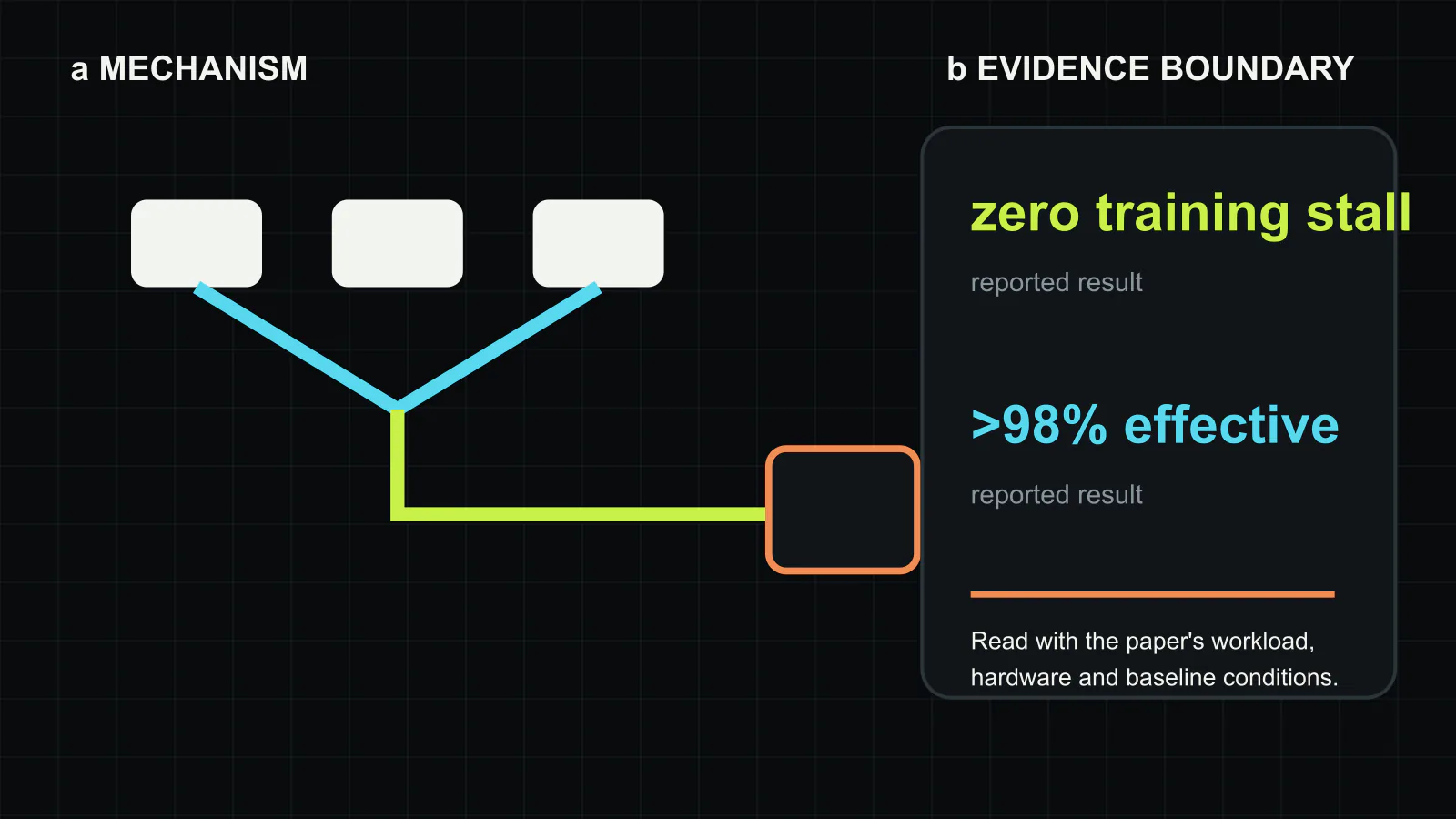
The paper reports that checkpoint operations can have zero impact on training in the evaluated design because workers do not run the checkpoint data path. Under its assumed failure and recovery rates, useful training occupies more than 98% of elapsed time. In one capacity analysis, the design can support about 400 Gbps when each data-parallel group transfers roughly 60 GB per iteration, as in the cited Llama2-7B example without model partitioning.
These figures use different evidence types. Training-path overhead is measured in the prototype conditions. Effective training time combines experiments with assumptions about failures and checkpoint availability. The 400 Gbps value is a support estimate tied to dump rate, state volume, topology, and checkpoint-node capacity. It is not a demonstrated universal port speed.
Checkpoint-node memory is substantial. The public implementation recommends at least 300 GB, with actual demand depending on workload scale. CPU processing, memory bandwidth, DPDK receive queues, I/OAT support, storage flush rate, and mirror-port capacity can each become the new bottleneck. Decoupling removes contention from GPU workers but does not remove the bytes from the system.
Comparison with asynchronous checkpointing
Many checkpoint systems stage state into host memory and let training resume while storage writes continue. They reduce the visible pause but still copy model and optimizer data from the GPU worker. FlowCheck avoids that worker-side extraction for reconstructable state by observing traffic that training already sends. The difference is most valuable when device-to-host copies or worker CPU and memory are scarce.
An asynchronous writer has a simpler ownership path: it receives a snapshot explicitly produced by the training process. FlowCheck infers a snapshot from updates. It gains lower interference but takes on stream identification, loss recovery, and deterministic replay. Neither approach dominates for every workload. A hybrid can use network-derived updates frequently and an explicit full checkpoint less often to bound drift and capture auxiliary state.
Incremental and differential checkpoints provide another comparison. They write only changed values, but the training process still identifies and exports those changes. FlowCheck moves change capture into the network observation plane. The choice depends on whether the operator trusts and can manage programmable mirroring at the required scale.
Network and security boundaries
Mirroring all-reduce traffic exposes model updates outside the training hosts. The checkpoint network and nodes must have protection equivalent to model storage. Tenant isolation, encryption or trusted network domains, access logging, and secure deletion apply. A misconfigured mirror could copy another job’s traffic or overload a monitoring destination.
Switch resources are finite. Mirror sessions, filters, and monitor-port bandwidth compete with troubleshooting and security uses. Topology changes must preserve coverage for every data-parallel group. If traffic crosses several switches, the operator must choose observation points that see a complete update without duplicating it in ways the checkpoint node cannot reconcile.
Failure domains should remain independent. If the checkpoint nodes, mirror network, and training fabric share the same switch or power domain, one incident can remove both computation and recovery. The architecture becomes more valuable when the replica reaches a different failure boundary and durable storage on a measured schedule.
An acceptance test based on recoverability
The first test is not whether training throughput changes. It is whether a restarted job reaches exactly the expected state after injected packet loss, reordering, mirror congestion, checkpoint-node restart, optimizer change, and switch failover. Every experiment should record the training step, latest complete replica step, durable storage step, and recovery result.
The second test measures lag under sustained load. A zero-pause system that falls hundreds of steps behind may lose more work than a conventional checkpoint with a small periodic stall. The recovery point objective should include both replication and storage flush, and admission control should reduce checkpoint frequency or add nodes before queues grow without bound.
The final test covers unsupported state. The team should list every object in the framework checkpoint and identify whether it comes from gradient replay, a side channel, or an explicit snapshot. Unknown fields should block publication of a valid recovery point. This turns an elegant data path into a reliable checkpoint contract.
The system decision
FlowCheck finds a second use for bytes that large-model training already pays to move. Mirroring gradient collectives can advance an off-path state replica without asking GPU workers to dump the same high-volume tensors. The benefit is a cleaner critical path and the possibility of frequent recovery points.
The cost moves into network observability and replica correctness. Operators must measure lost mirror packets, reconstruction completeness, auxiliary state, replica lag, and failure-domain independence. If those signals are first-class, zero worker pause can translate into more effective training time. If they are hidden, the job may run quickly while its usable recovery point silently ages.
Source and copyright note
This article is an independent editorial digest of the EuroSys 2025 paper[1] and the authors’ public implementation[2]. The prose and figure were created anew for Silicon & Systems; no paper figure or table was reproduced. Measured results and capacity estimates are distinguished. Copyright in the original paper is held by its authors and publication rights are licensed to ACM (2025).