A heartbeat detector turns silence into a failure report. That conversion needs a timeout, and the timeout has two conflicting jobs. It must exceed every legitimate delay caused by CPU scheduling, network queues, and operating-system processing, yet remain short enough to remove a crashed participant before a distributed service stalls. Commodity paths have long tails, so operators normally choose a conservative value and accept slower recovery.
FiDe takes the opposite approach[1]. Rather than adapting one more timeout to an unpredictable stack, it builds a narrow process-to-process interaction path whose latency is deliberately stable. Core isolation and reactive packet processing reduce end-host jitter. Traffic engineering reserves capacity. Redundant multicast trees cover link and switch failure. Once the path has an empirically bounded delay, a missing heartbeat can mean a crash without the usual false-suspicion margin.
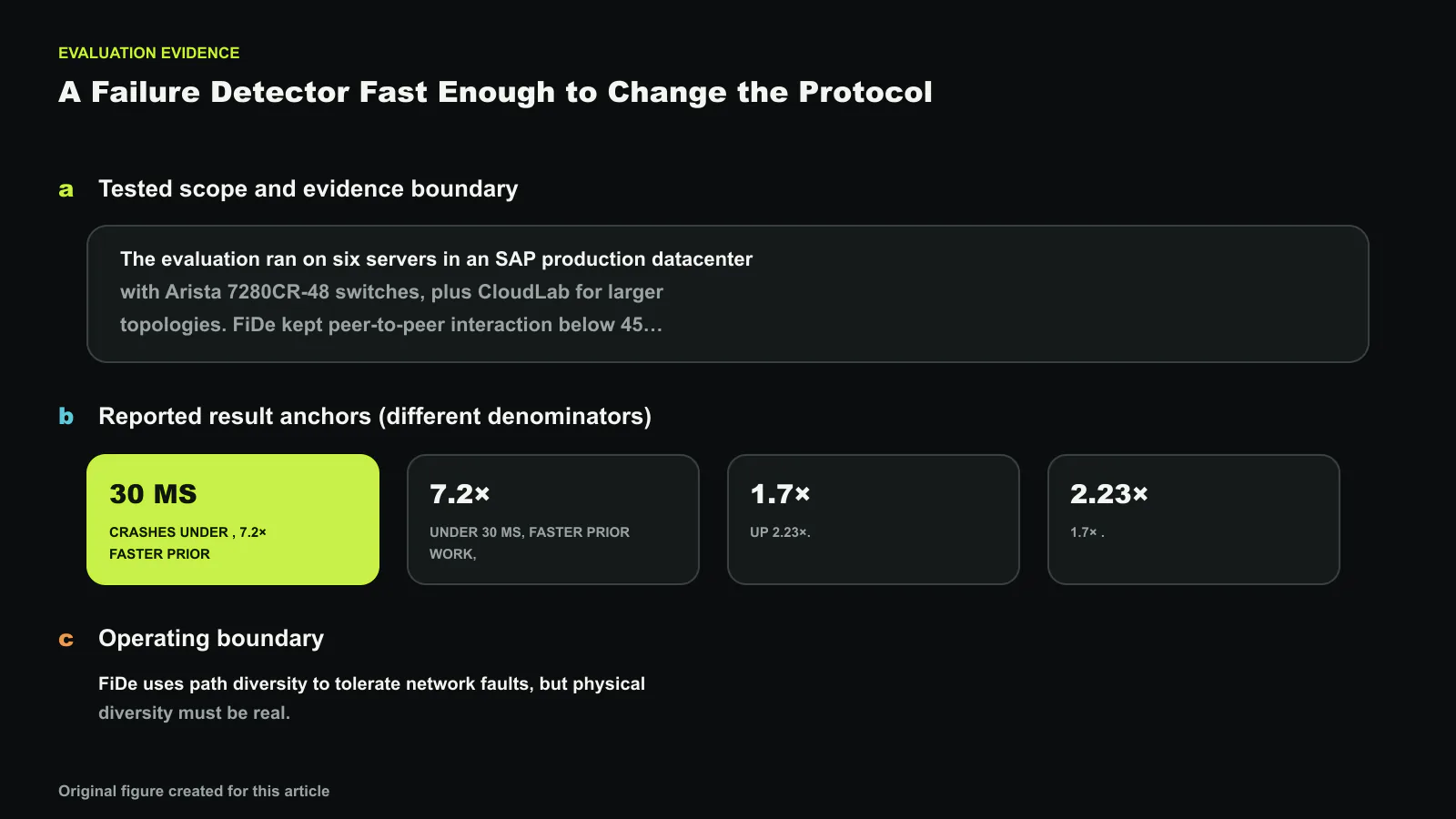
The paper reports remote process crash notification below 30 microseconds in its SAP datacenter testbed, 7.2 times faster than the compared state of the art. More importantly, the detector’s accuracy lets protocols change their failure-free message pattern. A participant can make progress based on a received heartbeat decision instead of collecting another majority round, because the detector is intended to provide a consistent view of which processes remain correct.
A detector implemented as infrastructure
Conventional failure detection is a library within the application. Its heartbeat competes with application threads, kernel work, interrupt handling, and ordinary traffic. Monitoring more layers can recognize deadlocks and gray failures, but it also adds probes and more components that themselves need monitoring. FiDe narrows its goal to crash failure and treats the detector as a separately engineered infrastructure component.
An application first registers the processes it wants to monitor. A controller selects redundant network paths and reserves bandwidth according to heartbeat frequency and message size. FiDe processes periodically send a small heartbeat that can piggyback a protocol decision. The network replicates it over internally disjoint multicast trees, so one forwarding component should not remove every copy.
At each host, heartbeat processing uses dedicated cores, XDP, and a tuned send/receive pipeline. The detector does not wait behind the monitored service’s event loop. A kernel watchdog covers a process that stops executing, while a separate active component avoids sharing all failure modes with the application. This separation makes the timing assumption an explicit resource contract rather than an implicit hope about scheduler behavior.
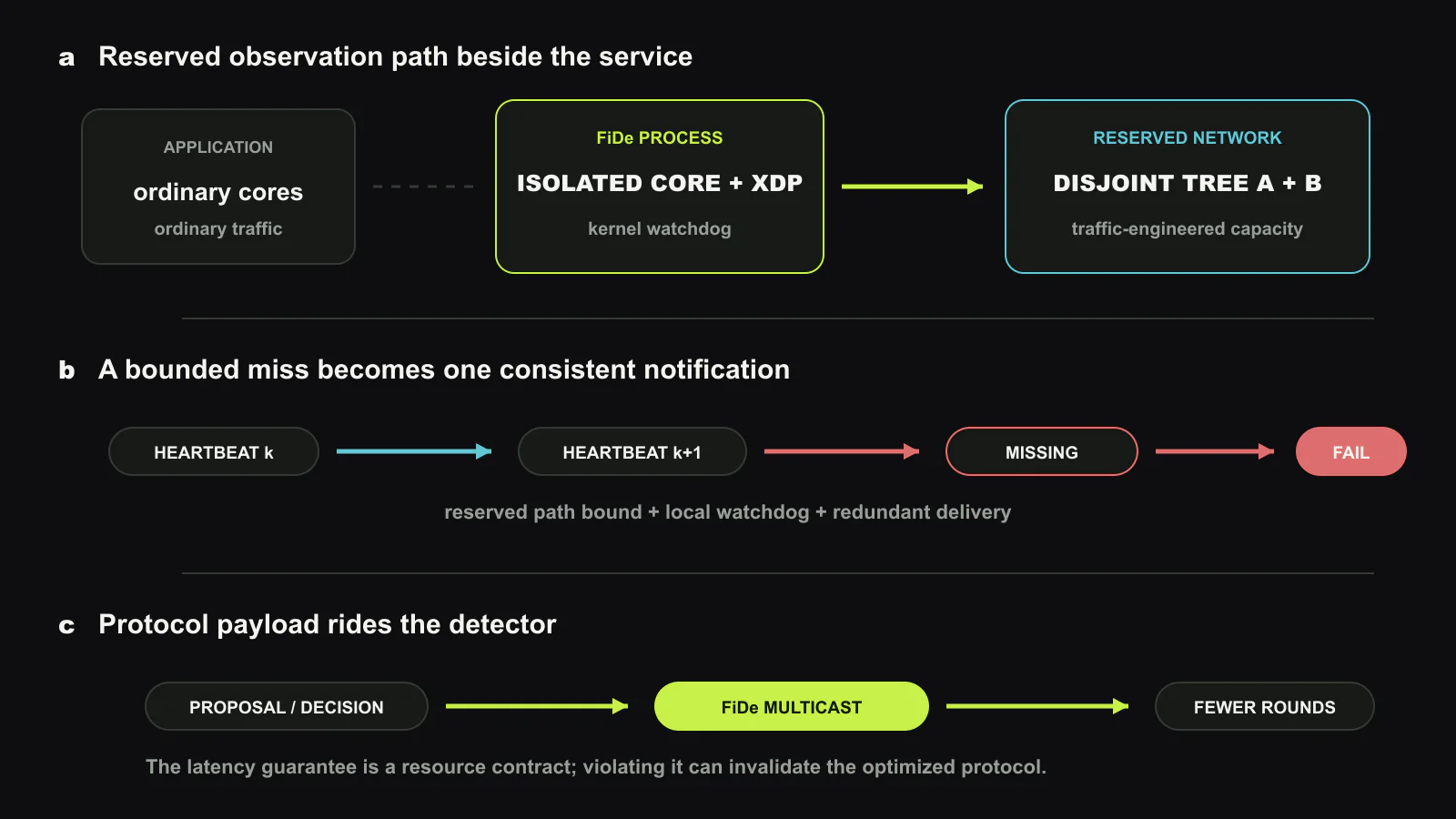
The design targets crashes, not every partial failure. A deadlocked process may be considered failed if the local watchdog observes lost progress, but a service returning incorrect data or one slow network direction needs other diagnosis. The specialization is why FiDe can simplify timing while gray-failure systems retain broader coverage.
Stable delay turns a timeout into a bound
The evaluation ran on six servers in an SAP production datacenter with Arista 7280CR-48 switches, plus CloudLab for larger topologies. FiDe kept peer-to-peer interaction below 45 microseconds in the primary comparison and outperformed alternatives by more than 5.4 times. The paper reports perfect empirical accuracy once the detection threshold exceeded 48 microseconds, roughly 16 times shorter than the threshold needed by two compared detectors.
Actual crash notification includes local observation, network delivery, and remote upcall. Its distribution stayed concentrated near the average and widened only around the 99.999th percentile. This is the intended effect of removing preemption and queueing from the path: the worst credible interaction becomes close enough to the common case that the timeout no longer needs a millisecond-scale safety factor.
Redundancy is not free. Each heartbeat consumes capacity on multiple trees, and reservations reduce bandwidth available to other traffic. With a 100-microsecond heartbeat interval and an approximately 400-byte piggyback limit, the paper estimates about 32 Mb/s of decision payload. A larger group, higher frequency, or taller tree increases resource demand. FiDe is therefore suited to a bounded set of coordination participants, not unmetered all-to-all monitoring across an entire datacenter.
Additional switch levels add roughly 5 to 10 microseconds of forwarding delay per level in the authors’ deployment analysis. The controller must include that path height in the threshold. The property is not a universal “30 microseconds everywhere”; it is a bound derived from a specific isolated pipeline and reserved topology.
Detection frequency also belongs in the service contract. Sending heartbeats more often shortens the time until the next missing message can be noticed, but consumes more packet-processing and multicast capacity. Sending them less often preserves resources while adding an interval before any threshold can expire. The useful quantity is therefore crash-to-notification time, including heartbeat phase, rather than the transport latency of one successful heartbeat. A capacity controller should admit a group only after multiplying its frequency, payload, replication factor, and path count, then retain headroom for recovery traffic and reconfiguration. Otherwise the detector can create the queueing variance that its timing proof assumes away.
Normal monitoring must remain outside that reserved budget. Debug traces, logs, and broad health probes can be bursty and should not share the same queue or core merely because they also concern reliability. FiDe obtains stability by keeping its signal narrow. Adding operational payload without an explicit bound would gradually turn the dedicated path back into the ordinary shared path it was designed to avoid.
Accuracy changes failure-free coordination
The usual consensus protocol cannot treat a timeout as proof because a slow correct process might be suspected. FiDe’s strong-accuracy objective lets the authors design heartbeat-synchronous uniform consensus variants. A process can piggyback its proposal or decision on the detector’s multicast, and every correct participant receives a consistent failure view. The failure detector carries useful protocol information instead of running as separate background traffic.
The paper integrates these algorithms into Redis and ZooKeeper-like coordination. In failure-free execution, RedisFiDe improved maximum throughput by 1.7 times and reduced latency to 0.46 times the baseline. The ZooKeeper integration reached up to 2.23 times throughput and 0.57 times latency. These gains are not recovery benchmarks: they come from eliminating message rounds that a less trustworthy detector would still need during normal operation.
That result also raises the deployment stakes. If the timing contract is violated, the optimized protocol can make an unsafe assumption rather than merely recover slowly. Reservations, detector isolation, controller correctness, and network-failure probability become part of the service’s safety case. Operators need continuous proof that the reserved path remains installed and within its measured latency envelope.
Fault containment and the remaining assumptions
FiDe uses path diversity to tolerate network faults, but physical diversity must be real. Two logical routes sharing a line card, power domain, or misconfiguration can fail together. The paper’s probability analysis depends on assumptions about independent failures. A production review should map trees to failure domains, not just switch identifiers.
The central controller is off the heartbeat data path after allocation, which prevents every heartbeat from depending on it. Its outage can still block new registrations and reconfiguration. Capacity must be reserved before demand arrives; an oversubscribed fabric cannot promise the same threshold by priority marking alone.
Dedicated cores and bandwidth also change the cost comparison. A conventional detector uses existing shared resources and pays with a longer timeout. FiDe buys precision with resources that may sit lightly loaded. This is attractive for a small coordination service whose failure stalls many machines, but not necessarily for every application process.
FiDe’s reported reliability is empirical within the evaluated hardware and software. Datacenter clocks, switch firmware, XDP behavior, watchdog scheduling, and topology changes require revalidation. A guarantee intended for protocol safety needs admission control and runtime alarms that fail closed when latency exceeds the configured bound.
Where the architecture is useful
The strongest fit is a compact set of replicas providing metadata, locks, membership, or synchronization for low-latency services. Their traffic is small enough to reserve, and their failure decision affects a much larger data plane. A detector that removes one normal-case consensus round can return the reserved-core cost many times over.
The model is weaker for thousands of ephemeral members, multi-region paths, or gray failures whose process continues sending heartbeats. Cross-region propagation alone exceeds the microsecond target, and bandwidth reservations across shared WAN domains are harder to enforce. Those systems still need leases, adaptive suspicion, application-level health checks, or reconciliation.
The reusable lesson is that failure detection performance is not only an algorithmic timeout choice. It is a property of the complete observation path. By isolating execution, reserving the network, and making redundancy explicit, FiDe shrinks uncertainty enough to alter the upper-layer protocol. The same benefit is also its limit: once a service relies on that altered protocol, every component that maintains the bound becomes part of correctness and must be operated accordingly.
Source and copyright notice
This article is an editorial analysis by Silicon & Systems. It restates the detector architecture, measurements, and assumptions in our own words. No source sentence, table, or figure is reproduced; the figure was created for this article. The paper is available from the USENIX ATC 2025 presentation page. Copyright remains with the authors, 2025.