Arm has spent decades selling architectures, cores and subsystems that other companies turn into processors. AGI CPU adds an Arm-designed production chip and a validated dual-node Open Rack server, developed with Meta as the lead partner. The processor specifications matter, but the larger change is that firmware, board design, thermals and software bring-up now arrive around one deployable reference point.
The announcement changes a system boundary
Cloud operators want CPU density and memory bandwidth beside AI accelerators, while OEMs need a complete platform that boots, cools and exposes standard I/O. Delivering only processor IP leaves each customer to repeat board validation and software integration, extending the interval between a core design and useful rack capacity. The obvious response is to compare Arm’s largest number with a competing device. That misses the architectural choice. The relevant boundary is where software state, memory ownership, communication and repair move together. A peak specification matters only after the deployment preserves that boundary under load.
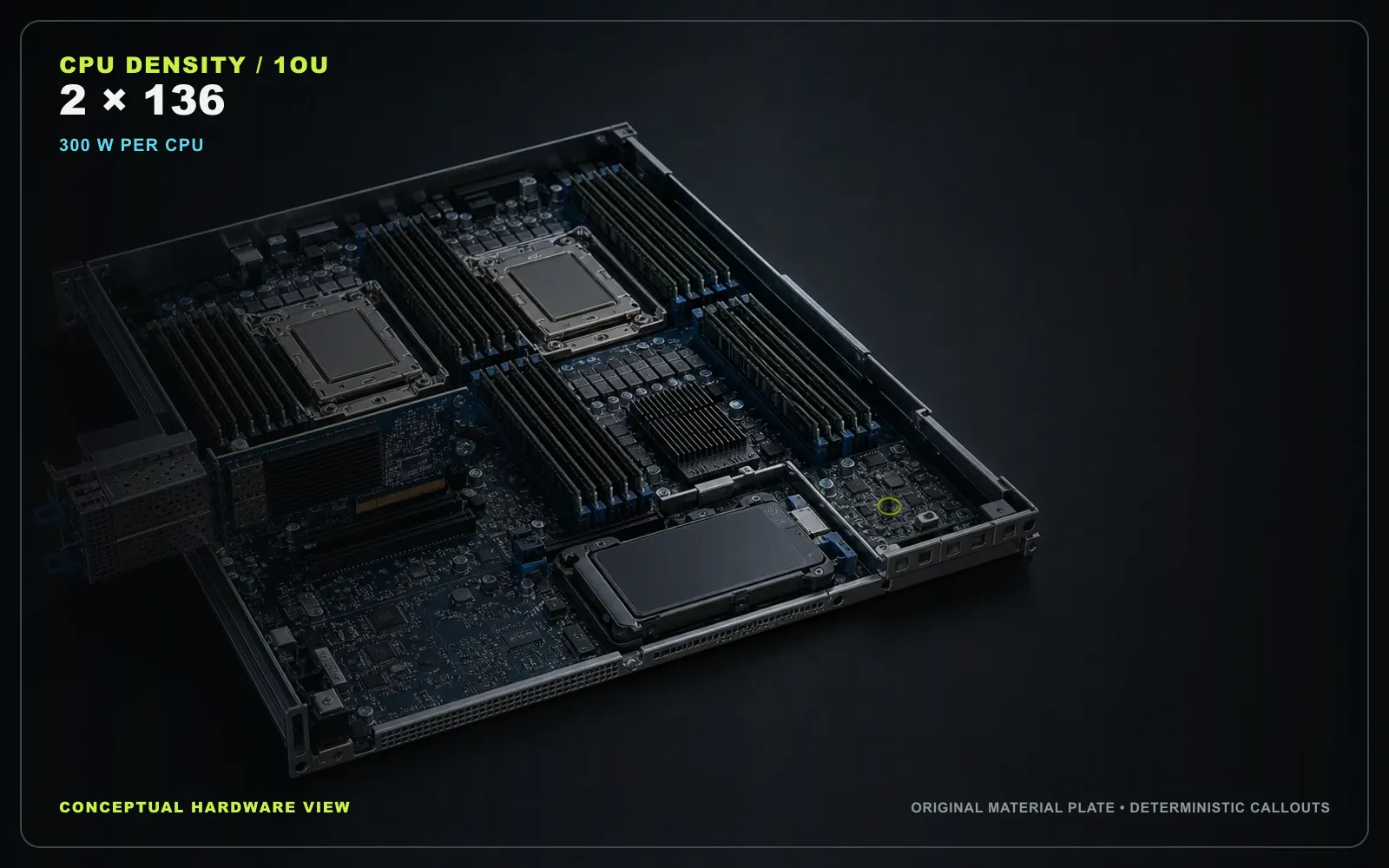
AGI CPU integrates up to 136 Neoverse V3 cores, 12 DDR5 channels at up to 8,800 MT/s and PCIe 6 connectivity within a stated 300 W envelope. Arm quotes 6 GB/s of memory bandwidth per core at sub-100 ns latency. The 1OU reference chassis contains two CPUs, 12 DDR5 DIMMs per node, E1.S storage, front and rear PCIe expansion, OCP NIC 3.0 and Open Rack 48 V power. These values come from Arm’s public material and describe the announced configuration. They should not be read as independent measurements or as performance available to every workload.
Reading the specifications without mixing denominators
The disclosed anchors are 136 cores per CPU; 272 cores per 1OU blade; 6 GB/s per core below 100 ns; 300 W per CPU. Each number answers a different question. Device capacity determines whether model or application state can remain local. Link and memory bandwidth set upper bounds before protocol, access pattern and contention. Core or arithmetic counts describe available machinery, while application completion depends on utilization and synchronization. Adding them together produces a visually impressive rack total but not a reproducible service result.
Company announcements are useful primary evidence for implementation facts because the supplier controls the design. They are weaker evidence for comparative economics because the supplier also selects the baseline, software and operating point. We therefore retain the announced values but label projections, supported maxima and vendor-run results. A neutral comparison would hold request mix, software maturity, facility power and availability targets constant.
The mechanism that is likely to persist
The reference server is not a packaging footnote. It fixes the memory population, expansion slots, management controller, power feed and cooling assumptions that determine whether quoted per-core efficiency becomes rack throughput. Arm is also changing its relationship with licensees: customers can still build custom silicon from Neoverse IP, but they can now buy an Arm-defined endpoint when time to deployment matters more than differentiation.
This mechanism can outlast the first product generation because it identifies where coordination belongs. It also creates a new obligation. Telemetry has to expose queueing, memory pressure, link utilization, throttling and faults at the same granularity as the service boundary. Without those counters, an operator can observe a slow application but cannot distinguish silicon saturation from placement, communication or recovery overhead.
What the disclosure does not establish
Arm’s more-than-two-times performance-per-rack and 8,160-core air-cooled density are company comparisons based on stated chassis and power assumptions. The public materials do not provide the full x86 baseline, workload mix, price, measured rack power or sustained thermal behavior. The reference server is production-representative, but customer systems and liquid-cooled density claims still require independent qualification.
Absence of those measurements is not evidence that the design fails. It defines the next acceptance test. Roadmap language should remain separate from shipping hardware; peak values should remain separate from sustained application rates; and a supplier’s comparison should remain separate from independent reproduction. This evidence discipline is particularly important in AI infrastructure because one missing rack component can change both performance and power denominators.
A practical qualification plan
A useful evaluation starts with three workloads rather than one synthetic peak. The first should maximize arithmetic with state that fits locally. The second should pressure memory capacity and bandwidth with realistic access skew. The third should cross the intended communication boundary using the message sizes and concurrency expected in production. All three should report completed work at p50, p95 and p99 latency rather than only average device utilization.
Power should be measured at the rack input and separated into compute, memory, networking, host, cooling and idle components. An operator should repeat the test after removing one replaceable module, one link and one network path. Time to isolate, remap and return to the service-level objective is often more valuable than the best healthy-system result. A design with a lower peak can deliver more useful capacity if it loses less work during maintenance.
Software qualification must record compiler and runtime versions, kernel coverage, model changes, fallbacks and time spent tuning. The test should distinguish software that already runs from software that needs product-specific reconstruction. It should also verify observability: counters need to explain where time and energy were spent, not merely show that a device was busy.
Procurement can then compare four totals: useful work per rack-hour, useful work per facility kilowatt-hour, capacity available during a component failure, and engineering time per new workload. Those denominators translate Arm’s architecture into an operating decision without discarding the genuine structural contribution.
The decision after Hot Chips
Arm’s announcement is important because it changes where a complete unit of compute can be built and managed. The durable question is whether the new boundary reduces movement and operational fragmentation after all supporting components are counted. Buyers should request the missing evidence at that exact boundary, while software teams should prototype placement and failure behavior before treating the largest specification as deployable capacity.
Integration economics beyond the headline device
The installed system has to reserve capacity for management, redundancy and maintenance. A nominally available core, link or memory channel may not be schedulable for a user job when it protects a failure domain or carries control traffic. Qualification should therefore publish both physical capacity and allocatable capacity under normal operation, during a component drain and after a failure. The same architecture can look efficient at peak load and expensive when a service objective requires spare paths.
Topology also changes software economics. A compiler may treat nearby memory or peers as a uniform resource, while the physical system contains several latency and bandwidth tiers. The runtime needs placement rules that match those tiers and must expose when it falls back to a longer path. Otherwise, an application update can silently alter communication and erase the benefit attributed to the new silicon. For Arm, the useful deliverable is not just a device API. It is a reproducible mapping from application state and collective operations to the physical hierarchy.
Lifecycle costs begin before deployment. Firmware signing, secure boot, isolation, error reporting, memory and network qualification, and existing orchestration integration all consume engineering time. They continue after launch as models, kernels and operating systems change. A supplier-controlled stack can optimize those layers together, but it can also make performance dependent on one release cadence. Buyers should request a supported-version matrix, rollback procedure and documented degraded mode rather than assuming that architectural compatibility guarantees operational compatibility.
Security and reliability should be tested at the new boundary. Shared memory, mixed instruction environments, modular accelerators and programmable transports create different questions, but the method is common: identify who owns an address, who can issue work, where errors are contained and which component can reset another. Fault injection should cover corrupted data, timeout, link loss and partial restart. The outcome is not only whether the system recovers, but also how much unrelated work is interrupted and whether state remains auditable.
Finally, utilization must be connected to delivered service. High device occupancy can coexist with poor completion when work waits in a network queue or is retried after a fault. Operators should correlate application traces with hardware counters and energy at the same timestamp. That correlation shows whether the new boundary removes movement or merely hides it inside another layer.
Source and copyright notice
This article is an independent Silicon & Systems editorial digest based on Arm’s official release and the cited primary material. We rewrote the architecture, specifications and limits in our own language and did not reproduce company slides, tables, diagrams or marketing images. The hardware plate and card motif were created for this article from rights-tracked, text-free source material; deterministic labels were added in code. Copyright in the cited source material remains with its respective owner (2026).