Large training jobs stop for more reasons than broken GPUs. A scheduler may reclaim a machine, operators may drain a rack, a node may slow down, or load balancing may call for a move. Checkpoint and restart handles the general case but pays for generality: terminate the job, allocate resources, rebuild communication groups, reload model state and warm the software stack again[3]. Runtime reconfiguration avoids a full restart yet can still pause every rank while collective communication is rebuilt.
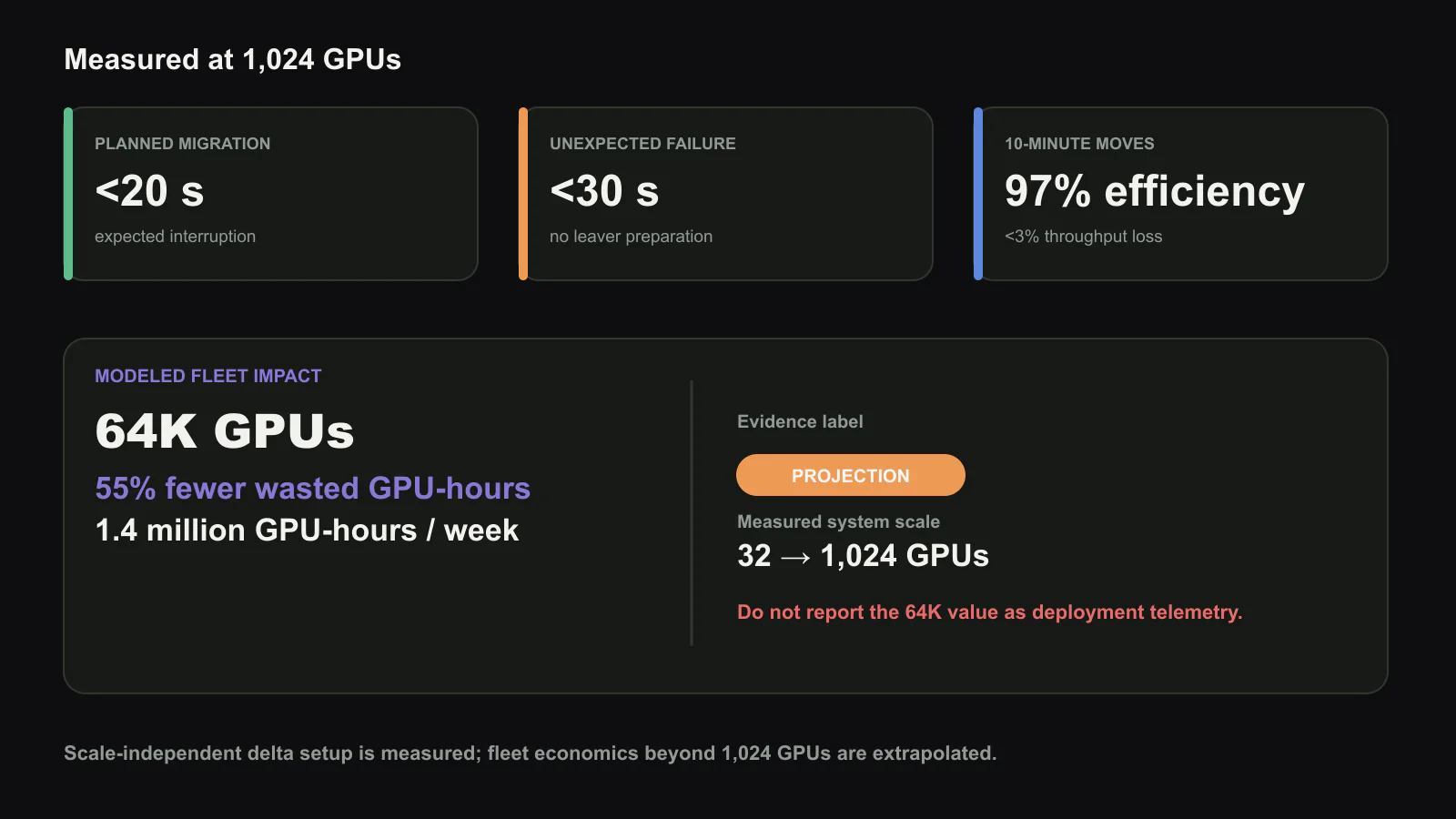
TrainMover, from Alibaba Group and academic collaborators, treats a machine replacement as a small change to a mostly unchanged distributed job[1]. At 1,024 GPUs, planned interruptions remain below 20 seconds and unexpected failures below 30 seconds. The system also claims zero additional model-memory overhead on active workers. Its design matters because it moves work out of the interruption window rather than merely making restart code faster.
A global job with a local difference
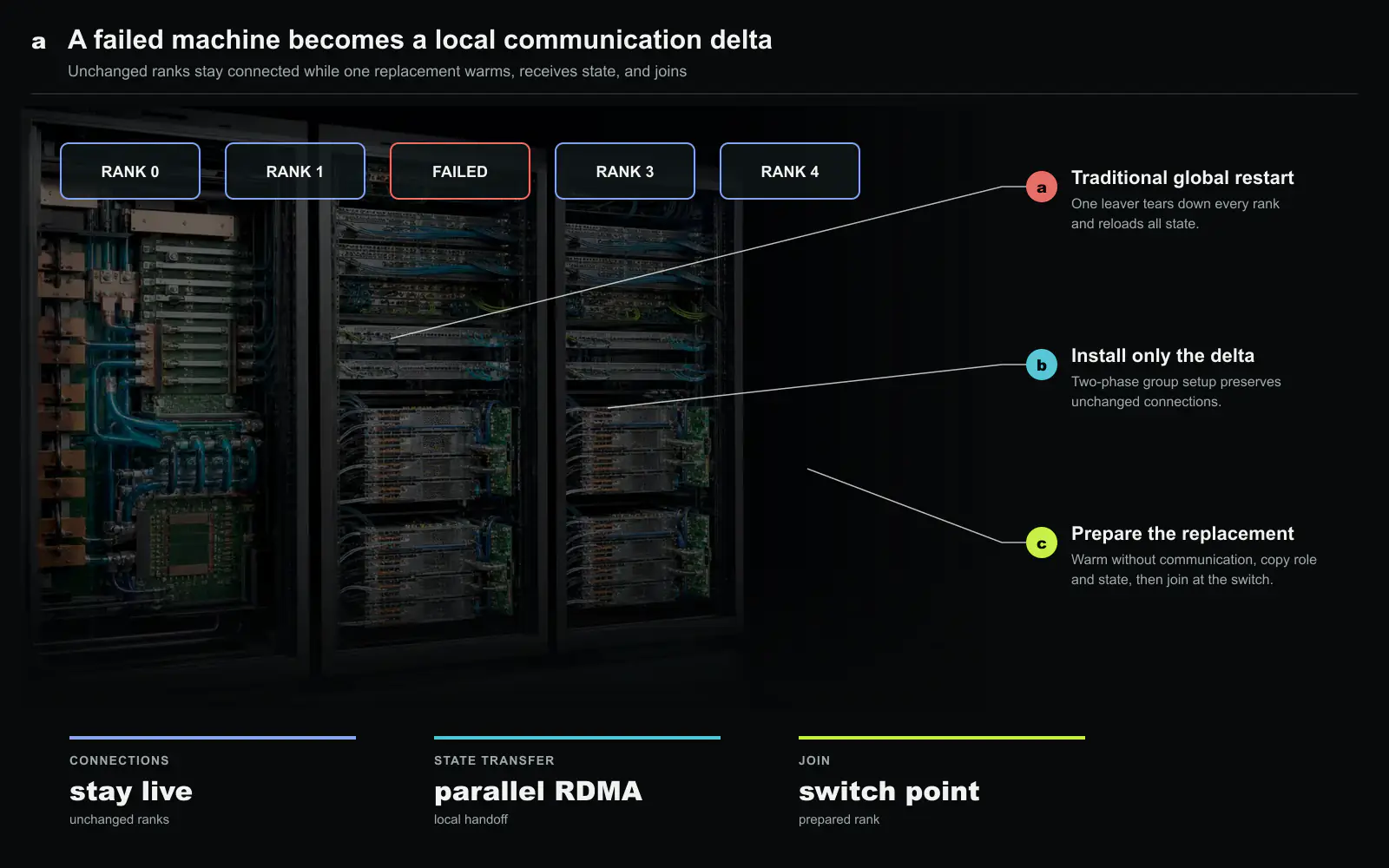
Collective communication libraries normally construct groups as a unit. If one member changes, the safe response is to rebuild the group for everyone. TrainMover splits setup into two phases. Before an interruption, ranks establish the communication state that will remain valid. When a departing machine and its replacement are known, the runtime installs only the delta between that pair and the affected peers. Unchanged workers retain their connections and keep their model state.
The replacement must still become execution-ready. Conventional warmup enters the actual distributed program, allocates memory, compiles or selects kernels, and may issue collectives. Those calls would collide with the live group. TrainMover instead runs communication-free sandboxed warmup: it exercises the local compute and memory paths while intercepting distributed communication. The joining machine becomes warm without being a temporary, inconsistent member of the job.
The third mechanism is a general standby. A spare is not tied permanently to a particular rank role. It can replace a worker participating in tensor, pipeline, data or expert parallelism because the runtime reconstructs the necessary role and transfers state from a surviving neighbor. State movement is parallel across leaver-joiner pairs and uses high-bandwidth RDMA. The paper argues that bounded GPU memory makes this transfer fit inside the recovery interval.
What was measured at 1,024 GPUs
The evaluation scales from 32 to 1,024 GPUs and changes the model configuration with scale, from a dense 175B model to MoE configurations as large as 5.12T parameters. Planned migration stays under 20 seconds at 1,024 GPUs. Unexpected failure recovery, which cannot prepare the departing side, remains under 30 seconds. Scaling from 32 to 1,024 GPUs adds no more than 10 seconds because the setup delta and state transfers proceed largely in parallel.
The paper also evaluates frequent resource rebalancing. Moving resources every ten minutes at 1,024 GPUs retains 97% training efficiency, or less than 3% throughput loss. This is a different use case from rare failure recovery: it asks whether migration is cheap enough to become a scheduling primitive. A cloud operator could shift machines away from an unhealthy or imbalanced pool before a hard failure, provided the scheduler can identify a better placement.
The baseline comparison is best read as a downtime decomposition. Checkpoint-restart pays allocation, initialization and data reload. Elastic systems reduce part of that sequence but often reconstruct broad communication state. TrainMover pays mainly for detection or coordination, the small group delta and the state handoff. The advantage grows with cluster size because the amount of changed membership stays small while a global restart becomes more expensive.
The 64K-GPU number needs its label
TrainMover projects that a 64K-GPU fleet would waste 55% fewer GPU-hours than the best evaluated alternative, equivalent to 1.4 million GPU-hours per week. This is the paper’s largest economic number and the easiest one to misreport. The system was measured to 1,024 GPUs; the 64K result extrapolates using an interruption model and the observed scaling behavior. It is evidence about potential fleet economics, not a seven-day counter read from a 64K deployment.
The projection is still informative. At 32K GPUs, the paper estimates that cutting a 4.45-minute recovery interval down to 20 seconds with one or a few standbys produces a throughput benefit comparable to adding roughly 2,400 GPUs under ideal linear scaling. The comparison explains why a small reserve pool may be cheaper than allowing every active GPU to wait for global recovery. It does not determine the correct standby count, which depends on failure correlation, capacity price and whether the spare can perform lower-priority work.
What TrainMover does not remove
Fast handoff requires a healthy source of model state, working RDMA paths and a control plane that knows which machine is leaving or has failed. A correlated rack or fabric failure can take away both the worker and the neighbor expected to supply state. The system also shortens the machine-replacement portion of recovery; it does not diagnose silent numerical corruption or decide whether user code caused divergence. Those concerns belong to detection and debugging systems such as the broader recovery stack discussed in ByteRobust[2].
The larger point is that elasticity has two meanings. An API may allow the membership of a job to change, while the implementation still stops thousands of ranks to make that change safe. TrainMover aims at operational elasticity: the cost should follow the number of changed machines, not the total job size. If that property holds in a provider’s own models and network, migration can become routine maintenance rather than a last resort.
Reliability becomes a capacity-allocation problem
TrainMover changes the unit of recovery from a job to a membership delta. That sounds like an implementation detail, but it changes fleet economics. Checkpoint-restart spends storage bandwidth and repeated computation after an event. TrainMover spends standby capacity and control-plane complexity before it. The right comparison is therefore not downtime alone. It is the sum of reserved spare GPU-hours, state-transfer traffic, migration interruption, and work that still rolls back when the handoff misses its deadline.
Separating these cost components explains why the 64K-GPU projection is useful without being a deployment result. A larger fleet creates more interruption opportunities, so a fixed global-restart cost compounds quickly. However, the saving depends on the event mix, checkpoint interval, spare-placement policy, and whether a compatible replacement exists in the same network neighborhood. An operator considering the design should replay its own trace through the model and publish sensitivity to each input, rather than importing the reported 55% reduction as a constant.
The operational target should be time to useful progress, not time to process recovery. A replacement can be alive while its communication groups, optimizer state, caches, or data-loader position are not ready to produce the next accepted step. Production telemetry should separate detection, replacement selection, sandbox warmup, delta installation, state copy, and the first post-handoff step. That decomposition makes the system actionable: if detection dominates, buy better health signals; if state copy dominates, change placement or checkpoint layout; if compatible spares dominate, treat resilience as a scheduler reservation. TrainMover’s deeper lesson is that reliability capacity must be planned as deliberately as training capacity.
The break-even point can be expressed without adopting the paper’s fleet projection. A reserved spare is justified when its opportunity cost is lower than the expected GPU-hours lost to interruptions that it can actually cover. Both sides depend on role and topology. A data-parallel replacement may be easy to place, while a pipeline or expert rank can require a specific neighborhood and state source. Reporting one fleet-wide spare ratio hides this structure. Operators need coverage by failure domain: host, rack, fabric island, accelerator type, and training role.
Correlated failures are the harder boundary. A power event, top-of-rack failure, bad software rollout, or corrupted checkpoint can remove the leaver, the standby, or the state source together. Delta reconfiguration shortens a local change but does not make those dependencies independent. The evaluation plan should include common-mode events and degraded network paths, not only single-machine replacement. This is where TrainMover connects back to conventional resilience rather than replacing it: local handoff handles frequent narrow events, while checkpoint diversity, failure-domain-aware placement, and rollback remain necessary for wide events.
A migration needs a precise consistency point
Moving only the affected part of a distributed job requires a moment at which old and new participants agree on model state, optimizer state, communicator membership, and in-flight work. If the boundary is vague, the job can resume quickly with one rank ahead, one collective partially completed, or one update applied twice. The protocol should name the last committed iteration and make every transition after it replayable or discardable.
The data plane and control plane must use the same membership version. A replacement rank should not enter collectives until every surviving rank has installed the new group, and old endpoints should lose authority before resources are reused. Timeouts need a recovery rule for the case in which the original worker returns during migration. These are distributed-systems conditions, not only training-runtime details.
Checkpoint interaction also needs labels. TrainMover can preserve most live state, while a durable checkpoint remains the fallback for larger or ambiguous failures. The operator should know which faults permit local handoff, which require group repair, and which force full restart. Each path should identify the amount of work that can be lost.
Spare capacity should match the repair unit
A global job does not always need a full duplicate cluster, but it does need a compatible destination for the failed unit. The reserve must match GPU type, memory, host software, network locality, and the parallel group that will be repaired. A free GPU across a slow or unsupported path may not be usable even when inventory reports capacity.
Admission control can reserve probable repair shapes instead of static devices for every job. The platform uses failure history and concurrent-job topology to estimate how many destinations are needed, then allows lower-priority work to borrow them with a preemption contract. Correlated rack or network failures require a wider reserve than independent GPU faults.
Fragmentation is part of reliability. If free devices are scattered, repairing one rank can force a larger group migration or restart. The scheduler can prefer placements that leave coherent spare islands and account for the opportunity cost. This connects day-one job placement with recovery days later.
Recovery should be priced in lost model progress
Migration time is only one component. Detection, diagnosis sufficient to choose the path, state transfer, communicator repair, cache or kernel warmup, replay, and performance after resumption all consume value. The metric should be accelerator-hours of valid progress lost per incident, including surviving devices that waited.
The projected 64K-GPU result is useful for understanding scaling behavior but should not be treated as a measured recovery time. A deployment should calibrate the model at smaller physical scales and show how control messages, network contention, and group size change. Sensitivity to simultaneous failures is especially important because one event can affect many ranks.
The alternative baseline must match the checkpoint policy. A frequent durable checkpoint shortens rollback but adds steady overhead. Live migration spends reserve and control complexity to reduce interruption. Comparing only recovery duration ignores the different costs paid before failure. A complete ledger includes steady checkpoint cost, reserved capacity, and expected incident loss.
Qualification should break the transition deliberately
Test single GPU, host, rack link, and control-process failures at different points in the iteration. Interrupt state transfer, delay a survivor, return the original worker, and fail the replacement. Verify that the job either resumes from one consistent version or falls back to a trusted checkpoint. Silent continuation with mixed state must be treated as the most severe failure.
Long-duration tests should add repeated moves. Memory leaks, stale communicators, address reuse, and performance drift may appear only after several repairs. Numerical validation should compare loss and model state after a migrated run with a controlled run at matched steps, within expected nondeterminism.
Operational rollout can begin with jobs that have frequent checkpoints and spare deadline, then expand as recovery evidence accumulates. Every event should record the chosen repair scope, reason, state bytes, interruption, replay, and post-move performance. This history calibrates both reserve policy and the projected large-scale model.
We read TrainMover as a proposal to make failure scope and recovery scope match. That can conserve enormous synchronized capacity when one machine leaves a large job. The result becomes dependable when consistency, compatible spare shapes, total lost progress, fallback boundaries, and repeated-failure tests are as explicit as the migration path itself.
Source and attribution
This article is an editorial summary prepared for Silicon & Systems. It restates the cited paper in our own words. No text, tables or figures from the paper are reproduced; both figures were created for this article. USENIX provides the paper through its open presentation page. Copyright (c) 2026 the authors.