SPEC CPU scores influence processor design, compiler work, and purchasing long after the suite’s applications become familiar. The 2026 revision addresses two gaps in CPU2017: too little behavioral diversity and a rate mode that largely runs copies of the same program[1].
Changing those workloads changes what a CPU score represents. Architects and buyers should not read CPU2026 as a continuation of the CPU2017 scale or assume that a stronger aggregate score identifies the same bottleneck. This review examines the new behavioral coverage, mixed rate workloads, and validation evidence that determine which design and procurement conclusions the suite can support.
More code and more parallel behavior
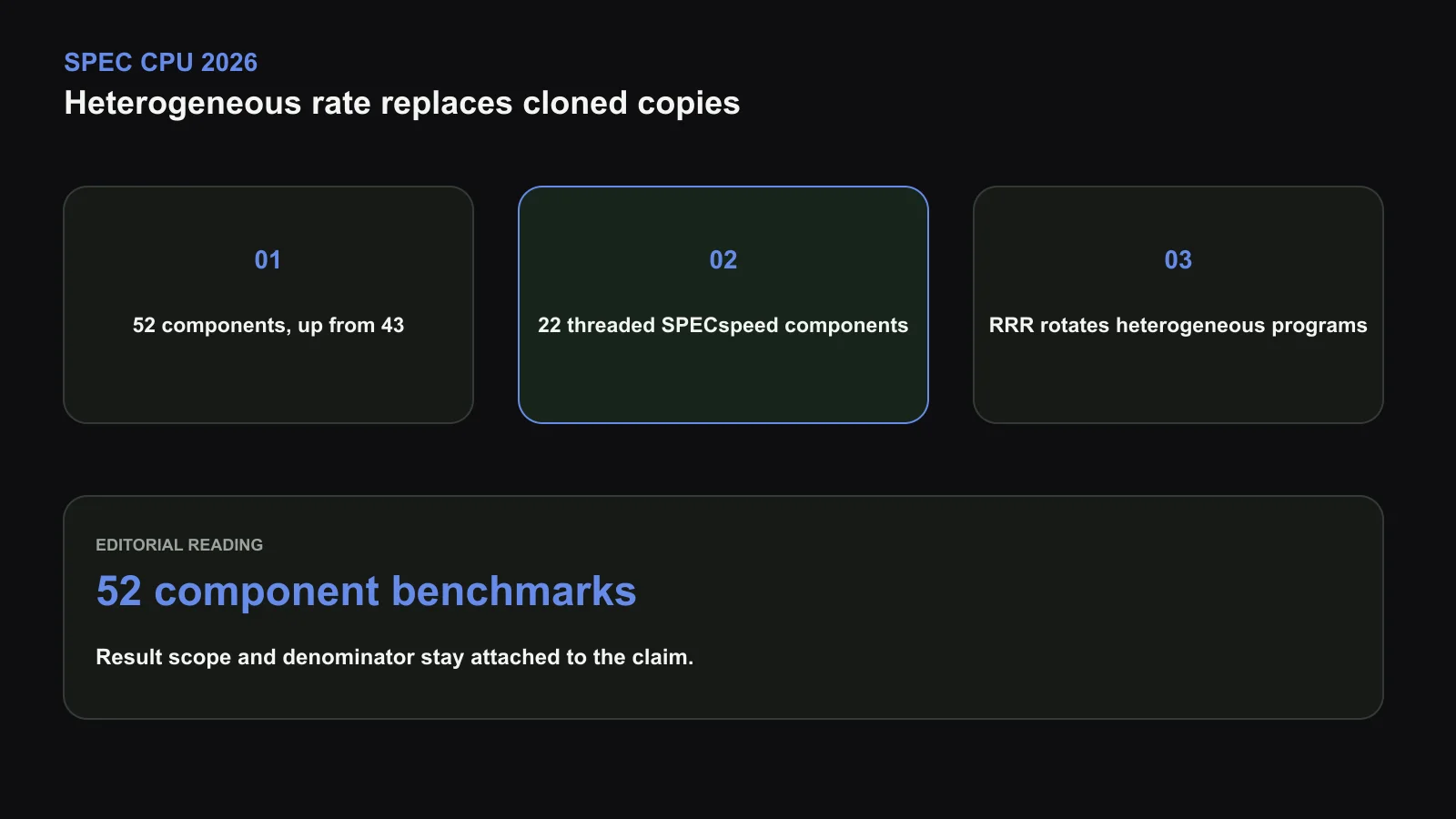
CPU2026 contains 52 component benchmarks, up from 43. It adds front-end-bound integer applications with large code footprints and expands multithreading: 13 floating-point and nine integer SPECspeed components use parallelism. Applications remain native C, C++, and Fortran so results avoid the run-to-run and portability complications of managed runtimes.
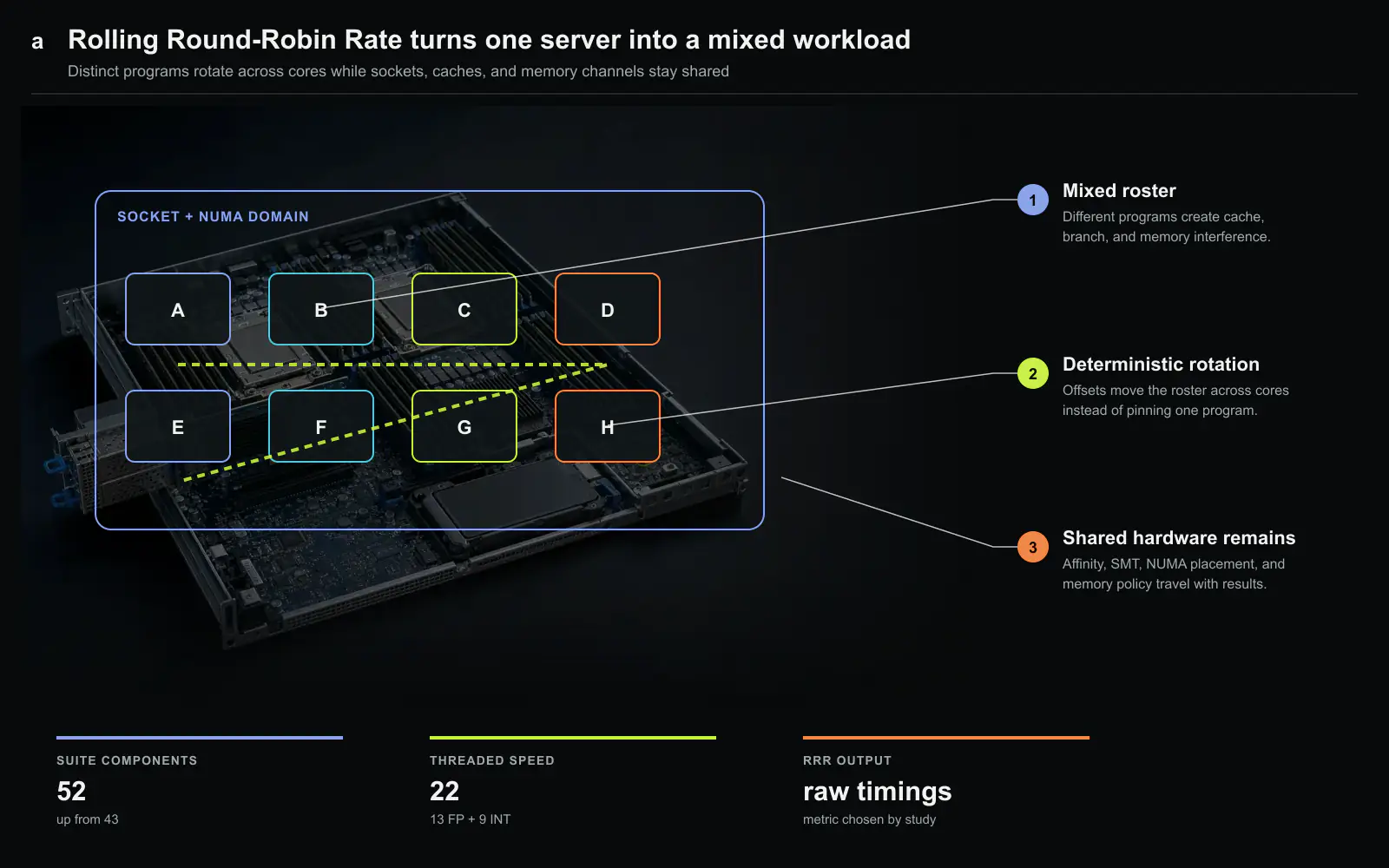
Rolling Round-Robin Rate (RRR) is the conceptual change. Each core executes all benchmarks in a roster, but starts at a different offset and advances through the list. The machine therefore sees mixed instruction, cache, memory, and branch behavior under one repeatable schedule. Researchers may use subsets and different increments, provided the configuration remains documented.
A long-lived suite must change without losing comparability
SPEC CPU suites become reference points for processor design, compiler tuning, academic evaluation, and procurement. Their stability is useful because results accumulate across vendors and generations. The same stability becomes a weakness when applications, core counts, memory systems, and software parallelism change enough that the suite no longer exercises the machine being purchased.[1]
CPU2026 expands from 43 to 52 component benchmarks and adds applications selected for newer front-end, memory, and parallel behavior. A larger count does not automatically mean broader coverage; the important question is whether the components occupy distinct performance regions and remain portable under the suite’s rules. Redundant programs can overweight one mechanism in an aggregate score.
Transition also needs overlap with prior practice. Buyers may want to connect a CPU2017 history to CPU2026, but there is no exact conversion when program mix and methodology change. Running both suites on several systems can show correlation and discontinuities; a fixed scaling factor would conceal the very behavioral changes the new suite was created to capture.
Native languages preserve one kind of control
The components use C, C++, and Fortran. Native builds let SPEC define compiler options, portability flags, run rules, and reference inputs without the nondeterminism of a managed runtime, distributed service, or frequently changing dependency graph. This strengthens cross-system reproducibility for core and compiler studies.
It also narrows the claim. Modern datacenter services rely on Java, Python, JIT compilation, garbage collection, RPC, kernels, storage, and network stacks. CPU2026 can improve front-end and threaded coverage while still omitting those service effects. It is a general-purpose compute suite, not a complete fleet proxy.
The right use is layered. CPU2026 can isolate processor and compiler behavior under controlled applications; service suites can test deployment software and SLOs; microbenchmarks can diagnose one resource. Agreement across layers builds confidence, while disagreement identifies where an abstraction stopped representing production.
More threaded speed workloads change the single-copy story
Thirteen floating-point and nine integer SPECspeed components use parallel execution. This recognizes that one application instance can consume several cores, sharing caches, memory bandwidth, and synchronization resources. It also lets the suite test scaling behavior that a purely single-threaded speed measurement would miss.
Thread count and affinity become first-order configuration. A result must specify how threads map to physical cores, simultaneous multithreading, NUMA domains, and memory. A high thread count can improve completion time while reducing efficiency per core. Frequency and power may change when more cores become active.
Parallel components do not make the suite a distributed benchmark. Their communication remains within one system image and follows the selected applications. They cannot reproduce network collectives, service fan-out, or cluster failures. Their value is to bring shared on-chip resource pressure into a controlled CPU suite.
Front-end pressure is no longer a side case
Large code footprints, indirect control flow, and instruction delivery can limit modern CPUs even when arithmetic and data caches are underused. CPU2026 adds integer applications intended to expose more of this behavior. Instruction cache, translation structures, branch prediction, decode bandwidth, and micro-op storage can determine performance.
This matters for design balance. A wider backend adds little when the front end cannot supply work. Compiler layout, function ordering, link-time optimization, and code-size choices can be as important as execution units. A suite with varied footprints gives those mechanisms a more visible role.
However, source compilation can amplify tuning differences. Vendor compilers may use profile-guided optimization or architecture-specific flags within the rules. Results should disclose base and peak configurations and distinguish portable improvement from extensive per-benchmark tuning. A purchasing decision based on a compiler configuration unavailable to the deployment can overstate the CPU benefit.
RRR creates reproducible heterogeneity
Traditional rate testing commonly launches several copies of one benchmark. This measures throughput under homogeneous pressure but does not resemble a server where different programs share caches, memory channels, and cores. RRR constructs a roster of distinct programs and rotates their starting positions across cores.
Every core eventually runs the roster, so start order does not permanently assign one program to one core. Different offsets keep the machine under mixed pressure. The schedule is deterministic enough to repeat, while subsets and increments let researchers create controlled experiments. This is a workload-construction method rather than one mandatory policy metric.
The rotation also reduces one source of placement bias, but it does not eliminate all interference. Programs can overlap at different phases, operating-system scheduling can move threads, and shared last-level cache or memory effects depend on timing. Repeated runs and phase analysis are necessary when small differences matter.
Raw results preserve several policy questions
RRR does not collapse throughput, fairness, slowdown, quality of service, and energy into one official score. This restraint is useful because those objectives can conflict. Maximizing total completed work may allow one program to slow severely; minimizing worst-case slowdown may leave capacity unused.
Researchers can compute aggregate throughput, harmonic or geometric slowdown, tail behavior, or per-workload interference from the raw durations. Heterogeneous-core studies can assign programs to different core types and evaluate mapping policy. Shared-cache and memory studies can compare controlled rosters.
The absence of one score increases reporting responsibility. Authors must define the metric, baseline, roster, increment, repetition, and treatment of incomplete work. Two papers can both use RRR yet answer different questions. The method is reproducible only when configuration travels with the result.
Score publication requires a stable run contract
SPEC results depend on source version, toolchain, flags, libraries, operating system, firmware, memory, affinity, and run rules. Disclosures and review make published records comparable. Research use can relax some requirements, but modified settings should not be presented as an official score.
Base and peak results answer different tuning questions. Base emphasizes a common set of compiler options, while peak permits more benchmark-specific optimization within rules. Buyers should compare the mode that resembles their software practice and inspect flags that materially affect results.
Reproducibility also includes environmental stability. Turbo policy, cooling, power limits, background services, and NUMA placement influence sustained performance. Repeated measurements and disclosure of variability matter more as reported differences shrink.
RRR can study heterogeneous processors carefully
Processors increasingly combine cores with different performance, power, cache access, or instruction capabilities. A homogeneous-copy rate test can miss the scheduler problem because every task appears equivalent. A mixed roster lets researchers ask which program belongs on which core and how migration affects shared resources.
One must separate hardware capability from oracle scheduling. Mapping each benchmark with foreknowledge of its full run can produce an upper bound unavailable to a real operating system. A practical policy should use online signals and include decision overhead. RRR supplies repeatable work; the scheduler evaluation must remain honest about information.
Fairness is also workload relative. A compute-bound program and memory-bound program can coexist efficiently, while two bandwidth-heavy programs interfere. Reporting isolated baselines allows slowdown to be attributed to sharing. The chosen roster should represent the decision domain rather than maximize one favorable pairing.
A suite influences hardware before publication
CPU benchmarks guide branch predictors, caches, prefetchers, vector units, and compilers during development. Once vendors optimize heavily for a fixed suite, improvements can become specific to its known programs. New components restore novelty temporarily, but long-term governance must watch for overfitting and retire workloads that cease to distinguish systems.
This does not make optimization illegitimate. Compiler and architecture changes that help a benchmark mechanism can help real programs with the same behavior. The concern is representativeness: whether the weighted suite reflects the population for which claims are made. Per-component data and external workloads are safeguards against one aggregate number dominating design.
CPU2026’s expanded code and RRR method improve that evidence base. They do not remove the incentive to tune, which is why transparent configurations and complementary benchmarks remain essential.
What the suite still cannot answer
It does not model managed-runtime warm-up, online services, databases distributed across nodes, accelerators, network failures, or rack power. It also cannot determine the workload weights of a particular organization. A CPU with an excellent aggregate score may be the wrong purchase if the buyer’s largest service stresses a missing behavior.
Energy and cost need separate data. Completion time can be combined with measured power, server price, memory capacity, and licensing to form a procurement model, but CPU2026 alone does not provide that denominator. Rate throughput under RRR likewise does not define a universal QoS policy.
The appropriate conclusion is scoped: CPU2026 provides a newer, more diverse, reproducible basis for general-purpose CPU and compiler analysis. Production decisions should validate its direction against local services and system constraints.
What readers should demand in a result
Every claim should identify suite revision, component or roster selection, speed or rate mode, RRR increment and offsets, base or peak rules, compiler and flags, thread and affinity policy, memory configuration, firmware, power limits, and repeated-run variability.
Aggregate scores should be accompanied by component results so regressions and mechanism-specific wins remain visible. RRR studies should publish isolated baselines and the selected policy metric. Comparisons with CPU2017 should be empirical on shared systems rather than derived from an assumed conversion.
These conditions preserve the suite’s central asset: a result another group can interpret and reproduce without guessing which hidden configuration created it.
Statistical practice matters more in mixed runs
RRR adds phase and interference variability to the ordinary run-to-run variation of a benchmark. A result should use enough repetitions to estimate its distribution and should avoid selecting the best rotation. Reporting median and spread by component makes a small aggregate difference easier to judge.
Order effects deserve a test. Changing offsets or roster order can reveal whether one published configuration benefited from favorable phase alignment. A robust hardware conclusion should persist across reasonable schedules, while a scheduler study may intentionally analyze that sensitivity. Warm-up, filesystem cache, and frequency state should be controlled or randomized consistently.
When comparing many components, isolated statistically significant wins can occur by chance. Effect size and consistency across mechanisms matter more than a collection of small p-values. Microarchitectural counters can support causality when they connect a performance change to front-end, memory, branch, or execution behavior.
Procurement requires local weights
A buyer can map component behaviors to its software inventory, but it should not invent precise weights without profiling. Start from fleet CPU time, power, latency sensitivity, and growth by workload class. Use CPU2026 components as mechanism probes, then validate candidate systems with representative services.
Memory capacity per socket, power, platform price, security features, and software licenses can outweigh a suite score. A 10% faster CPU that reduces rack density or requires more expensive memory may not lower total cost. Conversely, a modest aggregate gain can be valuable if it appears in the buyer’s dominant front-end-bound service.
The suite supports this decision by making controlled differences visible. It does not supply the organization’s utility function. Keeping those roles separate prevents a standardized score from becoming a universal purchasing formula.
Performance projections should include uncertainty from workload mapping. If a local service appears partly front-end-bound and partly memory-bound, several components may serve as imperfect proxies. A range derived from them is more honest than choosing the one benchmark that favors a candidate CPU.
The final purchase should be back-tested after deployment. Compare predicted and observed service capacity, then record which CPU2026 components tracked the result and which did not. This correspondence history improves the next procurement cycle and identifies when the suite or local weighting has become stale. It also gives compiler and architecture teams a concrete explanation for differences between standardized progress and the buyer’s realized capacity. Those explanations are often more valuable for the next design than the aggregate score itself. They guide investment.
What we take from it
RRR standardizes workload construction, not the policy conclusion. The suite intentionally leaves researchers free to compute throughput, fairness, interference, or QoS metrics from raw results. That makes the method useful for heterogeneous core allocation and shared-cache studies without pretending one aggregate score answers every question. CPU2026 will still miss managed services and distributed applications, but it gives general-purpose microarchitecture a more modern and reproducible baseline.
Source and attribution
This article is an original editorial summary with two newly created figures. No paper text, figure, or table is reproduced. The authors made a public arXiv manuscript available; the authoritative ISCA proceedings version is © IEEE 2026.