A change of GPU should be qualified as a change of numerical implementation, even when the application retains the same tensor types. An FP32 destination describes how a result is stored; it does not describe every intermediate sum that produced that result. This distinction matters when an infrastructure team compares accelerators, enables a lower-precision kernel or tries to reproduce a training failure. A faster configuration that passes a small random-input test can still behave differently on cancellation, tiny gradients or a large accumulated partial result.
Microsoft Research’s MMA-Sim study, presented at MICRO 2026, makes those hidden arithmetic choices inspectable[1]. The work reconstructs instruction-level models for ten GPU architectures and checks them against hardware. Its useful contribution is an executable explanation of numerical differences, rather than another scalar accuracy score. This review examines how that explanation is built, what its experiments establish, and how a deployment team can use it without confusing a matching simulator with proof of model quality.
Three questions that require different reference results
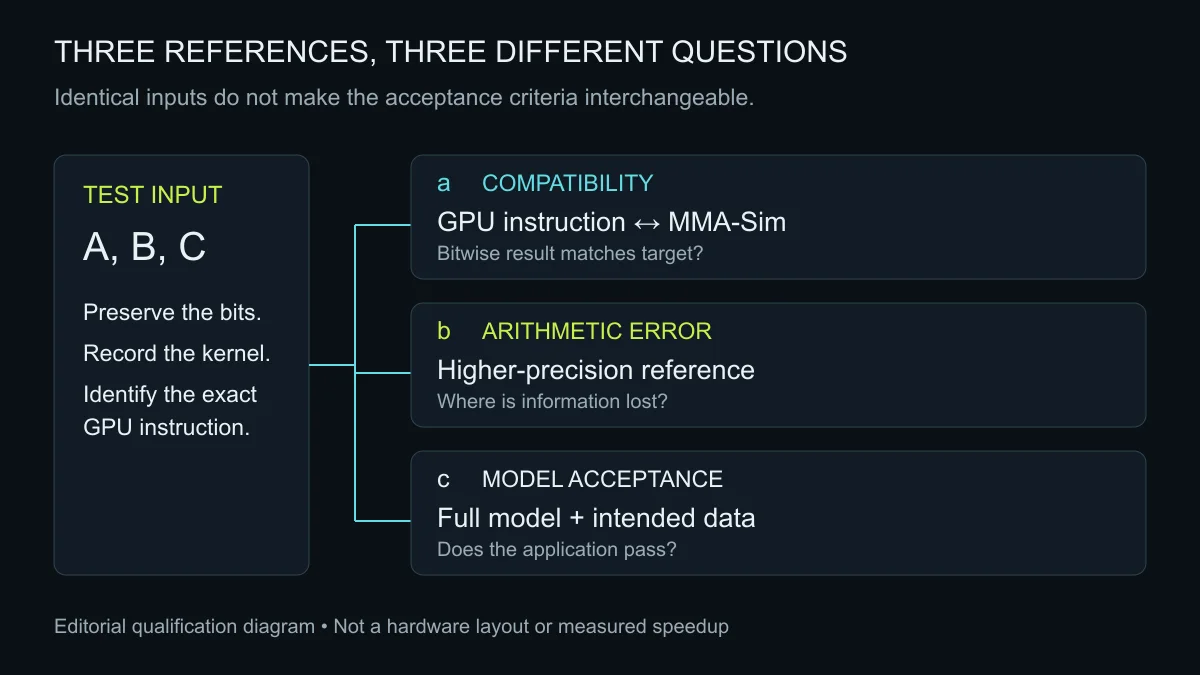
Numerical qualification begins by choosing the question. Does a simulator reproduce the target instruction? Does the instruction approximate the mathematical operation accurately? Does the resulting neural network meet its application requirements? These questions can have different answers for the same output.
For the first question, the reference is the selected GPU instruction. A simulator that duplicates an unusual rounding rule is correct as a compatibility model, even if another rounding rule would produce a smaller mathematical error. For the second question, an independent higher-precision calculation is more useful. For the third, the relevant evidence is a model-level evaluation with the intended precision policy, data and workload. Neither a bitwise match nor a low matrix error automatically establishes the last result.
This separation also changes debugging. If the simulator and instruction disagree, the immediate problem is an incomplete model, a test harness issue or an unexpected instruction mapping. If they agree but differ from the higher-precision result, the model can help explain the arithmetic. If the operator is numerically acceptable but the application fails, attention must move to composition, reduction order, scaling or other parts of the execution. Treating all three cases as an undifferentiated GPU accuracy issue wastes engineering effort.
The missing specification between inputs and outputs
Matrix multiply-accumulate computes a matrix product plus an accumulator. Real hardware must decide how many products share an internal sum, how their exponents are aligned, when insignificant bits are discarded and where rounding occurs. The accumulator may enter the same fused operation as the products or be combined with a previously computed partial result. Identical external types leave these choices unresolved.
Floating-point addition already depends on grouping. Suppose two large terms cancel and several smaller terms should remain. If the small terms lose their low-order bits while aligned with a large term, cancellation cannot restore those discarded bits. A different grouping can preserve more of the residual. Internal precision and normalization introduce additional distinctions beyond simply evaluating a familiar expression from left to right.
NVIDIA’s instruction documentation leaves aspects of MMA accumulation behavior unspecified for relevant instruction families[4]. PyTorch likewise warns that mathematically equivalent operations need not give identical floating-point results across implementations[3]. A backend can therefore change a numerical result without violating a promise of bitwise portability. The engineering issue is to identify which behavior the application depends on and test it explicitly.
Turning a surprising output into an arithmetic rule
The paper’s closed-loop feature probing starts with carefully constructed inputs. It first checks whether repeated execution is deterministic and whether identical dot products behave consistently at different output positions. That consistency allows the investigation to focus on one output element rather than reconstructing a separate rule for every matrix position.
The next probes isolate reduction grouping and arithmetic features. Large positive and negative terms reveal where cancellation happens. Progressively smaller contributions expose the effective precision of an internal sum. Inputs around rounding boundaries help distinguish directed rounding from nearest rounding. Other cases test whether a product is renormalized before it joins the sum. These are controlled experiments: changing one property of the input is intended to make a particular implementation choice observable.
An executable model assembled from those observations is then compared with the real instruction. The tests include ordinary random distributions, cancellation-sensitive inputs and random bit patterns. The last class covers unusual exponent ranges and special values that a normal distribution rarely exercises. When a mismatch appears, the authors reduce the failing input, often to only two to four relevant elements, and investigate the remaining values. The resulting case becomes another reusable feature probe.
The feedback loop is the central mechanism. Recording that two devices disagree is only the beginning; the model must predict the disagreement on subsequent inputs. However, this remains empirical reconstruction. Passing many tests is strong evidence for the modeled instructions and tested conditions, not a formal enumeration of every possible input. Nor is the process fully automatic: the paper identifies manual model construction and investigation of newly discovered behavior as part of the workflow.
What ten architectures establish
The hardware study spans NVIDIA V100, T4, A100, RTX 4090, H100, B200 and RTX PRO 6000 Blackwell, alongside AMD MI100, MI250X and MI300X. This is a specific experimental set, corresponding to seven NVIDIA and three AMD architecture families. It should not be expanded into a claim about every accelerator available today.
The test interface matters as much as the device list. The researchers use CUDA with inline PTX for NVIDIA and HIP with instruction intrinsics for AMD, checking how those interfaces map to actual hardware instructions. A library-level matrix multiplication can introduce extra tiling, casts and reductions. Modeling that entire library call without controlling its instruction sequence would mix hardware behavior with software decisions.
The models reveal several distinct ways of assembling a dot product. Some use chains of fused multiply-add operations. Others combine several products before a final normalization, with architecture-specific truncation and rounding. In the examined CDNA2 FP16 path, treatment of subnormal inputs adds another source of error. Thus, the input label alone is an incomplete key for a numerical model; the architecture, instruction variant and output type are also needed.
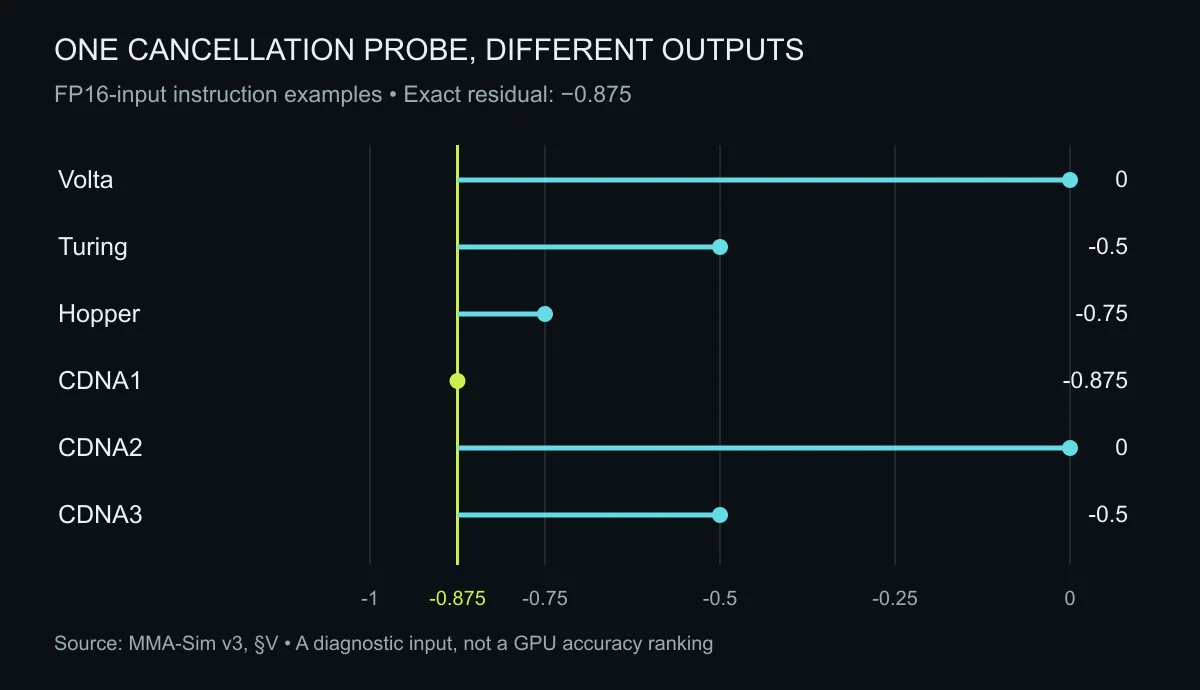
This distinction is visible in one deliberately cancellation-sensitive example. The paper combines a positive accumulator of 2²³ with a product of −2²³ and residual terms −0.5, −0.25 and −0.125. Exact arithmetic leaves −0.875. Selected FP16-input instructions instead return 0 on Volta and CDNA2, −0.5 on Turing and CDNA3, −0.75 on Hopper, and −0.875 on CDNA1. These are outputs for this input, not average errors or a ranking of the GPUs’ model quality.
Why the accumulator width is not enough
A particularly useful result concerns the examined FP8 paths on Ada Lovelace and Hopper. The inferred internal fused sum retains 13 fractional bits, while the compared non-FP8 paths retain 24 and 25 respectively. The corresponding ratios in the paper concern bounds on an internal error term. They are not measured multipliers for training loss, and they cannot be converted into a percentage drop in model accuracy.
The paper also identifies an output-rounding restriction for those FP8 paths even when the destination is FP32. Writing the result into a wider container does not recover information already discarded. Conversely, using an instruction with sufficient internal precision and then storing FP16 can make the final conversion the dominant limitation. A precision policy therefore needs to consider input conversion, accumulation and output conversion separately.
Generation names are not a substitute for this analysis. The tested Blackwell FP8 implementations use different precision parameters from the tested Hopper implementations. A mitigation designed for one generation may impose unnecessary cost on another. Even on the same device, changing the instruction family or destination type can change the relevant arithmetic. Numerical qualification must follow the selected kernel rather than a broad vendor label.
Mitigations move both error and execution cost
The paper studies targeted workarounds rather than one universal precision upgrade. For the examined CDNA2 FP16 path, scaling small inputs upward can avoid subnormal flushing, followed by rescaling of the output. Its example multiplies two 128-by-128 matrices: A has normally distributed values with mean zero and standard deviation 0.001, while B has mean zero and standard deviation one. The reported mean squared error falls from 7.632 × 10⁻⁹ to 1.591 × 10⁻¹⁸ against an FP64 reference. The result belongs to that input distribution and matrix experiment; it is not a measured training-accuracy improvement.
Scaling is attractive because it addresses the point where information disappears. It also requires range analysis. Scaling that protects very small values can bring large values closer to overflow, and the extra operations need placement within the real kernel. An application with changing activation distributions cannot assume that a constant scale chosen from one test remains suitable throughout training.
For CDNA3, the paper investigates a directional bias associated with internal rounding in selected mixed-precision instructions. One workaround performs the matrix product with a zero accumulator and adds the original accumulator separately using FP32 arithmetic. This changes where the accumulator participates in rounding. It does not make every component of the product exact, and it may require additional instructions or intermediate handling.
On the examined NVIDIA paths, alternatives include retaining FP32 output and replacing a precision-limited FP8 operation with a higher-precision instruction when accuracy is the priority. These changes can affect tensor-core throughput, register pressure, data conversion and memory traffic. The paper’s arithmetic experiments justify testing the alternatives; they do not provide an end-to-end cost curve for every production model. A deployment decision needs paired quality and performance measurements for the actual candidate kernel.
A practical place for an executable reference
We would use MMA-Sim in a layered qualification process. First, preserve the failing input and identify the exact instruction variant emitted by the compiler or selected by the library. Then compare that instruction with the matching simulator model. Only after this local comparison is understood should the investigation expand to the complete matrix kernel and network. This order limits the number of uncontrolled choices in each experiment.
The regression collection should retain inputs that expose cancellation, subnormal handling, saturation or rounding asymmetry, together with representative application samples. It should also record device architecture and the software versions that select the kernel. A compiler update can change an instruction sequence even when the application code and tensor types stay fixed. Rechecking only the final output shape would miss that change.
The simulator is a diagnostic tool rather than a replacement for hardware benchmarking. The paper reports that GPU acceleration reduces a million-test simulation phase from roughly 10–20 hours to about one hour. Constructing a model for an instruction typically takes 2–12 hours when the usual revision loops are included. These are modeling costs, not inference latencies or speedups in the application under study. The released implementation and equivalence tests provide a concrete starting point for independent checking[2].
Model-level acceptance should then measure the consequence the operator actually cares about: validation loss, convergence behavior, task quality or another defined requirement. A small systematic error can matter differently from an unbiased distribution with a similar mean squared error. Similarly, preserving an old bit pattern can be valuable for reproducibility without being the most accurate arithmetic choice. Those objectives should be selected before using numerical tests to approve a deployment.
The purchasing and porting decision
MMA-Sim adds an inspectable arithmetic layer to accelerator evaluation. A procurement comparison that records only format support and peak throughput omits behavior that can change the usable precision policy. If a candidate device needs a more expensive kernel to meet the same quality target, that kernel’s throughput is the relevant input to capacity planning. If the application tolerates the observed differences, a bitwise mismatch alone should not disqualify it.
The study does not establish a universal winner across NVIDIA and AMD, nor does one cancellation example justify such a ranking. It provides a way to explain why nominally similar operations differ and to target the expensive part of a fix. The resulting engineering decision is concrete: choose an instruction path whose numerical behavior is understood, measure its effect on the intended model, and compare the cost of the configurations that actually pass that requirement.
Source and copyright notice
This is an independent editorial analysis of the MICRO 2026 paper by Peichen Xie, Shuotao Xu, Yang Wang, Fan Yang and Mao Yang, all affiliated with Microsoft Research in the reviewed manuscript. The reviewed version is arXiv v3, dated September 28, 2026; the article’s source date records the work’s first public release on November 14, 2025. The arXiv copy is marked CC BY-NC-SA 4.0, with copyright retained by its rights holders. The separate software repository uses the MIT license. This article uses newly written explanations and original diagrams, with reported numerical facts distinguished from our deployment analysis. No source figure, table or passage is reproduced, and we did not independently rerun the ten-GPU experiments.