Llama 3 405B consumed about 3.8 × 10^25 floating-point operations during pretraining on 16,384 H100 GPUs. At that scale, the question is not whether to parallelize but which dimension should pay each communication cost. Meta’s ISCA 2025 paper documents a four-dimensional answer and, more importantly, why the answer must change during training[1].
Four partitions solve different limits
Fully sharded data parallelism distributes parameters, gradients, and optimizer state. Tensor parallelism splits individual layers and pays frequent collective communication. Pipeline parallelism assigns layer groups to stages but creates bubbles when microbatches are scarce. Context parallelism divides long sequences, reducing per-GPU activation pressure while introducing attention communication.
No one dimension dominates. Llama 3 has phases with different sequence lengths, batch sizes, model structures, and GPU allocations. Long-context training can reduce the global batch so far that a conventional pipeline schedule lacks enough microbatches to fill stages. Meta therefore developed a pipeline schedule that tolerates changing batch shapes and a context-parallel method that supports document-mask attention rather than assuming one continuous sequence.
Efficiency includes diagnosis
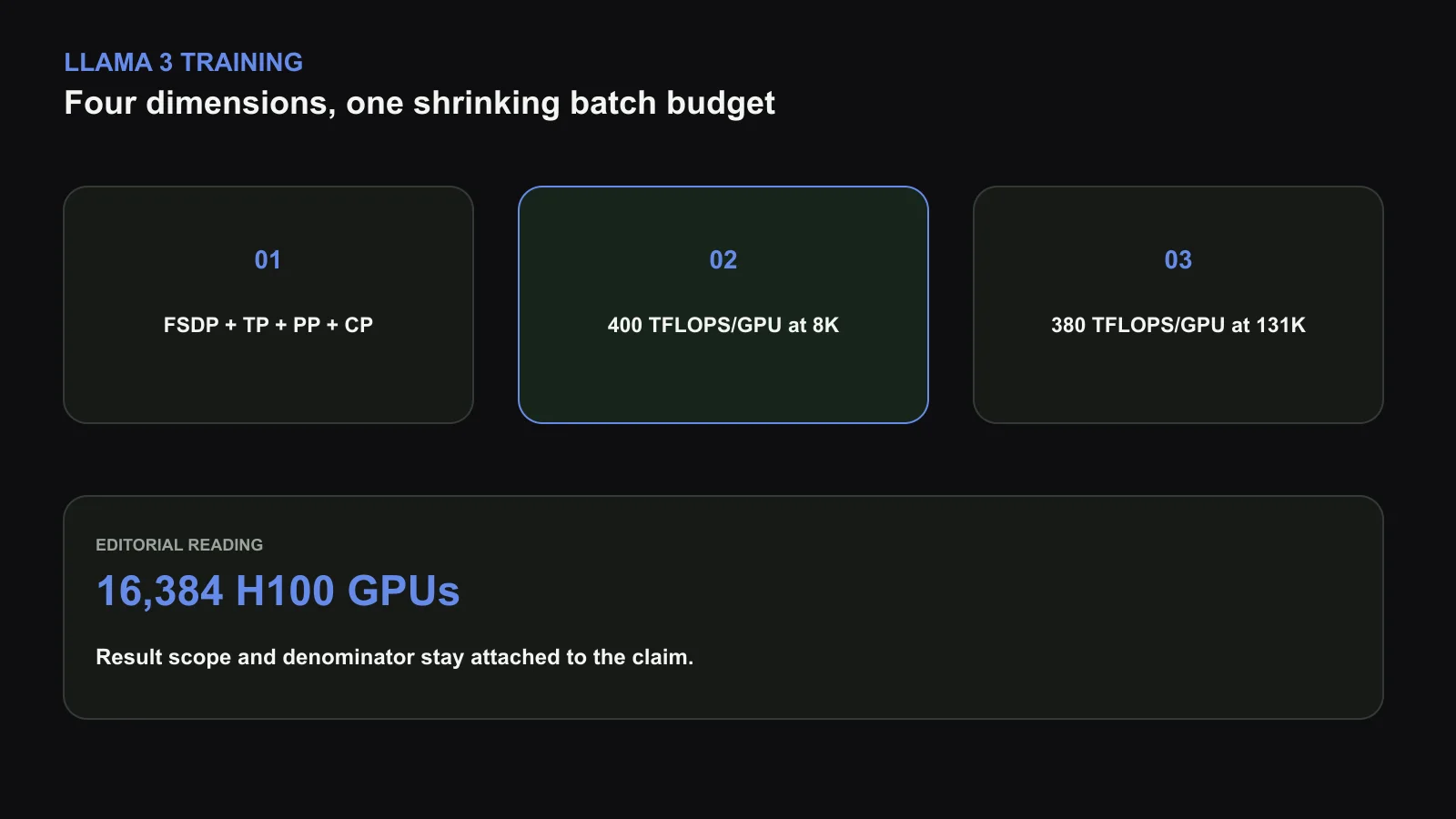
The implementation reports about 400 TFLOPS per GPU for an 8K sequence and 380 TFLOPS per GPU at 131K. One context-parallel attention experiment achieves 3.89× scaling from one to four GPUs. These figures are useful operating points, not isolated kernel peaks. They include schedules designed around a model whose batch and architecture evolve.
The paper gives debugging equal architectural weight. A numerical error or straggler that appears only after thousands of ranks synchronize cannot be treated as an ordinary application bug. Profiling, deterministic comparison, and identifying the responsible rank are necessary to preserve useful machine time. At 16,384 GPUs, observability sits on the critical path to performance.
The memory equation comes before the topology
A 405-billion-parameter model cannot be placed by counting arithmetic units alone. Parameters, gradients, optimizer state, activations, temporary buffers, and communication workspaces compete for HBM. Their sizes change with precision, sequence length, checkpointing policy, and training phase. Fully sharded data parallelism distributes the persistent model states, but each rank must still gather the pieces needed for its current layer and retain activations required by backward computation.[1]
This is why a parallel layout that fits an 8K-token phase may fail at 131K tokens even with the same weights. Attention and activation memory grow with sequence structure, while the global batch may shrink to remain within a fixed training objective. The system then has fewer microbatches available to fill a deep pipeline. Capacity and utilization therefore change together rather than forming two independent tuning problems.
The correct starting point is a per-rank memory budget for each phase. Only after weights, states, activations, and safety margin fit should the planner compare communication. Otherwise, an apparently efficient layout will fail at runtime or rely on emergency recomputation and host offload that invalidate its throughput estimate.
Each parallel dimension buys a different resource
FSDP increases aggregate model-state capacity by sharding parameters, gradients, and optimizer state across data-parallel ranks. It pays all-gather and reduce-scatter traffic around layer execution. Tensor parallelism divides operations within a layer and can pool memory at finer granularity, but its collectives occur frequently and are sensitive to fast links. Pipeline parallelism assigns layer ranges to stages, reducing per-rank state while introducing bubbles and point-to-point activation transfers.
Context parallelism splits one long sequence across ranks. It directly reduces per-GPU activation and KV-related pressure, but attention still requires information from other context partitions. The communication pattern must also preserve document masks so tokens from separate packed documents do not attend to one another. A context method designed only for one continuous sequence would change training semantics even if it ran quickly.
These dimensions are not interchangeable. Increasing tensor parallelism may relieve HBM but add a collective to every layer. Adding pipeline stages can lower memory while losing utilization when the batch supplies too few microbatches. More FSDP ranks can extend the sharding group beyond the fastest network domain. The selected composition is a mapping from algorithmic state to physical hierarchy, not a label attached to the job.
Pipeline bubbles become a batch-semantics problem
A conventional pipeline fills stages with microbatches, reaches steady state, and drains them. The fraction of idle slots falls when the number of microbatches is large relative to the number of stages. Frontier training cannot always increase that number: the global batch is constrained by optimization behavior, and long sequences consume enough memory that each microbatch may already be minimal.
Meta’s schedule is designed to tolerate changing batch shapes and training phases rather than requiring one fixed relationship. The scheduler coordinates forward and backward work while respecting activation availability and memory pressure. The goal is not merely to reduce a textbook bubble ratio. It is to keep a valid training batch moving when sequence length, pipeline depth, and accumulation policy change during the run.
This result has a software implication for accelerators. Hardware can provide fast links, but the runtime needs programmable schedules, asynchronous transfers, and memory accounting fine enough to change layouts without rebuilding the entire training stack. A device optimized for one static pipeline may leave expensive capacity idle during the phase that matters most.
Network hierarchy constrains the composition
The 16,384 GPUs are not connected by one uniform fabric. Links inside a server have different bandwidth and latency from links across racks or larger domains. High-frequency tensor collectives belong on the fastest local connections when possible. Lower-frequency sharding or pipeline traffic can cross slower levels if message size and overlap make it tolerable. A logical degree that ignores placement can turn one topology hop into the dominant training cost.
Collective algorithms also change with message size and group shape. Ring, tree, and hierarchical implementations trade bandwidth efficiency against latency and concurrency. Several parallel dimensions may issue communication at once, so optimizing each collective in isolation can create contention. The planner must consider overlap between computation, tensor reductions, parameter gathering, and pipeline transfers.
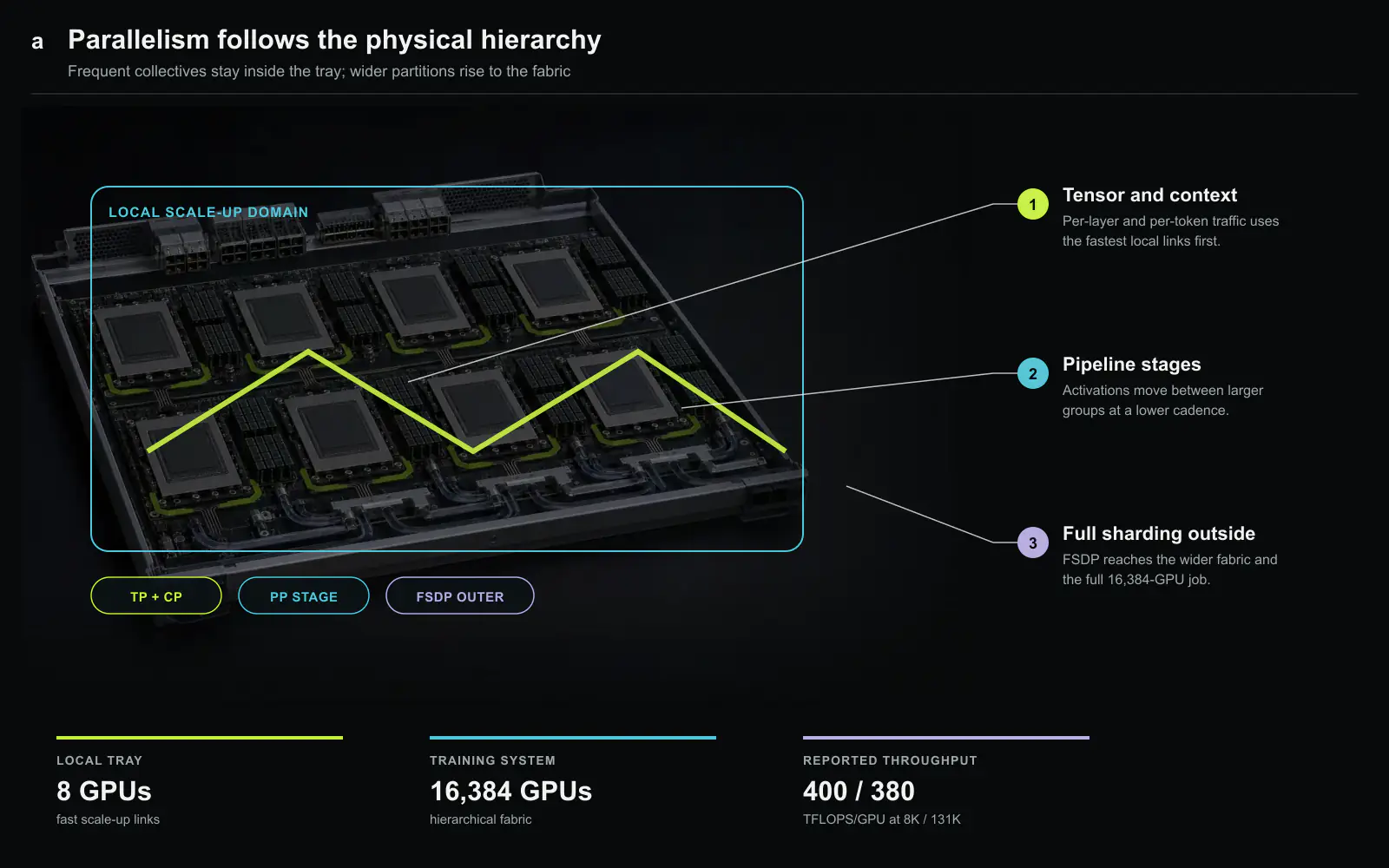
Reported TFLOPS per GPU are consequently system measurements at selected layouts. They reflect the model, precision, kernels, schedule, network placement, and periods included by the profiler. They should not be compared with peak tensor-core throughput or another training result whose sequence, batch, sparsity, and accounting differ.
Long context changes more than attention cost
At 131K tokens, activation storage and attention communication become first-order constraints. Context parallelism allows several GPUs to share one sequence, but it also creates load-balance questions when packed documents have different lengths or masks. Work should be divided by effective attention and token processing, not merely by equal numbers of positions.
Long sequences also reduce the number of independent examples that fit in the global batch. This weakens data and pipeline concurrency just when more memory pooling is needed. Checkpointing activations can save HBM but repeats computation in the backward pass. The best layout therefore depends on the relative price of compute, local link bandwidth, global link bandwidth, and memory at that phase.
The reported 380 TFLOPS per GPU at 131K, compared with about 400 at 8K, shows that the implementation retained much of its throughput at the evaluated points. It does not imply that every sequence length between them has the same efficiency or that communication is negligible. Operators need a phase-by-phase curve and tail behavior, especially when rare long examples determine the maximum memory reservation.
Failure and diagnosis are part of scaling efficiency
A job consuming 3.8 × 10^25 operations runs long enough to encounter hardware, network, software, and numerical faults. A transient error that forces a restart wastes all computation since the last checkpoint. A straggler can hold thousands of peers at a collective without producing a clear crash. At this scale, mean kernel throughput is insufficient; useful training throughput includes checkpoint time, recovery, degraded components, and time spent locating divergence.
Numerical faults are especially difficult because the first visible loss divergence may occur long after a rank produced a bad value. Deterministic replay, rank-local checksums or comparisons, synchronized logging, and progressively narrower reproduction are needed to identify the source. Performance debugging similarly requires traces that connect model operations to collective groups and physical links.
Observability has a budget. Logging every tensor or event would overwhelm storage and perturb timing. The system needs tiered signals: cheap continuous health and progress metrics, sampled profiles, and detailed capture triggered around an anomaly. The paper’s inclusion of debugging techniques is evidence that these facilities are part of the machine’s effective architecture.
Reconfiguration has its own cost
Changing parallel degrees between training phases can recover capacity and utilization, but model state must be redistributed. Parameters, optimizer shards, and checkpoint layouts may no longer align with the new groups. The transition can require a coordinated pause and substantial network traffic. A layout that is 3% faster for a short phase may not repay its conversion cost.
The training system should estimate the remaining work in a phase, the expected throughput difference, and the cost and risk of redistribution. It also needs a restartable checkpoint at the boundary because partial remapping across thousands of ranks is a complex failure point. Configuration should be versioned with the checkpoint so a recovered job reconstructs the same groups and schedules.
This makes adaptive parallelism a control problem. Offline models can propose layouts from memory and topology, while online measurements verify whether collectives and kernels meet the forecast. Changes should occur at safe phase boundaries with an explicit amortization test, not as continuous reactions to transient noise.
What future systems should expose
Accelerators need fast collective primitives and enough local memory, but flexibility matters as much as a peak link rate. The runtime should form and reshape groups, select collective algorithms, overlap transfers, reserve workspaces, and attribute stalls to a particular parallel dimension. Counters should identify whether a rank waited for data, a collective, a pipeline neighbor, or memory allocation.
Schedulers need topology awareness from node to global fabric and must keep the selected groups physically aligned. Checkpoint services need bandwidth and formats that support changing shard layouts. Compilers need operator implementations that remain efficient under different tensor and context partitions. None of these layers can be optimized independently if the training plan changes across sequence-length phases.
For a reader comparing training systems, the decisive disclosure includes model and precision, sequence and batch, activation policy, all four parallel degrees, physical placement, achieved per-GPU throughput, communication share, memory headroom, checkpoint interval, and failed or degraded time. Without those conditions, a single utilization number cannot explain how much useful training the cluster delivered.
The limits of the case study
Llama 3’s architecture, training curriculum, and Meta’s network determine the reported optimum. Models with mixture-of-experts routing, different layer balance, alternative optimizers, or more memory per accelerator can select different compositions. The 3.89× context-parallel experiment from one to four GPUs demonstrates strong scaling for that attention setup, not linear scaling to the full machine.
The paper also evaluates a system already engineered around H100. It does not isolate the return of every network upgrade or prove that adding parallel dimensions is always better than using fewer, larger-memory accelerators. Its transferable contribution is the decision framework: fit all states, map frequent communication to fast links, preserve batch semantics, measure phase-specific throughput, and include diagnosis and transition cost.
A layout decision can be audited as a balance sheet
For each phase, a training team can list the bytes saved and communication added by one increment of FSDP, tensor, pipeline, or context parallelism. The table should include activation recomputation, pipeline bubble time, collective contention, and transition cost. Measured throughput then validates each term. This prevents a layout from being chosen because one parallel dimension has a familiar name or a favorable microbenchmark.
The same balance sheet supports hardware planning. If long-context phases lose time to scale-up collectives, faster local links or larger HBM may be more useful than additional peak arithmetic. If pipeline bubbles dominate because global batch cannot grow, fewer larger-memory devices can outperform a wider machine. If recovery and diagnosis consume the gap, reliability investment can return more training than a nominal compute upgrade.
Most importantly, the calculation should use useful tokens or optimizer steps per wall-clock and facility resource, not instantaneous TFLOPS. That denominator includes the changing layout, checkpoint boundaries, failures, and periods when ranks wait for one another. It is the closest operational measure of whether four-dimensional parallelism converted 16,384 accelerators into progress.
A published configuration should also include the duration of each phase and the fraction of the total run spent there. An impressive long-context operating point has limited economic impact if it covers a small fraction, while a modest improvement in the dominant pretraining phase can save far more cluster time.
What we take from it
The common description of distributed training as a choice among data, tensor, or pipeline parallelism is obsolete at frontier scale. The actual system is a changing composition of all four, constrained by batch semantics and the network hierarchy. Future accelerators should therefore expose fast collectives, enough memory for flexible partition changes, and counters that make numerical and performance faults attributable. Raw arithmetic is only one term in the training-time equation.
Parallelism is a workload contract, not a model constant
The four-way decomposition should not be copied as a fixed recipe. Tensor, pipeline, context, and data parallelism consume different links, create different bubbles, and expose different recovery units. Their balance changes with sequence length, microbatch size, optimizer state, checkpoint interval, and the topology actually available to the job. A configuration that fits pretraining can become inefficient during long-context adaptation or serving-oriented post-training.
An operator therefore needs a versioned parallelism plan for each workload phase. The plan should state placement constraints, expected communication by fabric tier, memory headroom, restart boundary, and the metric that triggers a new partition. Replaying representative traces on the target cluster is more useful than comparing peak bandwidth alone because it reveals contention with storage, checkpointing, and other tenants. The system decision is whether the chosen decomposition produces more completed tokens within the job’s time and failure budget, not whether every accelerator reports high utilization.
Source and attribution
This article independently summarizes the paper in new language. Both figures are original and no source figure or table is reproduced. The public paper is licensed under CC BY 4.0; copyright is held by the authors, © 2025.