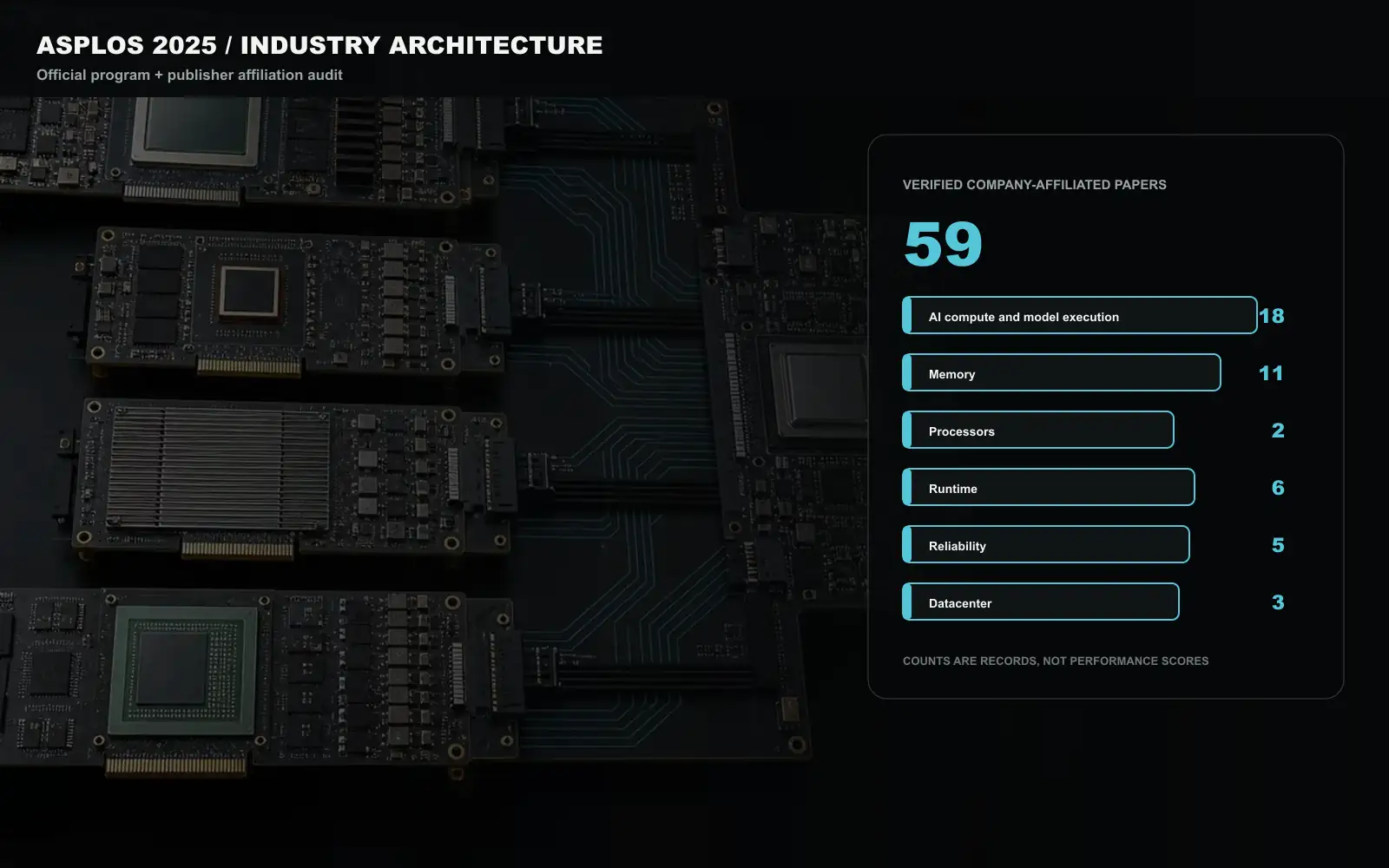
ASPLOS 2025 shows companies moving optimization across compilers, runtimes, memory managers, accelerators, and cloud control planes instead of asking one layer to absorb the whole cost. The 59 records in this review passed two checks: the title appears in the official conference program, and at least one publisher-supplied author affiliation directly names a commercial company or corporate research organization. That rule includes university-industry collaborations but excludes papers that merely acknowledge a vendor, authors whose current employer differs from the paper affiliation, and automatic institution matches that cannot be confirmed in the source metadata.[1]
The inventory is time-bounded through August 31, 2026. 37 records had an openly accessible full-text location in the discovery metadata; the remaining records are included only at the level supported by the official program and DOI metadata. We use open manuscripts for mechanism-level observations and do not reconstruct a closed paper from an abstract. Existing Silicon & Systems reviews remain linked through their DOI where available rather than being rewritten as duplicates.
What the publication count does and does not measure
A company affiliation is evidence that the work crossed an industrial research boundary. It is not evidence that the mechanism shipped, improved total cost, or survived a production workload. Some papers report fabricated silicon or deployed systems. Others present simulation, trace replay, emulation, compiler experiments, or analytical models. Those evidence classes answer different questions and cannot be ranked by one headline number.
The count also reflects publication practice. Google (9), NVIDIA (8), Microsoft (7), Alibaba (6), Huawei (6), Intel (4), IBM (3), Meta (3) appear most often in this verified set, but a company that publishes less may still deploy more. Large university collaborations can add many papers without transferring the mechanism into a product. For this reason, the complete index below preserves title, DOI, and corporate affiliation while the analysis focuses on recurring system decisions.
AI compute moved from peak arithmetic to resource contracts
The AI papers increasingly ask who controls memory, scheduling, precision, and failure recovery rather than how many operations a datapath can issue. Training and inference make different demands: training needs synchronized progress across large groups, while inference must protect latency under changing sequence length, batch size, and model state. A mechanism that improves one regime can waste capacity in the other.
The most transferable question is therefore the resource contract. A paper should identify which bytes remain resident, which work can be preempted, how much parallelism is required to reach the reported result, and what happens when the model or request distribution changes. Without those conditions, an accelerator speedup is difficult to translate into a server count or service-level objective.
Memory behavior became part of the architecture rather than an input
The memory papers span cache management, prefetching, address translation, disaggregation, storage paths, and data movement. This breadth reflects a common constraint: useful work is often limited by where state resides and when it moves, not by the peak rate of the execution units. Caches and prefetchers can reduce average latency while making interference or tail behavior harder to predict.
Production adoption needs a byte-and-time ledger. The platform should distinguish capacity saved from traffic added, local hits from remote service, average bandwidth from tail latency, and one-time migration from steady-state work. The same mechanism can look favorable in an isolated benchmark and become expensive when recovery, coherency, or multi-tenant isolation is included.
Compiler and runtime work became an architectural control plane
Compiler, runtime, and scheduling papers show that architecture is no longer fixed when the chip leaves fabrication. Kernel selection, graph partitioning, queue admission, placement, and code generation decide which hardware paths are exercised. This software control plane can recover performance from a general device, but it can also hide brittle assumptions about shapes, driver behavior, and workload repetition.
A credible evaluation should separate search cost from execution benefit, warm from cold behavior, and offline tuning from decisions made inside a service deadline. It should also test a hardware or model generation that was not used to design the policy. Otherwise the reported gain may be a successful fit to one benchmark rather than a reusable architectural mechanism.
Reliability and security need an explicit failure boundary
Security and reliability mechanisms often trade metadata, checks, sampling, or redundancy against performance. Their value depends on the failure model. A defense against one fault or attack pattern should not be read as general isolation, and a low average overhead does not reveal the worst recovery path or the state exposed during rollback.
The adoption checklist is concrete: define the protected state, the detector’s blind spots, the time to containment, the state that must be reconstructed, and the behavior when the detector itself fails. Fleet evidence is particularly valuable because it exposes background errors and operational constraints that simulation rarely includes. Even then, hardware generation and deployment policy limit transferability.
The operating decision behind this literature
Across the set, the architectural boundary moves only when another layer accepts new responsibility. More flexible hardware asks the compiler to supply better schedules. Disaggregated memory asks the runtime to place data and recover from remote faults. Shared accelerators ask the scheduler to expose interference and preemption. Security metadata asks the memory system to preserve tags through caches, DMA, and I/O.
This changes procurement and design review. Peak throughput should be accompanied by the minimum useful batch, residency requirement, worst queue delay, failure recovery cost, and software dependency. The paper that reports the largest speedup is not automatically the safest choice. The stronger candidate is the one whose assumptions match the operator’s workload and whose fallback remains measurable.
How to use the complete index
The index is grouped by the principal topic visible in each title. Several papers belong in more than one group; each appears once to keep the count auditable. A DOI link is a bibliographic record, not a statement that the full text is free to reuse. Readers should check the license on the specific manuscript before reproducing a figure or table.
The best follow-up candidates combine three properties: a mechanism that changes a system boundary, enough public evidence to preserve evaluation conditions, and an implication that matters beyond one product. Papers already covered by Silicon & Systems should be extended only when new evidence changes the judgment. The rest form a monitored backlog rather than a queue for shallow summaries.
Complete ASPLOS 2025 company-affiliated paper index
AI compute and model execution, 18 records
- Concerto: Automatic Communication Optimization and Scheduling for Large-Scale Deep Learning, Alibaba.
- Einsum Trees: An Abstraction for Optimizing the Execution of Tensor Expressions, Intel.
- FlexSP: Accelerating Large Language Model Training via Flexible Sequence Parallelism, ByteDance.
- Forecasting GPU Performance for Deep Learning Training and Inference, Meta.
- GraphPipe: Improving Performance and Scalability of DNN Training with Graph Pipeline Parallelism, NVIDIA.
- Has Machine Learning for Systems Reached an Inflection Point?, Google DeepMind.
- Load and MLP-Aware Thread Orchestration for Recommendation Systems Inference on CPUs, AMD.
- Mosaic: Exploiting Instruction-Level Parallelism on Deep Learning Accelerators with iTex Tessellation, Cambricon, Tencent.
- OS2G: A High-Performance DPU Offloading Architecture for GPU-based Deep Learning with Object Storage, Alibaba.
- PAPI: Exploiting Dynamic Parallelism in Large Language Model Decoding with a Processing-In-Memory-Enabled Computing System, NVIDIA.
- PartIR: Composing SPMD Partitioning Strategies for Machine Learning, Google DeepMind, Isomorphic Labs.
- Past-Future Scheduler for LLM Serving under SLA Guarantees, SenseTime.
- Practical Federated Recommendation Model Learning Using ORAM with Controlled Privacy, NVIDIA.
- Relax: Composable Abstractions for End-to-End Dynamic Machine Learning, OpenAI, NVIDIA, Cisco, ByteDance, Netflix.
- Spindle: Efficient Distributed Training of Multi-Task Large Models via Wavefront Scheduling, Alibaba.
- TAPAS: Thermal- and Power-Aware Scheduling for LLM Inference in Cloud Platforms, Microsoft.
- Using Analytical Performance/Power Model and Fine-Grained DVFS to Enhance AI Accelerator Energy Efficiency, Huawei.
- Vela: A Virtualized LLM Training System with GPU Direct RoCE, IBM.
Memory, storage, and data movement, 11 records
- AnyKey: A Key-Value SSD for All Workload Types, Micron.
- Data Cache for Intermittent Computing Systems with Non-Volatile Main Memory, Arm, Synopsys.
- FleetIO: Managing Multi-Tenant Cloud Storage with Multi-Agent Reinforcement Learning, Google.
- M5: Mastering Page Migration and Memory Management for CXL-based Tiered Memory Systems, Intel.
- MDPeek: Breaking Balanced Branches in SGX with Memory Disambiguation Unit Side Channels, Huawei.
- Necro-reaper: Pruning away Dead Memory Traffic in Warehouse-Scale Computers, Google.
- SMaCk: Efficient Instruction Cache Attacks via Self-Modifying Code Conflicts, Google.
- Stramash: A Fused-Kernel Operating System For Cache-Coherent, Heterogeneous-ISA Platforms, Google.
- Systematic CXL Memory Characterization and Performance Analysis at Scale, Microsoft, Samsung.
- vAttention: Dynamic Memory Management for Serving LLMs without PagedAttention, Microsoft.
- Velosiraptor : Code Synthesis for Memory Translation, Cisco.
Processors, accelerators, and execution, 2 records
- Hierarchical Prefetching: A Software-Hardware Instruction Prefetcher for Server Applications, Huawei.
- Squeezing Operator Performance Potential for the Ascend Architecture, Huawei.
Runtime, compiler, and scheduling, 6 records
- Automatic Tracing in Task-Based Runtime Systems, NVIDIA.
- Composing Distributed Computations Through Task and Kernel Fusion, NVIDIA.
- Concurrency-Informed Orchestration for Serverless Functions, Alibaba, Amazon.
- Exo 2: Growing a Scheduling Language, Adobe.
- Hardware Sentinel: Protecting Software Applications from Hardware Silent Data Corruptions, Meta.
- Tela: A Temporal Load-Aware Cloud Virtual Disk Placement Scheme, Tencent.
Reliability, security, and verification, 5 records
- AMuLeT: Automated Design-Time Testing of Secure Speculation Countermeasures, Microsoft.
- HetEC: Architectures for Heterogeneous Quantum Error Correction Codes, IBM.
- MOAT: Securely Mitigating Rowhammer with Per-Row Activation Counters, Google.
- QECC-Synth: A Layout Synthesizer for Quantum Error Correction Codes on Sparse Architectures, AWS Quantum Technologies.
- Tackling ML-based Dynamic Mispredictions using Statically Computed Invariants for Attack Surface Reduction, IBM.
Datacenter, network, and system policy, 3 records
- Coach: Exploiting Temporal Patterns for All-Resource Oversubscription in Cloud Platforms, Microsoft, Google, Meta.
- Performance Prediction of On-NIC Network Functions with Multi-Resource Contention and Traffic Awareness, Microsoft.
- Virgo: Cluster-level Matrix Unit Integration in GPUs for Scalability and Energy Efficiency, NVIDIA.
Other architecture mechanisms, 14 records
- Accelerating Retrieval-Augmented Generation, Samsung.
- Controlled Preemption: Amplifying Side-Channel Attacks from Userspace, NVIDIA.
- D-VSync: Decoupled Rendering and Displaying for Smartphone Graphics, SPEC, Huawei.
- Dynamic Partial Deadlock Detection and Recovery via Garbage Collection, Uber.
- Earth+: On-Board Satellite Imagery Compression Leveraging Historical Earth Observations, Microsoft.
- Enabling Efficient Mobile Tracing with BTrace, Huawei.
- Enhancing CGRA Efficiency Through Aligned Compute and Communication Provisioning, Google.
- EXIST: Enabling Extremely Efficient Intra-Service Tracing Observability in Datacenters, Alibaba.
- Mint: Cost-Efficient Tracing with All Requests Collection via Commonality and Variability Analysis, Alibaba.
- PICACHU: Plug-In CGRA Handling Upcoming Nonlinear Operations in LLMs, Google.
- ReSBM: Region-based Scale and Minimal-Level Bootstrapping Management for FHE via Min-Cut, Ant Group.
- Rethinking Java Performance Analysis, Google.
- Segue & ColorGuard: Optimizing SFI Performance and Scalability on Modern Architectures, Intel.
- Skia: Exposing Shadow Branches, Intel.
Source and copyright notice
This time-bounded editorial synthesis uses the official ASPLOS 2025 program, Crossref DOI metadata, and OpenAlex discovery records verified against publisher-supplied affiliations. It restates no closed-paper mechanism beyond public metadata and reproduces no publisher prose, table, or figure. The conceptual hardware plate and deterministic labels were created for this article. Rights for each paper remain with its authors and publisher; follow the linked DOI for the authoritative record and license.