A benchmark matters when someone is willing to spend capital based on it. Meta says DCPerf informs procurement for millions of CPUs, which makes its validation criterion unusually concrete: does a runnable open suite predict the production services that will occupy those servers?[1]
Production shape before benchmark convenience
DCPerf covers web serving, data caching, big-data processing, ranking, and video encoding. The suite retains service features that conventional compute kernels omit, including multiprocess and multithread concurrency, RPC-shaped execution, large instruction footprints, managed runtimes, storage traffic, and accelerator-adjacent work. Automation produces a suite score while preserving per-workload metrics and performance-per-watt analysis.
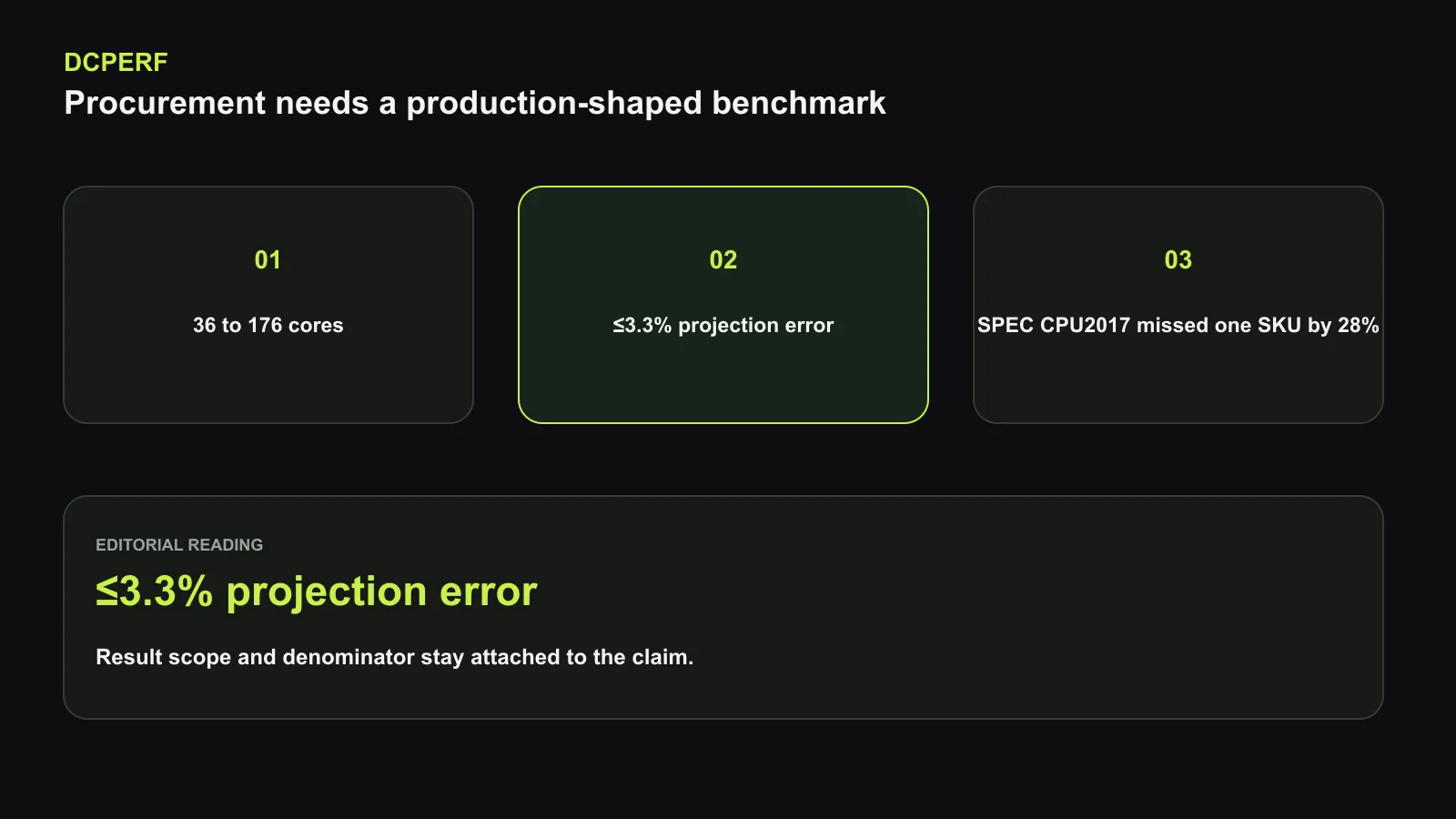
The authors compare benchmark projections with representative production applications over four server generations spanning six years and 36 to 176 cores. DCPerf stays within 3.3% of the production result. On one recent server SKU, SPEC CPU2017 overestimated the production gain by 28%. CloudSuite’s in-memory analytics workload, meanwhile, could not drive more than 20% CPU utilization on a 176-core machine in the reported setup.
A benchmark is a maintained product
Matching throughput once is insufficient. DCPerf compares top-down pipeline categories, IPC, bandwidth, instruction-cache behavior, branch behavior, power, and software overhead. It also exposes where the proxy diverges. The authors report that power-profile correlation is closer for DCPerf than SPEC, while some benchmark components still overrepresent particular behavior.
The suite has already changed decisions. A performance-per-watt comparison led Meta to select a different CPU SKU than absolute speed alone would have suggested. In another case, a vendor change reduced L1 instruction-cache misses by 36% and L2 misses by 28% in DCPerf, yet did not materially improve the relevant production workload. That negative result is precisely what a procurement benchmark should reveal.
The unit of fidelity is a service, not an instruction mix
A production service contains work that disappears from a kernel benchmark. Requests arrive through RPC libraries, pass encryption and serialization, allocate objects, touch caches and storage, and contend with runtime and operating-system activity. Its useful throughput is bounded by a service-level latency target rather than by the point at which every core reaches 100% utilization. DCPerf therefore builds client-server workloads and retains the software layers that create these costs instead of replacing them with one hot loop.[1]
The suite’s five categories occupy different operating points. Web serving combines front ends, caches, databases, and managed-language execution. Ranking includes feature processing, back-end access, and a latency constraint. TaoBench models a read-through cache with fast and slow paths. SparkBench exercises a large data set and remote storage, while video transcoding scales independent encoding work across cores. A geometric-mean suite score is available, but the individual results remain necessary because no CPU is uniformly strong across these patterns.
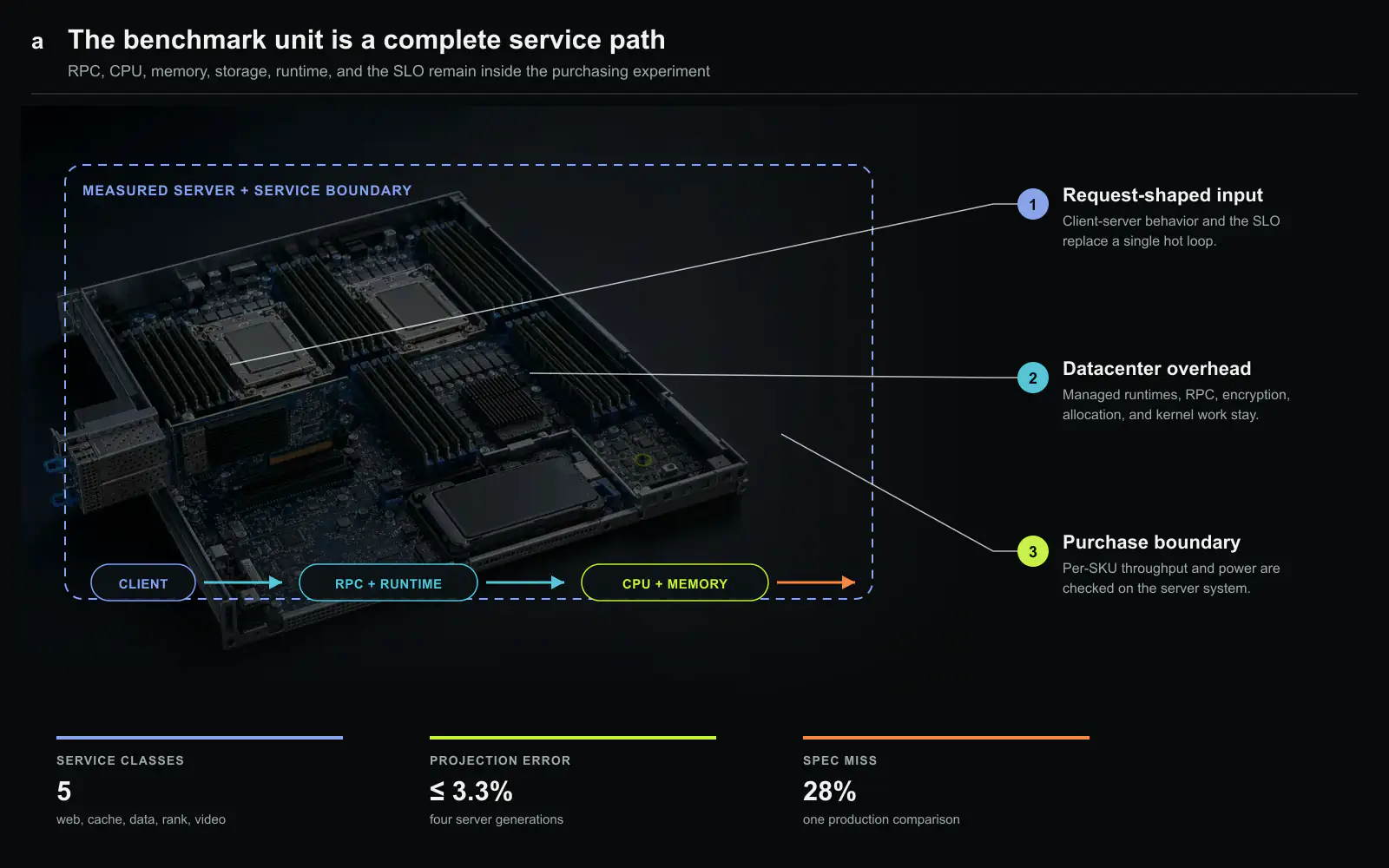
This design also makes data generation part of benchmarking. A reduced data set must preserve schema, types, cardinality, distinct values, object sizes, and hit-rate distributions closely enough to create the same control and memory behavior as the service. Simply shrinking the production data until the program fits on one server can move the working set into cache and reverse the bottleneck. Fidelity is therefore established by both the request-level outcome and the microarchitectural profile.
Datacenter overhead is part of the workload
DCPerf treats common infrastructure libraries as a first-class CPU consumer. RPC, compression, encryption, hashing, serialization, memory management, and concurrency support do not implement the business feature, yet production cannot omit them. The paper describes this surrounding work as a datacenter tax and supplies microbenchmarks to isolate components after the full application exposes a bottleneck.
The separation is diagnostically useful but should not be confused with removal. A faster compression routine matters only in proportion to the cycles that a service actually spends compressing. A microbenchmark can show the direction and ceiling of an optimization; the end-to-end workload determines whether enough requests travel through that path for the change to affect capacity. This is one reason the instruction-cache reduction cited by the paper did not guarantee a production win.
Managed and native stacks also respond differently to a CPU. MediaWiki uses HHVM and a mix of PHP and Hack, DjangoBench uses Python processes, SparkBench runs a Java environment, and the native workloads rely on C or C++. Front-end capacity, branch prediction, memory latency, core count, and compiler quality contribute in different ratios. A suite that contains only native compute would hide precisely the diversity a fleet purchaser needs to price.
Calibration must survive a new microarchitecture
Matching one current server is easier than predicting a CPU that does not yet exist. A proxy can be tuned until its throughput agrees with production while using different instruction-cache, branch, memory, or kernel behavior. When the next design changes one of those resources, the apparent agreement breaks. DCPerf addresses this by comparing top-down pipeline categories, IPC, cache misses, bandwidth, frequency, power, and software overhead, not only requests per second.
The four-generation evaluation is consequently stronger than a same-machine correlation. The servers span six years and core counts from 36 to 176, exposing changes in memory capacity, network bandwidth, and microarchitecture. An error within 3.3% says the benchmark tracked the relative production movement across those evaluated systems. It does not establish a 3.3% bound for every future CPU, because a new cache hierarchy, accelerator path, or software stack may create behavior outside the calibration set.
Vendors can run DCPerf on simulators or early silicon before enough systems exist for hyperscale production tests. That makes the suite part of a design feedback loop. However, simulation results need the same software versions, request rates, data sets, and SLO constraints as later measurements. Otherwise, discrepancies can be blamed on the CPU when they originate in the benchmark environment.
Throughput must remain inside an SLO
Several DCPerf components search for the maximum request rate that still meets a latency or quality condition. This is different from saturating all cores and reporting completed operations. A service may intentionally stop at 50% to 80% CPU utilization because queueing near saturation makes tail latency unstable. CloudSuite’s inability to exceed 20% utilization in the cited 176-core setup is a warning that a benchmark can run correctly yet fail to stress the purchased machine.
The client therefore matters as much as the server. It must generate enough requests, avoid becoming CPU or network limited, and reproduce the intended endpoint mix. Storage and network dependencies need representative latency and bandwidth. If they are local when production uses remote services, the benchmark shifts work toward the CPU; if they are too slow, the processor waits and CPU differences disappear.
Results should report the achieved throughput together with latency percentiles, CPU utilization, and any error-rate constraint. A normalized score without those conditions can reward a configuration that violates the service objective. It can also hide whether a many-core processor scaled through useful parallel work or merely accumulated idle threads.
Power changes which CPU is economical
Thermal design power is not the same as the power a server consumes under a fleet workload. Most applications cannot exercise every execution unit at its maximum electrical load, and operators leave utilization headroom to protect latency. DCPerf therefore measures motherboard-reported power under its practical workload mix and supports performance-per-watt comparisons in addition to absolute speed.
The boundary still requires care. On-board sensors may include CPU sockets and memory but omit fans, power-conversion loss, storage, networking, or rack cooling. Firmware power limits can improve efficiency while lowering the peak request rate. A procurement analysis should state both the metered components and the facility assumptions used to translate server power into total cost of ownership.
This is why performance per watt selected a different SKU in the reported case. The fastest processor can require enough additional power that fewer servers fit within a datacenter feed, or the electricity and cooling cost outweigh the reduced server count. Conversely, a slower but efficient CPU is not better if more machines, memory, switches, and licenses erase the saving. DCPerf supplies workload evidence; the operator still has to apply its own power and capital constraints.
One score should not erase workload-level decisions
The overall geometric mean is convenient for tracking regressions, but procurement rarely uses one denominator. A fleet may need separate weights for web, ranking, cache, analytics, and media capacity. Some services are limited by latency, others by throughput or memory per socket. The correct aggregation uses the expected deployment mix and includes confidence ranges for workloads whose proxy is less faithful.
A per-workload view also reveals design trade-offs. More cores can improve video encoding while hurting a cache workload if memory bandwidth per core falls. A larger last-level cache may help ranking but leave a streaming query unchanged. Compiler or library updates can move these relationships without any hardware change. Publishing the components lets vendors and operators see which mechanism produced the overall score.
The 28% SPEC mismatch illustrates this point rather than proving that SPEC CPU2017 is defective. SPEC answers a different question with compute-focused programs and standardized rules. It remains useful for compiler and core studies, while DCPerf asks how a service-oriented fleet changes. Selecting a benchmark begins by selecting the decision it is allowed to inform.
Recalibration is a release process
Production software changes daily, but a benchmark must remain reproducible long enough for vendors and researchers to compare systems. DCPerf balances these requirements with versioned releases, automation, machine-readable results, and extensible monitoring hooks. A small maintenance team reviews changes and can add new metrics as processor behavior evolves. This governance is part of the technical contribution because an abandoned benchmark quickly becomes a historical workload.
Recalibration should begin when production profiles drift beyond agreed tolerances, not whenever one code change lands. Operators need stable reference machines, pinned dependencies, representative data, and a record of configuration differences. A new benchmark release should run beside the old one so score changes can be separated into workload evolution and hardware response.
Open source enables external inspection and vendor contributions, but it does not expose Meta’s production code or traffic. Other organizations should use the framework to build their own correspondence study: classify the largest power consumers in the fleet, create deployable proxies, compare throughput and low-level profiles across several machines, and only then attach the results to purchasing. The method transfers more readily than the workload weights.
What buyers should demand from a fleet benchmark
A credible submission should disclose the benchmark version, operating system, compiler and runtime versions, firmware power policy, memory population, storage and network arrangement, request generator, data-set scale, achieved SLO, and the power boundary. Results should include repeated runs and variability, not only the best score. If a vendor tunes the system, the same tuning opportunity should be available to competing systems and described in the report.
The buyer should also ask for production back-testing across more than one generation. A proxy that predicts only the current incumbent may have been fitted to that machine. Negative examples are especially valuable: they show which attractive microarchitectural improvements failed to create service capacity. DCPerf’s cache-miss case demonstrates the kind of evidence that prevents a local metric from becoming an expensive purchasing assumption.
Finally, benchmark ownership must be explicit. Someone must decide when a workload no longer represents the fleet, validate incoming patches, secure the dependencies, and preserve old results. Without that organization, an open suite is code, not a decision system.
The remaining blind spots are architectural
DCPerf primarily represents general-purpose CPU services. It does not reproduce a complete disaggregated application graph, every storage server, or accelerator-heavy AI node. Keeping several components on one machine makes the suite deployable, but it compresses network fan-out, failure behavior, and interference from unrelated tenants. A CPU whose advantage appears only under a particular remote-memory or accelerator protocol may therefore need a separate system benchmark.
Security mitigations and fleet policy can also change the ranking. Kernel hardening, virtualization, memory encryption, frequency governors, and reliability settings consume different resources on different processors. They belong in the test configuration when production requires them. The appropriate conclusion is not that DCPerf replaces every benchmark, but that it supplies the service-shaped CPU layer in a portfolio whose other layers test distributed scale, accelerators, storage, and facility power.
That portfolio should use a shared reference configuration and versioned metadata so results can be joined without pretending their scores have the same denominator. The outcome is a purchasing dossier: service capacity, tail latency, power, memory per socket, distributed behavior, and known blind spots for each candidate SKU.
What we take from it
DCPerf shows that benchmark design is an ongoing correspondence problem, not a one-time workload release. Open code makes the method inspectable, but it does not make the workload universal. A cloud provider, enterprise, or CPU vendor should borrow the validation process and then test whether its own fleet shares Meta’s service mix. The strongest contribution is therefore the loop: production measurement, simplified proxy, microarchitectural comparison, purchasing decision, and repeated recalibration.
Source and attribution
This editorial digest uses independent wording and two original figures. It reproduces no paper prose, figure, or table. The public paper is licensed under CC BY 4.0; copyright is held by the authors, © 2025. The linked DCPerf code is distributed separately under its repository license.