Large synchronous jobs turn one local fault into thousands of waiting GPUs. Alibaba reports that error recovery once consumed more than 30% of training time, while network collisions added another communication penalty. C4 treats the collective layer responsible for synchronization as the signal for fixing both problems[1].
The broader message is that a collective is not only a data-moving primitive. Its timing can become both a fleet-health sensor and a traffic plan. This review asks which reported gains follow from that reusable idea and which depend on Alibaba’s topology, workload regularity, and recovery policy.
The collective is a sensor
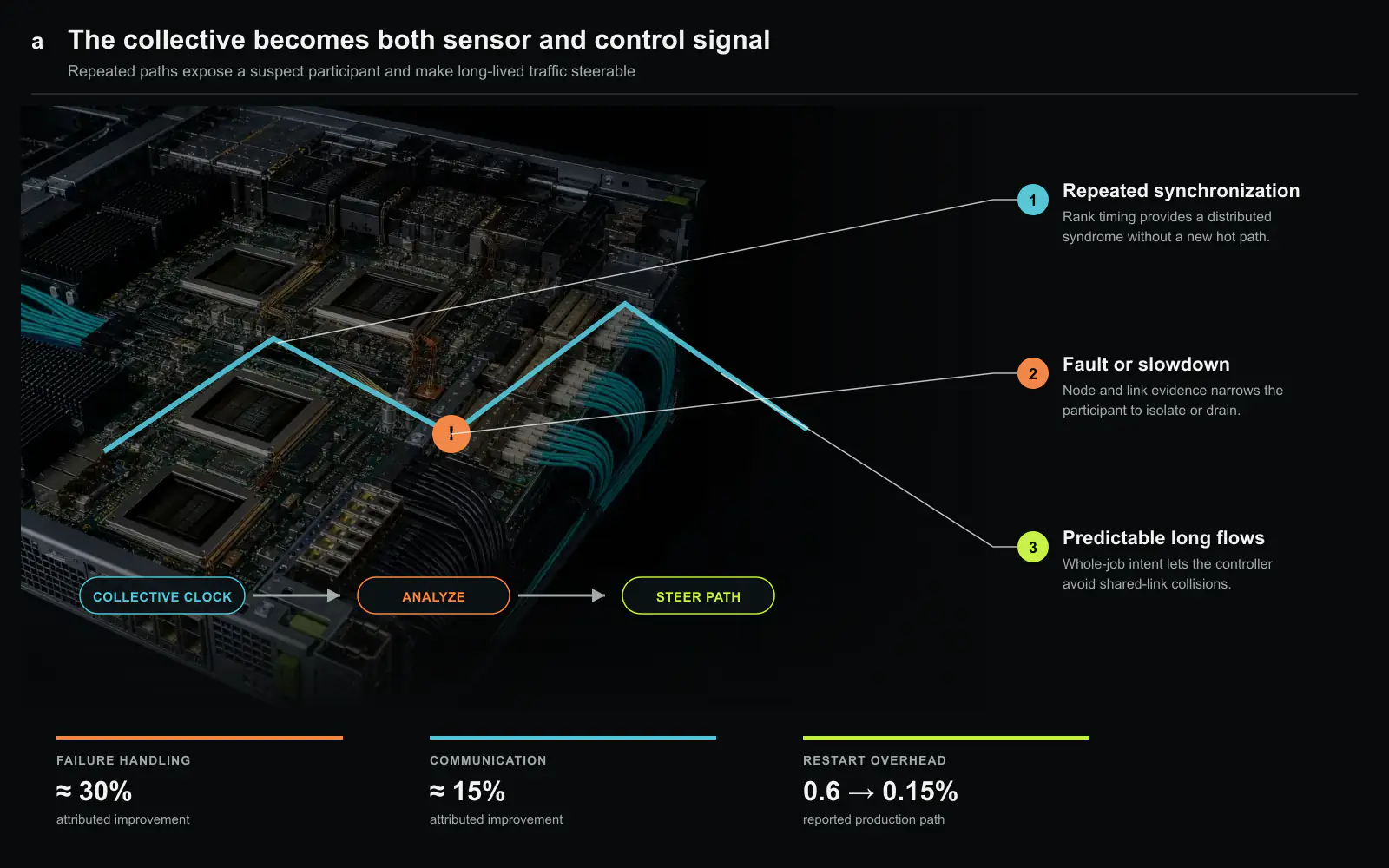
Training workers repeat similar communication at iteration boundaries. A slow or broken component therefore leaves a recognizable timing syndrome in the collective. C4’s detection path identifies and isolates the responsible node or link and restarts the job, reducing diagnosis from tens of minutes to seconds in the reported deployment. The same regularity makes the small set of long-lived collective flows predictable enough for traffic planning.
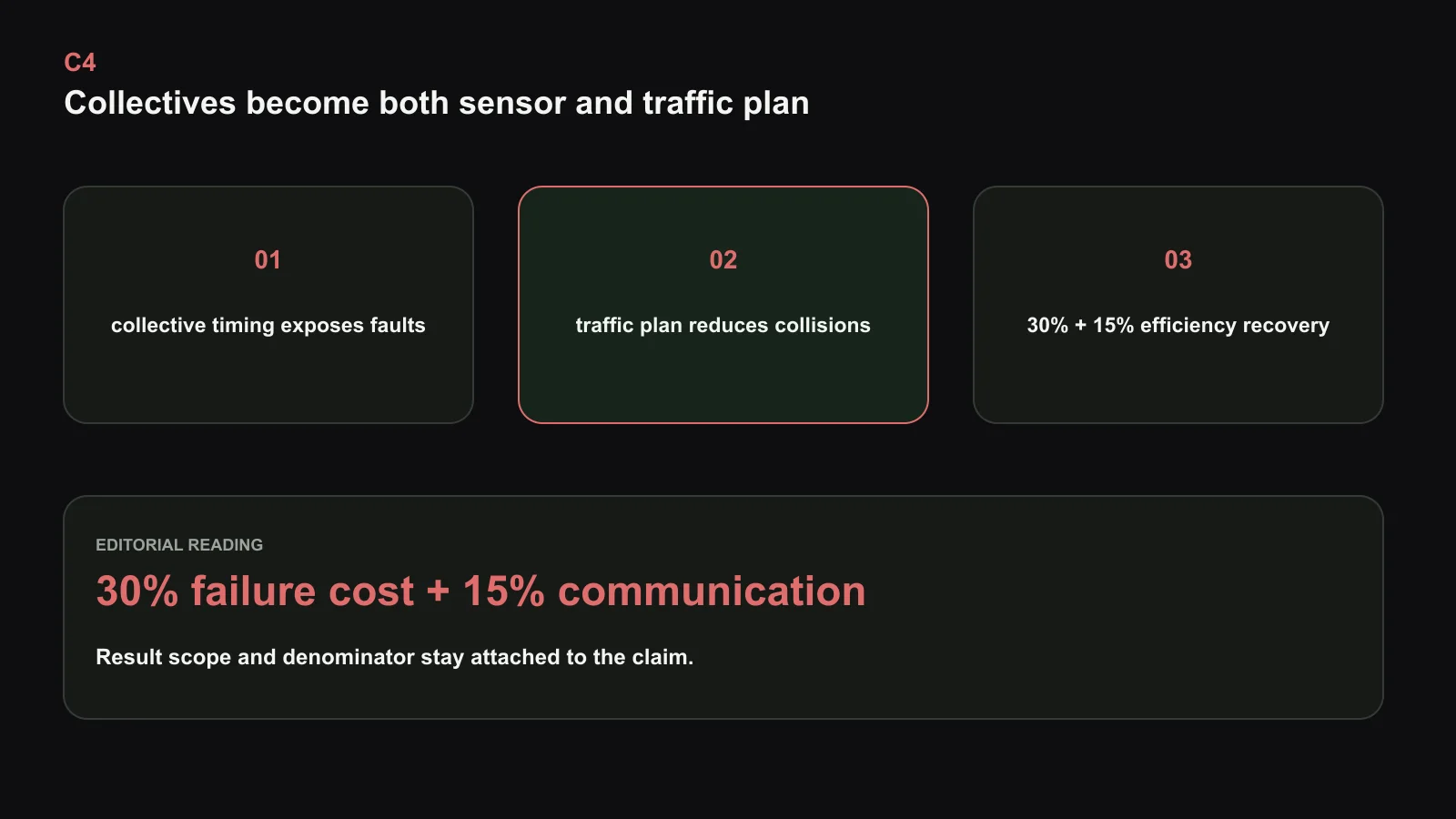
The production rollout reduced reinitialization overhead from 0.6% to 0.15% after users could checkpoint more frequently. Across the wider system, the paper attributes roughly 30% efficiency improvement to failure detection and recovery and about 15% throughput improvement to communication planning. These are additive categories in the authors’ accounting, not one 45% speedup measured for every job.
Why synchronous training amplifies a local defect
Bulk-synchronous training advances only when every participant reaches the next collective. A GPU that stops, a link that drops packets, or a storage operation that stalls is therefore not confined to one worker. Healthy ranks wait at the synchronization boundary, reserve accelerators and network paths, and produce no new model state. As jobs grow, the probability that at least one component fails during a long run rises, while the amount of capacity stranded behind that component grows at the same time.[1]
C4 separates startup faults from runtime faults and distinguishes communication hangs, noncommunication hangs, communication slowdown, and compute slowdown. That taxonomy matters because the recovery action is not identical. A dead worker can be isolated and replaced. A slow collective may indicate a degraded GPU, a bad NVLink path, congestion, or an upstream compute delay that merely appears at the communication barrier. Restarting without locating the source can place the same defective node back into the job and repeat the loss.
The economic unit is useful training progress, not accelerator allocation. A nominally occupied GPU contributes nothing while waiting for a failed rank or repeating work since the last checkpoint. C4 therefore measures initialization, checkpoint, fault isolation, restart, and communication costs as parts of one efficiency budget. This framing explains why a control-plane improvement can recover as much machine time as a faster kernel.
Collective timing provides a distributed syndrome
Repeated collectives give C4 a reference rhythm. Workers submit similarly partitioned messages in the same logical order, and the communication library knows communicator identifiers, ranks, operation types, algorithms, data types, element counts, and start and completion events. C4 extends the runtime and transport layers to record this information close to execution. CPU timestamps alone are insufficient because asynchronous GPU kernels and queued network operations can make host time a poor proxy for when communication actually ran.
For a collective such as all-reduce, corresponding message chunks should progress with a recognizable relationship across ranks. C4 compares their completion timing and maps delay into a worker-to-worker view. A row or column pattern can point to one participant or path rather than merely reporting that the global operation was slow. Synchronization points serve as anchors, so the analysis does not need perfectly synchronized traces for every instruction in the training stack.
This method is stronger than a fixed timeout because it uses peer behavior as the baseline. A timeout must be loose enough for legitimate variation and can wait minutes before declaring a fault. Relative timing can identify a rank that departs from the current job’s rhythm even when the absolute duration changes with model phase. However, the inference is still a syndrome, not a physical diagnosis. C4 sends detailed events to a background root-cause system while the online path focuses on the immediate decision to isolate and restart.
Detection is connected directly to recovery
The online path combines enhanced collective-library instrumentation, per-node agents, a central analyzer, and the job-steering service. Agents report health and timing data; the analyzer identifies abnormal workers; the steering layer removes suspect resources and restarts from the latest valid checkpoint. Keeping this loop inside the training platform reduces the handoff that previously required an operator to collect logs, compare ranks, and decide which node to quarantine.
Checkpoint policy changes when recovery becomes reliable. In the reported environment, users could save state more frequently because the restart path was faster and less disruptive. Reinitialization overhead fell from 0.6% to 0.15%. More checkpoints still consume storage and network resources, so the optimum is not “checkpoint every step.” It depends on failure rate, checkpoint size, write bandwidth, restart time, and the amount of computation between durable states.
The central analyzer also introduces an operational boundary. It must process telemetry from large jobs without becoming the next bottleneck or a single point that blocks recovery. Event schemas must remain stable across collective-library versions, and clocks and sequence identifiers must make records comparable after partial failure. A production design needs retention and privacy rules because traces can expose model shapes, communication volume, and cluster topology even when they contain no training data.
Predictable flows make traffic planning tractable
Distributed training uses relatively few long-lived, high-volume flows compared with a request-serving fabric. Their endpoints and collective phases are often known before an iteration begins. C4 uses that predictability to manage paths across the cluster and reduce collisions on oversubscribed links. The planner can reason about whole-job communication rather than allowing every transport connection to select a path independently.
The gain depends on topology. The paper’s cluster pool was designed so a large job could be placed on a consistent subset of servers, and its traffic engineering was integrated with Alibaba’s network and collective library. A different fabric may expose adaptive routing, proprietary switch telemetry, rail-optimized GPU placement, or optical reconfiguration with different control times. The portable idea is to expose collective intent to the network controller; the exact route algorithm and reported 15% improvement are not portable constants.
Planning also has a timescale constraint. A route decision that arrives after a short collective has finished adds control traffic without preventing the collision. C4 benefits from flows that persist long enough and repeat often enough for placement and path assignments to matter. Mixture-of-experts routing, irregular sparse communication, and elastic membership reduce that predictability. Those workloads may need faster local adaptation or probabilistic load balancing rather than a centralized plan derived from a stable iteration.
The two gains should not be multiplied blindly
The paper describes the original system as operating around 30% efficiency and reports a progression toward about 45% through the combined C4 work. It also attributes approximately 30% improvement to reducing error-induced overhead and about 15% to communication optimization. These statements use the authors’ production accounting and should not be converted into one universal formula. The base period, affected job population, and definition of efficiency determine whether percentages add, compound, or apply only to selected runs.
Fault savings are inherently distributional. A job that never encounters a defective component gains little from faster recovery, while a long run spanning thousands of devices can save hours. Communication planning likewise helps when several large collectives would collide on a shared bottleneck; a well-isolated job may see little change. The correct evaluation reports the fraction of jobs affected, the time saved when an event occurs, and the cluster-wide capacity released, in addition to average throughput.
The results come from a deployed platform, which gives them operational credibility but narrows external generalization. Hardware generations, network topology, job sizes, checkpoint intervals, and software versions all shape the outcome. A buyer should not insert 30% and 15% into another cluster’s return-on-investment model without rebuilding those distributions from local telemetry.
What transfers to another training platform
The first transferable component is an event model that spans collective, transport, node, and scheduler state. A platform should be able to answer which logical operation was waiting, which ranks had completed it, which physical paths carried its chunks, and which resource was removed. Separate dashboards that cannot share identifiers leave operators reconstructing the same chain manually during an outage.
The second is a closed response loop with conservative escalation. Automatic isolation should act on high-confidence syndromes and retain enough evidence for later root-cause analysis. Ambiguous slowdowns may warrant draining a node after the current step rather than terminating a valuable job immediately. The policy must balance false positives against the cost of keeping thousands of healthy GPUs idle.
Lastly, checkpoint and routing policy should use the measured failure and traffic distributions rather than fixed folklore. Faster detection changes the best checkpoint interval. More stable placement changes which links require traffic engineering. As the job mix evolves, the same instrumentation can show whether the original assumptions still hold. C4’s lasting contribution is this coupling of observation and control, not a frozen set of percentages.
Limits that matter before deployment
C4 assumes regular synchronization and a communication library that the operator can modify. Fully asynchronous optimization, highly dynamic expert routing, and third-party binaries provide weaker anchors. Hardware faults that corrupt data without causing a timing deviation also need independent integrity checks. Conversely, a timing anomaly can originate in software scheduling or storage rather than in the link that appears slow, so isolation must be reversible and auditable.
Central traffic engineering also competes with failure handling for authority over placement and paths. A node marked suspect should not remain attractive to the route planner, and a rerouted flow should not be mistaken for a hardware slowdown. These controllers need a shared state model and versioned decisions. Without it, two individually reasonable automations can oscillate the cluster.
For operators evaluating a similar system, the decisive evidence is not a demo that detects one injected failure. It is the false-positive rate across benign phase changes, detection latency by failure class, restart success from real checkpoints, capacity recovered over months, and throughput under concurrent jobs. Those measurements show whether the collective truly serves as a reliable sensor in that particular fleet.
A useful capacity model starts with lost GPU-seconds
The benefit can be estimated without adopting Alibaba’s percentages. For each failure class, multiply its arrival rate by the accelerators held by an affected job and by the interval from loss of useful progress to successful restart. Add the recomputation since the last checkpoint and the initialization time of the replacement allocation. This produces lost GPU-seconds, a quantity that can be compared directly with the capacity cost of extra telemetry, spare nodes, and checkpoint I/O.
Communication waste can be treated similarly. Measure the time ranks spend blocked in collectives, identify the portion associated with shared-link contention, and multiply by the participating accelerators. A 5% delay on a 16,000-GPU job can matter more than a 30% delay on a small experiment, yet a route planner may have greater freedom to move the smaller flow. The model exposes that trade-off instead of treating every percentage point as equal.
This accounting also prevents double counting. If faster failure isolation reduces the period during which a broken job congests the network, part of the apparent communication gain may share the same cause. Event-level attribution should assign recovered time once, then report secondary effects separately. That discipline is necessary before converting efficiency into deferred hardware purchases or energy savings.
Deployment should proceed by confidence tier
A practical rollout can begin with passive observation. The system records collective sequences and compares its diagnosis with operator conclusions without changing placement. The next tier can automatically flag or drain resources after a job ends. Only well-characterized syndromes should trigger immediate isolation and restart. Each tier needs a rollback rule and a record of the evidence that justified the action.
Traffic planning can follow the same progression: shadow recommendations, a subset of noncritical jobs, then large training runs whose topology and collective schedule are known. Phase changes should invalidate stale plans, and the scheduler must know when a job has been resized or restarted. This gradual path turns C4’s architectural insight into an operational control system without assuming that a detector proven in one cluster is safe everywhere.
The final acceptance test should compare an interval with C4 disabled, an observation-only interval, and an active-control interval under a comparable job mix. Reporting useful training tokens or steps per allocated GPU-hour, together with failure-class counts and collective wait time, prevents a busier or easier workload from being credited to the controller. It also makes regressions visible when the model portfolio or network changes. Job-size buckets should remain visible so an influx of small experiments does not conceal the behavior of the largest, most failure-sensitive runs.
What we take from it
C4 shows that telemetry does not need a separate observation plane when the workload already emits a regular global signal. Its limit is the same assumption: irregular workloads and rapidly changing flows provide a weaker syndrome and a less stable traffic plan. The transferable lesson is to instrument the synchronization primitive that already defines useful progress, then attach the fault and congestion response directly to it.
The production metric is recovered training progress
A deployment should judge C4 by the work it restores, not by the number of anomalies it labels. The relevant timeline begins when collective behavior first departs from the healthy baseline and ends when the job resumes useful steps on a repaired allocation. Detection latency, diagnosis time, restart time, replayed iterations, and unnecessary interventions belong in the same record. Otherwise, a sensitive detector can appear successful while consuming more accelerator-hours through false alarms.
The baseline must also be versioned with the environment that produced it. Collective shapes change with model parallelism, batch size, topology, communication libraries, and firmware. A pattern learned from one configuration can classify a valid optimization in another as a fault. Operators therefore need canary jobs, controlled fault injection, and rollback thresholds before allowing the diagnosis path to trigger recovery automatically. The procurement question is whether C4 increases completed training progress per installed GPU-hour under the buyer’s own workload and failure distribution.
Source and attribution
This article restates the public paper in original language and uses two new figures. No paper figure or table is reproduced. The arXiv manuscript is publicly accessible; the proceedings version is © IEEE 2025.