A checkpoint taken from a 4,096-GPU job is rarely consumed under the exact conditions that created it. A failed host changes the available rank set. Evaluation may use fewer GPUs. Supervised fine-tuning and reinforcement learning choose different parallel dimensions. Even a context-length change can make the original tensor, pipeline, and data-parallel plan inappropriate. If the on-disk format encodes that physical layout, recovery begins with a large distributed conversion before useful work can resume.
ByteCheckpoint treats that conversion as a first-class lifecycle operation. The NSDI 2025 paper describes a production system spanning Megatron-LM, PyTorch FSDP, local disks, HDFS, and network-attached storage. It separates the identity and shape of a logical model state from the shards produced by a particular training run, then reconstructs the target shards while loading. The result is not merely a faster save function. It is a checkpoint representation that can move between stages and resource allocations.
Why a physical shard is the wrong durable object
Parallel training divides state for several reasons. Tensor parallelism splits matrix dimensions, pipeline parallelism assigns layers to stages, and data parallelism replicates or shards optimizer state. The same parameter can therefore be written as a different set of files depending on the chosen combination. A filename such as rank 37 does not describe which logical tensor values it owns after the job changes.
Conventional approaches either require the original layout to load or perform an offline resharding job. The first weakens recovery because the unavailable machine or GPU count may be the reason for restoring. The second duplicates I/O: read the old checkpoint, materialize or rearrange it, write a converted copy, then load again. At hundreds of billions of parameters, the conversion competes with training for storage bandwidth and delays evaluation and post-training branches.
ByteCheckpoint records metadata that maps every numerical shard back to a logical tensor. The storage representation does not need to predict the future parallel plan. At load time, the target framework describes the shards it needs, and the system calculates which stored ranges contribute to each target range. Numerical data can then move directly from source shards to their consumers without assembling one complete tensor on a single host.
Resharding during load
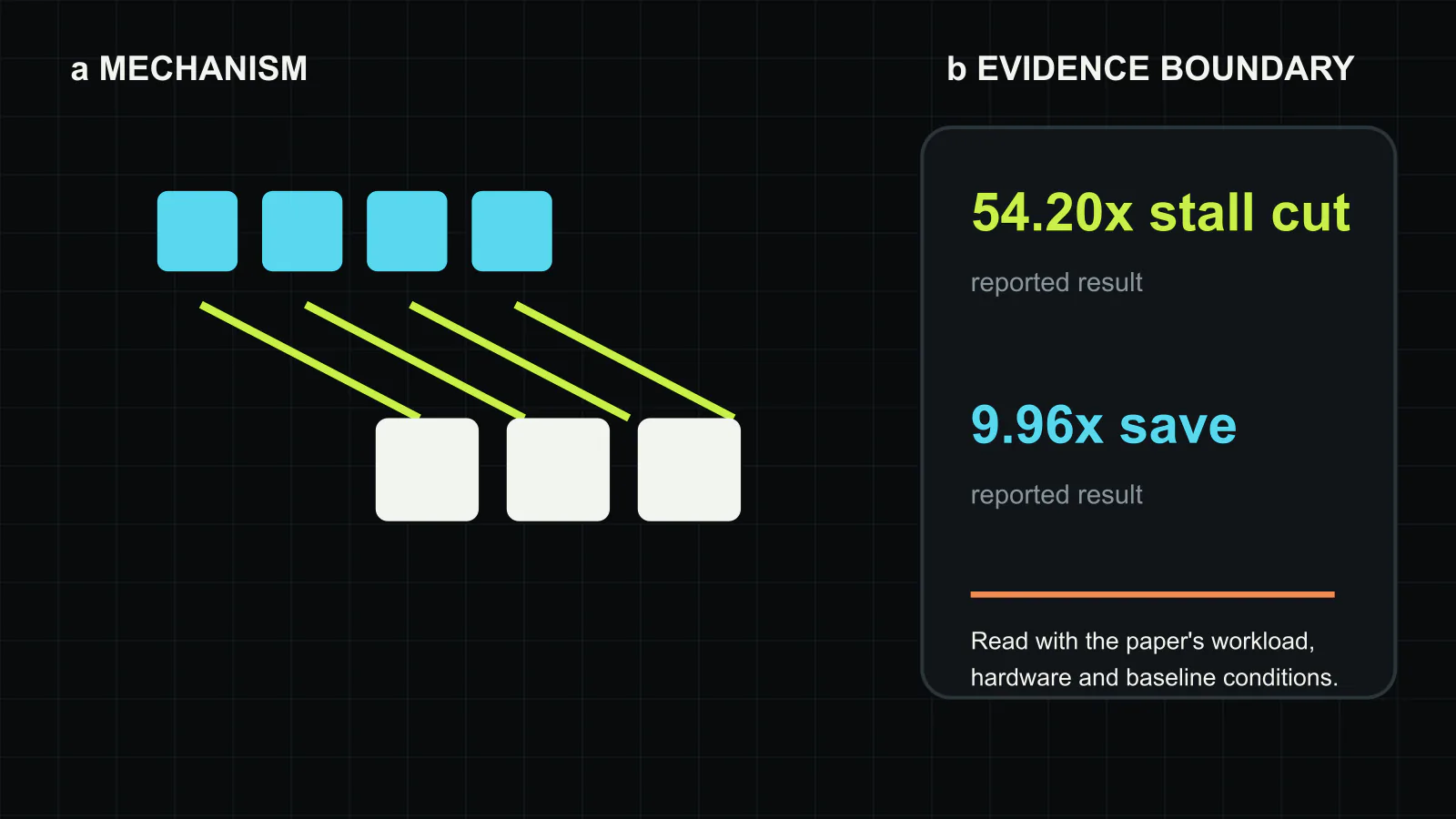
The useful work is an intersection problem. Each saved shard covers a region of a logical tensor, and each requested target shard covers another region. ByteCheckpoint computes their overlap, assigns reads, and routes the bytes to the target rank. This avoids a separate converted checkpoint and permits a different GPU count or parallel composition. Optimizer states and dataloader state require their own metadata because they do not all shard like model weights.
Planning can itself become expensive when thousands of ranks exchange large metadata sets. ByteCheckpoint reduces redundant planning and coordinates only the information required for the target. The paper also describes asynchronous and pipelined movement across device memory, host memory, serialization, and persistent storage. These stages matter because a fast filesystem cannot hide Python serialization, device-to-host copies, or a straggling rank.
The abstraction spans frameworks through adapters. Megatron-LM and FSDP represent distributed state differently, while storage systems expose different APIs and consistency behavior. ByteCheckpoint places a common save/load workflow between them. A new integration still has to describe tensor identity, sharding, and storage operations correctly; framework independence is an interface contract, not automatic compatibility with arbitrary training code.
The difference between API time and training stall
Checkpoint performance is often reported as total save time. Training efficiency depends on how long the forward and backward loop must stop. ByteCheckpoint therefore overlaps portions of copying, serialization, and upload with resumed computation. The paper reports reductions in runtime checkpoint stalls ranging from 12.13x to 161.50x, with a 54.20x average against the evaluated open-source baselines.
End-to-end save and load show smaller, still substantial gains. The reported average improvements are 6.05x for saving and 3.88x for loading, while the best cases reach 9.96x and 8.80x. These numbers have different denominators. Stall reduction measures blocked training time; save and load improvements measure completion of the checkpoint operation. A design can nearly eliminate the visible pause while background transfer continues for much longer.
That distinction affects fault exposure. Training that resumes before persistence completes has a window in which a second failure can invalidate the new checkpoint. Operators need to measure checkpoint durability latency as well as API return and training stall. Storage backpressure can also accumulate if checkpoints are requested faster than the background pipeline drains.
Production scale and test conditions
ByteCheckpoint was deployed in a production AI environment spanning tens of thousands of GPUs. The paper states that it supported a 405-billion-parameter model on 8,960 GPUs. Detailed experiments include a video diffusion transformer trained with FSDP on A100 80 GB GPUs and a GPT-style model using Megatron-LM on H800 80 GB GPUs. Hosts use InfiniBand and HDFS in the main reported setup.
This breadth strengthens the interoperability claim, but it does not turn the maximum speedups into storage-independent constants. Tensor sizes, optimizer choice, network oversubscription, filesystem load, CPU serialization capacity, checkpoint interval, and the source and target layouts all change the result. The baselines are PyTorch Distributed Checkpoint and Megatron Distributed Checkpoint versions evaluated by the authors; later releases may narrow particular gaps.
The paper’s monitoring tools are operationally important. They record time and byte counts for planning, device-to-host movement, serialization, dumping, and upload across ranks. A three-dimensional heat map of the parallel topology can expose ranks that carry extra dataloader state or encounter a slow storage path. Without this breakdown, a unified API can hide which stage is limiting a specific model.
Checkpoint consistency is still the application boundary
A representation cannot decide when model, optimizer, scheduler, random-number, and input-pipeline states form a valid recovery point. The training framework must establish that consistency. Asynchronous saving increases the need to define ownership of buffers and mutations after the checkpoint call. An adapter that labels tensors correctly but captures them at incompatible steps produces a portable yet invalid artifact.
The same caution applies to post-training. A checkpoint may be numerically loadable while missing tokenizer revisions, data mixture identifiers, optimizer hyperparameters, or executable code needed to reproduce the run. ByteCheckpoint focuses on distributed numerical state and generic extra state; a production registry still needs immutable manifests for software, datasets, and policies.
Security and tenancy also move into the format. Logical metadata reveals model structure, and shared storage may contain many branches of a model family. Encryption, access control, deletion, and audit should follow logical model identity rather than rank filenames. Deduplication can save capacity, but only when the trust boundary allows blocks to be shared.
What infrastructure teams should test
A checkpoint acceptance test should intentionally change the recovery environment. Save with one tensor- and pipeline-parallel plan, remove ranks, load with another plan, and compare model, optimizer, dataloader, and random state. Repeat across the actual storage tiers and under concurrent checkpoint traffic. Measure blocked training time, full persistence latency, restart time, temporary host-memory demand, metadata planning time, and bytes read more than once.
The test should include a failure during background save. It should establish which previous checkpoint remains valid, how incomplete objects are discovered, and whether cleanup can race with readers. A load benchmark without integrity and failure injection verifies bandwidth but not recovery.
Finally, teams should price the adapter surface. Every new framework state type needs a stable logical identity and sharding description. If those mappings live in ad hoc training scripts, the format can drift. Schema versioning, compatibility tests, and a reader for old checkpoints are as important as the fast data path.
The system decision
ByteCheckpoint shows that checkpointing is not an occasional file write. It is the state interchange layer connecting pre-training, evaluation, recovery, supervised fine-tuning, and reinforcement learning. A physical shard layout is convenient for the writer but too narrow for that role.
The practical selection criterion is therefore portability under change. A system that writes at line rate but requires the same GPU count and parallel plan can fail at the moment recovery matters. A logical representation with load-time resharding spends metadata and planning work to remove that dependency. For long-lived foundation-model programs, the durable asset is not the fastest set of rank files. It is a checkpoint that remains readable after the cluster and the training stage have changed.
Source and copyright note
This article is an independent editorial digest of the NSDI 2025 paper[1]. The prose and figure were created anew for Silicon & Systems; no paper figure or table was reproduced. Reported speedups retain the authors’ workloads, baselines, and storage conditions. Copyright in the original work remains with its authors and the USENIX proceedings (2025).